The biggest problem with chicken is that it is not hard to cook; however, it is very simple to ruin. One of America’s top foods is also One of America’s worst. And most Americans do not even understand it.
Why? The fear of a food-borne illness from consuming chicken causes some people to “over-cook” their chicken, “to be safe”. That is understandable. We hear about e-coli contamination and salmonella poisoning frequently. The chicken is usually either extremely dry, extremely tough, or extremely stringy. And the irony here is that these individuals were attempting to avoid making a mistake in terms of food safety. In fact, they probably created a food safety mistake.
Why does so much chicken get ruined?
Some of the reason why so much chicken gets ruined is simply because people are afraid to take the risk of possibly serving undercooked chicken. When cooking chicken, there is always a risk of providing undercooked chicken. And let us face it, food safety does matter. But when we are too afraid to cook chicken to the correct temperature, we often find ourselves adding additional time to cooking our chicken, which ultimately ruins the chicken.
The problem of Playing It Safe with chicken
Another problem with Playing It Safe when cooking chicken is that many people follow a pattern when preparing their chicken. They prepare the chicken until it looks fully cooked. Then they allow it to sit on the heat for a little while longer. Then they cut into it to see if it is fully cooked. If it appears to be undercooked, they add a few more minutes to the cooking time. By the time they finish cooking the chicken, it has been overcooked.
Ironically, the consumer was attempting to avoid a potential mistake. However, in doing so, he or she created a food safety mistake.
The correct internal temperature to eliminate bacteria from your chicken
Fortunately, there is a resolution to this dilemma. Although there are several types of poultry (chicken, turkey, duck) that must be cooked to an internal temperature that kills bacteria, there is only one temperature for eliminating bacteria from your chicken. And that temperature is 165℉.
Unfortunately, many cooks misinterpret how this temperature should be applied. In addition, many believe that they must cook the chicken to 165 degrees to eliminate the bacteria. This is not true.
What people do not understand about the temperature fix
Most people are unaware that chicken continues to cook internally after it has been removed from heat. This phenomenon is known as carry-over cooking. Due to carry-over cooking, the internal temperature of the chicken increases after it has been removed from heat.
Therefore, it is essential to remove the chicken from heat once the internal temperature has reached 155-160℉. Allow the chicken to rest for a few moments prior to consumption. At this point in time, the internal temperature of the chicken will be elevated to approximately 165℉ due to carry-over cooking.
That is it! That is the fundamental difference between preparing dry, overcooked chicken versus preparing moist and tender chicken.
How carry-over cooking works
Carry-over cooking occurs when a portion of heat remains in a piece of poultry after it has been removed from a heat source. In turn, this residual heat re-distributes itself throughout the poultry. Therefore, when you remove the poultry from the heat source at an internal temperature less than 165℉, you are essentially premature in removing the poultry from heat.
Why inspecting chicken is a mistake
Many people still utilize visual inspection of their poultry to determine if it is cooked through. However, there are three serious problems with utilizing visual inspection techniques when determining if your poultry is cooked.
First and foremost, as soon as you create an opening in your poultry (i.e., cutting into it), you lose valuable juices. Secondly, you cannot accurately obtain a measurement of the internal temperature of your poultry via visual inspection methods. Thirdly and lastly, lost juices means dry chicken.
Visually inspecting your poultry provides you with limited knowledge regarding the internal temperature of your poultry. Thus, you are trading accuracy for potentially inaccurate information.
Texture differences are immediately noticeable
Upon implementing the temperature fix for cooking chicken, you immediately recognize substantial differences in texture. Moisture rich and tender chicken provides a clean biting sensation. Conversely, dried-out and stringy chicken is dry and quickly looses its moisture content.
Although both items originate from the same packaging and are cooked identically, they taste nothing alike.
Timing will never be accurate enough for cooking chicken
While Recipes provide general guidelines for cooking times (E.g., six to eight minutes per side for grilled chicken breast, twenty five minutes for baked chicken), none of these guidelines are truly precise.
In fact, Timing is based on numerous factors including thickness of the item being cooked (thickness of the chicken breast), heat level used during preparation (grill vs broiler), starting temperatures of the item being cooked (room temperature vs refrigerated), etc. Furthermore, Two identical sized and prepared pieces of poultry may cook at Two completely different rates.
time is an approximate value. Temperature is a definite number.
Common errors made when using food thermometers to cook chicken
Although many people have realized that using an instant-read meat thermometer is one method of obtaining accurate measurements regarding the internal temperature of their poultry, many still fail to produce correctly cooked poultry when using thermometers.
Common errors made when using thermometers include:
- Reading internal temperatures too late
- Only checking internal temperatures in One location on the poultry
- Removal of the poultry at an internal temperature greater than 165 degrees
- Failure to consider the resting time.
people are therefore technically utilizing the proper tool to measure internal temperatures; however, people continue to generate erroneous data.
The device that ultimately solved the issue
The main issue at this juncture is no longer comprehending temperature; rather, it is recognizing when you are hitting the correct internal temperature at precisely the right moment.
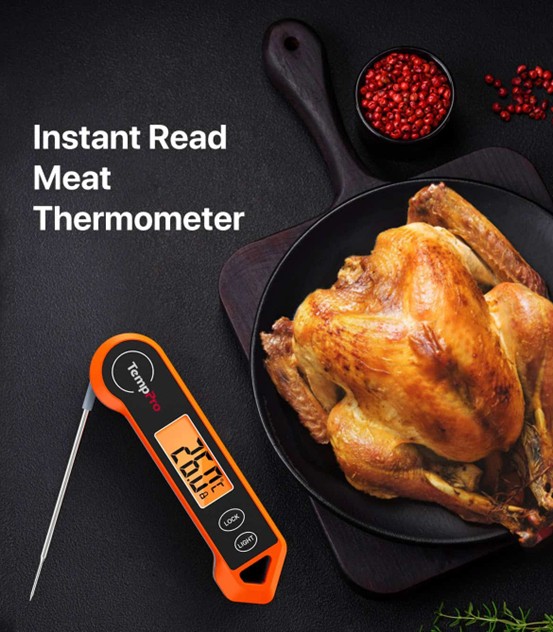
The TempPro TP19H Instant-Read Meat Thermometer now address this concern. It delivers chicken temperature readings in approximately 3-4 seconds, allowing you to evaluate internal temperatures while minimizing additional cooking time for the chicken. The speed of delivery proves more important than many people realize. Additional 30-60 seconds on high heat can result in pushing chicken beyond its optimal point of juiciness.
It delivers accurate readings within ±0.9℉, thus reducing uncertainty regarding whether you has achieved an internal temperature of 155℉ or has already surpassed the ideal internal temperature.
Furthermore, instead of cutting into the chicken and losing juices while assessing internal temperatures, you receive an instantaneous internal reading while maintaining integrity of all components.
TempPro TP19H features a large backlit screen for enhanced visibility regardless of whether you’re using it inside or outdoors at night. It’s also designed with waterproof materials for easy cleaning under running water. Convenient features such as foldable probes and magnetic storage provide convenient means for storing these devices when Timing is critical.
Ultimately, the utilization of an instant-read thermometer enables you to transform your attempt at cooking chicken from guesswork to precision-based and repeatable processes.
FAQ about Cooking Chicken
Q1. What temperature should chicken be cooked to?
Chicken is safe to eat at 165°F, but it should be removed from heat around 155-160°F due to carry-over cooking.
Q2. Why is my chicken always dry?
Most likely because it was cooked past 165°F. Even small temperature increases can significantly reduce moisture.
Q3. Can I rely on cooking time instead of temperature?
No. Cooking time varies based on thickness, heat, and starting conditions. Temperature is the only reliable method.
Q4. Why shouldn’t I cut into chicken to check doneness?
Cutting into chicken releases juices and does not give an accurate internal temperature reading.
Q5. What makes the TempPro TP19H useful?
It provides fast, accurate readings so you can remove chicken at the right moment before it overcooks.
Conclusion
Cooking chicken correctly does not involve extending cooking times or being overly cautious when cooking your chicken. Rather than relying solely on extended cooking times or excessive caution when cooking your chicken; it involves knowing specifically when to cease cooking.
Once you transition from time-based cooking to temperature-based cooking methods, you eliminate over-cooking and cutting into your meat to assess its internal temperature, and most importantly you get consistent results every time you cook your chicken.