For years, companies treated AI as a tool. It summarized meetings, drafted emails, and answered questions on demand. Humans remained at the center of every workflow.
Even industries like software and product development, including firms such as a mobile app development company in Dallas, have traditionally relied on people-led execution supported by software tools.
That assumption is starting to break.
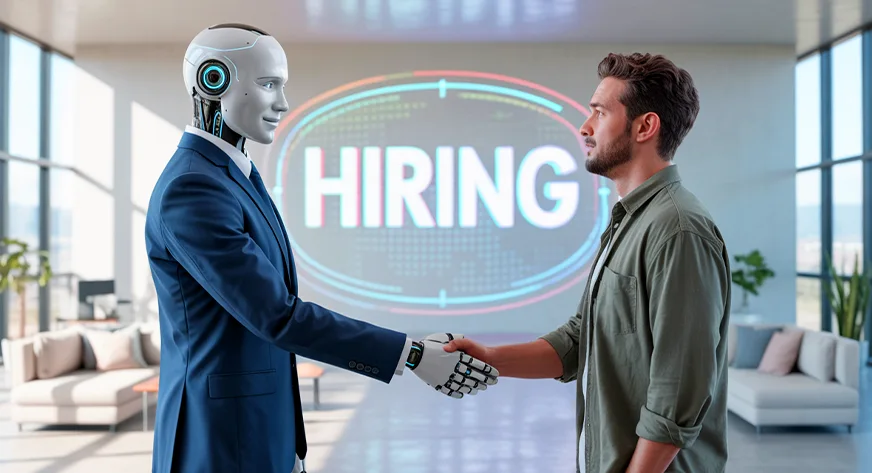
A new class of AI systems is entering the workplace. These systems do more than assist. They plan tasks, make decisions, coordinate with software, and complete assignments with limited human input. Companies are beginning to refer to them as AI agents, digital workers, or virtual employees.
This is a new model for organizing work. The companies that adapt early may discover that the future workforce is larger than expected. It just will not be entirely human.
From Assistants to Employees: The Shift Happening Right Now
The first wave of generative AI changed how people create content. The second wave is changing who, or what, performs the work.
The difference is easy to miss. AI assistants respond to prompts. AI employees pursue objectives.
A marketing assistant might draft an email campaign. An AI employee can research competitors, segment audiences, generate copy, schedule campaigns, monitor performance, and suggest adjustments without waiting for instructions at every step.
This shift is becoming one of the hottest discussions in enterprise technology. Companies are experimenting with AI agents that can interact with multiple systems, maintain memory across tasks, and collaborate with humans or other agents. The goal is no longer to speed up individual tasks. It is to automate entire workflows.
That ambition is fueling a new race across the industry.
Major technology companies are introducing agent frameworks that allow AI systems to act with greater autonomy. Enterprises are creating internal agent ecosystems where AI systems communicate with one another, share context, and execute work across departments.
The language used by executives is changing as well.
The question is no longer whether AI can assist employees.
The question is how organizations will operate when software becomes part of the workforce itself.
Why Companies Are Building AI Workforces Instead of Bigger Teams
The appeal of AI employees is not just speed. It is structure.
For decades, scaling a company meant scaling headcount. Growth required hiring, onboarding, training, and managing larger teams. That model still works, but it is increasingly constrained by cost, time, and talent availability.
AI agents introduce a different scaling model.
Instead of adding more people, companies are beginning to add more execution capacity through software agents. A single team can now deploy multiple AI workers, each assigned to a narrow function such as lead qualification, invoice processing, data reconciliation, or customer interaction analysis.
The shift is already visible in early enterprise deployments. Organizations are testing multi-agent systems where different AI workers handle different stages of a workflow. One agent gathers data. Another analyzes it. A third produces outputs. A fourth checks for errors or inconsistencies. The result is a pipeline of machine-driven execution layered inside existing business processes.
This is where economics becomes difficult to ignore.
AI workforces change how management operates.
The companies moving fastest in this direction are not asking whether AI can replace employees. They are asking how many parts of their existing workforce can be decomposed into repeatable tasks that agents can execute reliably.
That question is reshaping how organizations think about growth itself.
Instead of hiring bigger teams, they are building denser systems of execution.
The New Management Challenge: Supervising Digital Workers
As AI agents move closer to employee-like roles, the management function is shifting in ways most organizations are not fully prepared for.
Traditional management is built around people. Managers assign tasks, evaluate performance, resolve blockers, and support career growth. AI employees do not need motivation, but they do require structure, control, and oversight. That changes what “management” means inside a company.
The first challenge is accountability.
When an AI agent completes a task, who is responsible for the outcome? In early deployments, companies are discovering that responsibility does not disappear. It moves upward. Human supervisors remain accountable for decisions made or executed by AI systems.
The second challenge is permissions.
AI agents often need access to multiple systems to function effectively. That includes CRM platforms, databases, communication tools, and internal documentation systems. Without strict controls, the risk of data leakage, incorrect actions, or unintended system changes increases.
This is creating a new category inside enterprise IT: non-human identity management.
The third challenge is coordination.
Unlike human teams, AI agents can operate at a much higher speed and volume. That creates friction when they interact with human workflows. A single agent may generate hundreds of outputs, alerts, or recommendations in the time it takes a human to review a small subset. Without proper orchestration, this leads to overload instead of efficiency.
To solve this, companies are experimenting with layered systems where agents are grouped into structured workflows. Some agents focus on data collection, others on analysis, and others on validation. A separate control layer determines what reaches human decision-makers.
The fourth challenge is quality control.
AI systems can produce fast results, but speed does not always equal correctness. In enterprise environments, even small errors can scale quickly when automated systems are involved.
All of this is redefining the role of management itself. But one pattern is becoming clear.
The companies that succeed with AI employees are not the ones that deploy the most agents. They are the ones that learn how to manage them like a structured workforce rather than a collection of tools.
What Happens When Every Employee Gets an AI Counterpart
The idea of AI employees becomes more tangible when it is no longer abstract at the organizational level, but personal.
Instead of asking how many AI agents a company should deploy, attention shifts to a different question. What changes when every employee works alongside a dedicated AI counterpart?
This is where the structure of work begins to shift inside teams.
In early implementations, AI counterparts are being positioned as role extensions rather than replacements. A software engineer is supported by agents that handle debugging, code suggestions, documentation, and testing. A sales executive is paired with systems that research prospects, draft outreach messages, and track engagement patterns. A finance analyst works with agents that reconcile data, flag anomalies, and generate reporting drafts.
This shift is becoming visible across software teams as well. From enterprise engineering groups to firms offering mobile app development services in Houston, AI agents are beginning to take on repetitive development tasks, freeing employees to spend more time on creative problem-solving and product decisions.
Leadership teams are paying attention to this gap.
Companies are starting to ask not only who is performing well, but who is adapting well to AI-enabled workflows. That distinction may become one of the defining factors in future talent evaluation.
As AI counterparts become more common, the boundary between “tool” and “teammate” becomes harder to define. The most advanced organizations are already operating in that gray zone, where AI is not just supporting work, but actively participating in it.
The next question is what happens when these systems scale beyond individuals and start shaping entire organizational structures.
Conclusion
The idea of a workforce made only of people is starting to lose relevance in many organizations.
AI employees are moving from experimental pilots into structured parts of enterprise systems. They are being assigned responsibilities, embedded into workflows, and evaluated on performance metrics that resemble those used for human roles. The shift is not sudden, but it is steady enough that companies are beginning to redesign how work is organized.
What stands out most is not the technology itself, but the redefinition of capacity.
What is already clear is that AI is no longer sitting at the edge of enterprise operations. It is moving into the center of how work gets done.
The companies that adapt to this shift will not simply be using better tools. They will be operating with a different definition of workforce altogether.
And that is where the real change begins.