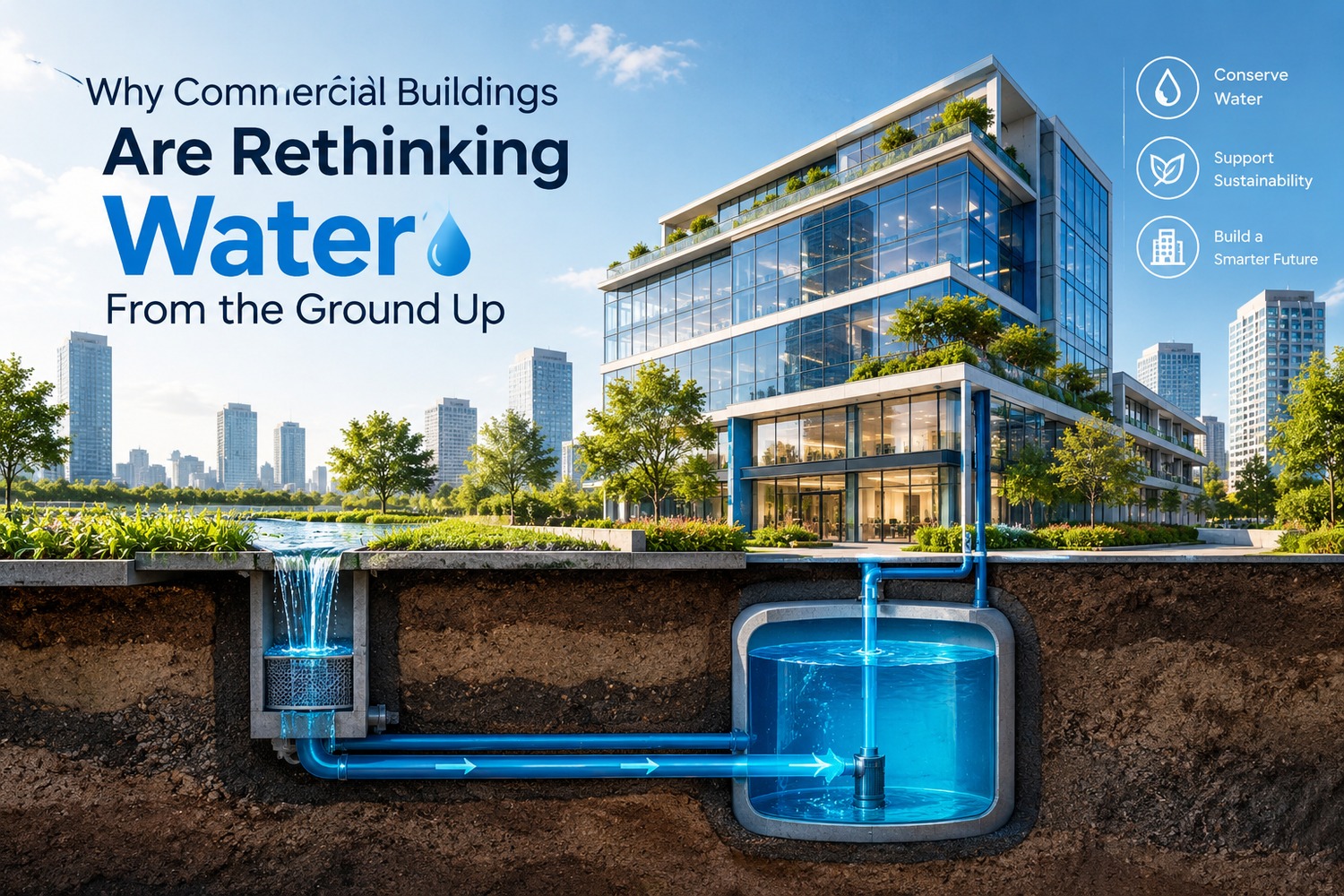
Most commercial real estate conversations about sustainability start and end with solar panels and EV charging stations. Water barely gets a mention, even though it’s often the utility cost that scales fastest and the resource that carries the most regulatory risk over a 30-year building lifecycle. That’s a misjudgment the smartest developers are quietly correcting right now.
The premise of this article is simple: treating on-site water management as core infrastructure, not a green building checkbox, changes the financial and operational math for commercial projects. Here’s what that shift actually looks like, why the timing makes sense, and how to think about it for your own building.
The Scale of the Problem No One Talks About in Pitch Decks
Commercial buildings have a water footprint that most developers don’t advertise. The commercial and institutional sector is the second largest consumer of publicly supplied water in the U.S., accounting for 17 percent of the withdrawals from public water supplies, according to the EPA’s WaterSense program. Hotels, office buildings, hospitals, schools, and mixed-use developments are all pulling from the same stressed municipal systems, and those systems are under increasing pressure.
This sector includes a variety of facility types such as hotels, restaurants, office buildings, schools, hospitals, laboratories, and government and military institutions, each with different usage patterns and therefore different opportunities for reduction. A hotel with 200 guest rooms and a fitness center generates a completely different greywater profile than a Class A office tower. But both buildings share one thing: they’re sending a significant portion of that water straight to the drain after a single use.
That’s the inefficiency on-site water recycling was built to solve. Greywater typically accounts for 50 to 70 percent of a building’s total wastewater. That water, collected from showers, hand wash basins, and laundry, has already been treated once by a municipal system, moved through infrastructure at significant energy cost, and used for a purpose that required potable quality. After one hand wash, it doesn’t need to go to the sewer. It can be recaptured, treated on-site, and put back to work.
What “On-Site” Actually Means for a Commercial Project
There’s a meaningful difference between installing a rainwater barrel and building a decentralized water management system. The former is a gesture. The latter is infrastructure.
A well-designed commercial-scale system handles multiple water streams at once: greywater from sinks and showers, rainwater collected from rooftops, and in some designs, stormwater that would otherwise run off the site. Each stream goes through treatment appropriate to its reuse application. Treated greywater flushes toilets and feeds cooling towers. Harvested rainwater can cover irrigation and, with the right treatment standard, even potable needs.
The critical word there is “standard.” Not all greywater systems are certified to the same level of rigor. The NSF 350C standard, which is recognized by both the International and the Universal Plumbing Code authorities, is the benchmark that matters when a building needs to demonstrate safety for code compliance, LEED documentation, or public occupancy approval. A system that’s been independently tested and certified to that standard doesn’t just protect building occupants. It protects the developer from liability and simplifies the permitting conversation with local authorities.
Consider a concrete scenario: a 250-unit mixed-use tower in Miami going through permitting in 2025. The project team installs a certified greywater recycling system and a rainwater harvesting loop for toilet flushing and cooling tower makeup. The building no longer needs to buy potable water for those uses. Municipal water demand drops. The building qualifies for Florida’s density bonus program for water-resilient design. And the system’s certified status means the building’s engineers don’t have to negotiate bespoke code approvals, because the standard already exists. That’s the full picture: cost savings, code clarity, and development incentive in a single infrastructure decision.
The Numbers Behind the Business Case
The financial argument for on-site water recycling has gotten sharper as water rates have risen and as research has matured. A 2025 peer-reviewed study published in the journal Energies and indexed through the Directory of Open Access Journals examined a 10-floor residential building and found that greywater recycling systems produced 18 percent water savings and 40 percent energy savings, with a payback period of 4.42 years. Commercial buildings with higher occupancy and greater water intensity generally see payback timelines in a similar range.
| Water Stream | Primary Reuse Applications | Treatment Level Required
|
|---|---|---|
| Greywater (sinks, showers) | Toilet flushing, laundry, cooling tower makeup | NSF 350C certified treatment |
| Rainwater (rooftop collection) | Irrigation, toilet flushing, potable (with advanced treatment) | Varies by end use; potable requires full treatment |
| Stormwater (site runoff) | Irrigation, cooling tower makeup | Filtration and disinfection |
The business case also extends to property value and tenant positioning. Buildings that can demonstrate water resilience are increasingly attractive to institutional tenants, who face their own ESG reporting obligations. A building that’s insulated against municipal water price spikes is a more stable operating environment. That stability shows up in lease negotiations and cap rate conversations, even if it doesn’t appear on a standard pro forma.
The LEED Gap and Why Certification Alone Isn’t Enough
Here’s a counterintuitive finding worth sitting with. Statistical analysis from a University of Maryland study covering more than 10,000 buildings found no significant differences in water consumption between LEED and non-LEED buildings, suggesting the LEED system should secure more points for water efficiency and apply weights based on local conditions and building attributes.
That’s not an argument against pursuing LEED certification. It’s an argument that certification without a robust water management system underneath it doesn’t deliver the actual consumption reductions. The paper trail looks good; the meter tells a different story.
The real work is in the system design, not the scorecard. LEED points for water efficiency are worth pursuing because they reduce costs and support permitting, but they only translate into actual water savings when the underlying infrastructure is doing something real. A greywater recycling system that genuinely displaces potable water use will register on the meter. A building that earns water efficiency credits through low-flow fixtures alone may not.
“The government should incentivize facility managers to reduce technology failure, promote long-term monitoring, and raise public awareness regarding water conservation.”
Researchers from the University of Maryland’s Center for Global Sustainability, writing in their 2021 analysis of water savings in LEED-certified buildings published via the Center for Global Sustainability
The Three-Layer Water Decision Framework
When a commercial project team sits down to evaluate on-site water management, most of them approach it as a single yes-or-no question. That’s the wrong frame. A more useful structure breaks the decision into three distinct layers, each with its own payback logic and regulatory path.
- Layer 1, non-potable displacement: Can you replace purchased potable water for toilet flushing, irrigation, and cooling tower makeup with treated greywater or harvested rainwater? This layer typically carries the clearest ROI and the most straightforward regulatory pathway.
- Layer 2, stormwater management integration: Can the system reduce site runoff in a way that satisfies local stormwater regulations, potentially reducing infrastructure fees or unlocking density bonuses?
- Layer 3, potable rainwater treatment: For projects in water-stressed markets or with specific resilience requirements, does full potable rainwater treatment make sense? This layer has a longer payback but provides genuine water independence during supply disruptions.
Most commercial projects find their best entry point at Layer 1, then evaluate whether Layers 2 and 3 pencil out given local water rates, incentive programs, and code requirements. For projects in Florida, California, Texas, and other high-growth, water-stressed states, all three layers are worth pricing at the design stage, because water rates and regulatory requirements are both moving targets.
Companies like Ecovie Water Management have built their practice around exactly this kind of integrated, site-specific design work, offering commercial-scale systems that cover greywater recycling, rainwater harvesting, and stormwater management under one technical roof.
Getting the Timing Right
The single most expensive moment to add water recycling infrastructure is after a building is occupied. Retrofit costs, tenant disruption, and the complexity of retrofitting dual plumbing into an existing structure can multiply project costs by a factor of three or more compared to designing the system in from the start.
That makes the design development phase, not construction documents, the right time to have this conversation. Engineers need greywater and rainwater collection routed into the initial plumbing layout. Mechanical rooms need to account for treatment equipment. Civil engineers need to factor stormwater harvesting into site drainage plans. None of this is complicated when it’s included at the right point in the process. All of it is expensive when it’s added later as an afterthought.
Water challenges aren’t going away. The buildings being designed today will be operating in a water landscape that’s meaningfully different in 2045. The developers who treat on-site water management as a core infrastructure decision now, rather than a nice-to-have sustainability feature, are building assets that will hold up. The ones who don’t are building in a vulnerability they can see coming from a long way off.