Understanding Psychological Evaluations for Immigration in Legal Relief Options
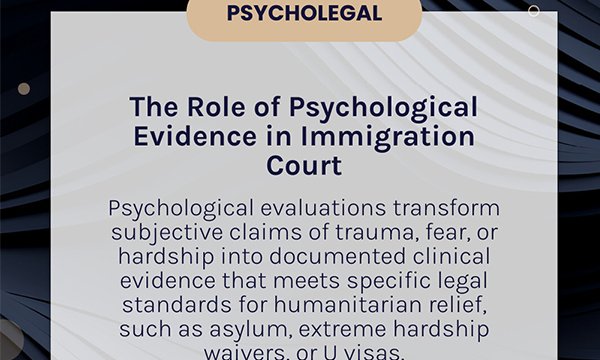
Immigration law is inherently adversarial and evidence-heavy. When a petitioner seeks humanitarian relief, they are essentially asking the government to exercise discretion or grant protection based on specific statutory criteria. A psychological evaluation provides a scientific basis for these claims, transforming subjective experiences of pain or fear into documented, clinical evidence.
The psycholegal referral question is the cornerstone of these reports. Unlike a clinical diagnosis, which focuses on treatment planning, the referral question in an immigration context asks whether the applicant’s psychological profile meets the specific threshold required by law. Whether it is proving that a U.S. citizen will suffer “extreme hardship” if a spouse is deported or establishing that an asylum seeker has PTSD consistent with their account of persecution, the evaluator must remain tethered to the legal standard. For professionals entering this field, understanding the intersection of clinical findings and legal requirements is paramount, and resources such as high-stakes psychological evaluations provide the necessary framework to navigate these complex requirements.
Asylum and Withholding of Removal Evaluations
Asylum claims require proof of past persecution or a well-founded fear of future persecution based on protected grounds, such as political opinion, religion, or membership in a particular social group. A psychological evaluation here often documents the presence of PTSD or other trauma-related disorders. The goal is to demonstrate that the applicant’s psychological symptoms are consistent with their narrative of torture or abuse, bolstering their credibility in the eyes of the court.
Extreme Hardship Waivers and Cancellation of Removal
These cases often involve “qualifying relatives”—usually U.S. citizen spouses, parents, or children—who would suffer if the applicant were deported. The evaluator must assess the mental health of these relatives to determine if the potential separation would cause hardship that goes beyond the “normal” difficulties of a family member’s departure. This requires a deep dive into the specific medical, psychological, and economic ties between the parties.
T Visa, U Visa, and VAWA Petitions
These visas protect survivors of human trafficking, victims of certain crimes, and survivors of domestic violence. The evaluation must document the “substantial physical or mental abuse” the applicant endured. It is not enough to show that a crime occurred; the report must articulate the long-term psychological impact of that victimization, which is often essential for proving that the applicant has suffered severe mental pain.
Special Immigrant Juvenile Status (SIJS)
SIJS is designed for children who have been abused, neglected, or abandoned by one or both parents. The psychological evaluation helps the juvenile court determine that it is not in the child’s best interest to return to their home country, often by highlighting the lack of protective resources and the potential for further psychological harm.
Assessment Methodologies and Clinical Report Structuring
A forensic immigration report is not a standard clinical progress note. It must be structured to withstand the scrutiny of government attorneys and immigration judges. The architecture of a professional report typically includes a comprehensive psychosocial history, a detailed trauma timeline, a mental status examination, collateral data analysis, and a clinical formulation that links the client’s symptoms to the legal criteria.
Core Components of Psychological Evaluations for Immigration
The report must clearly delineate the “why” behind the findings. It should bridge the gap between the client’s lived experience and the diagnostic criteria found in the DSM-5-TR. A strong report does not merely list symptoms; it discusses functional impairment—how the client’s trauma or hardship affects their ability to work, parent, care for themselves, or maintain daily life. Furthermore, forensic evaluators should integrate collateral records, such as prior medical charts, police reports, country conditions documentation, and school records, to corroborate the clinical narrative.
Recommended Assessment Instruments and Cross-Cultural Limitations
Clinicians often utilize standardized tools like the PCL-5 for trauma, the PHQ-9 for depression, the GAD-7 for generalized anxiety, or comprehensive inventories such as the MMPI-3 or PAI. However, these instruments must be interpreted with caution. Many standardized measures were developed and normed on Western, English-speaking populations. Evaluators must consider whether an elevated score reflects a genuine pathology or a cultural difference in symptom reporting. When possible, using culturally adapted measures or validated translations is preferred, provided the evaluator understands the psychometric limitations of those translations and notes them explicitly in the evaluation.
Clinical Assessments Versus Forensic Immigration Reports
One of the most common pitfalls is the “dual role” dilemma. A therapist who has been treating an immigrant for months may feel they are the best person to write an evaluation. However, the American Psychological Association (APA) Specialty Guidelines for Forensic Psychology strongly advise against this practice. A treating therapist acts as an empathetic advocate for the patient’s therapeutic progress, whereas a forensic evaluator serves as an objective, independent fact-finder for the court. Mixing these roles compromises the report’s credibility, invites intense cross-examination regarding bias, and creates an ethical conflict of interest.
Navigating Cross-Cultural Competence and Linguistic Nuances
Cultural competence is not a “soft skill” in this field; it is a clinical necessity. Conducting cross-culturally competent immigration psychological evaluations requires clinicians to bridge linguistic barriers and diverse conceptualizations of mental health. If an evaluator fails to understand that a client’s report of “spirits,” “ataques de nervios,” or “susto” is a culturally specific idiom of distress rather than a symptom of psychosis, the entire evaluation could be invalidated.
Working with Qualified Medical Interpreters
Conducting an evaluation through an interpreter adds a layer of complexity. The interpreter must be a qualified professional who understands the importance of maintaining the exact meaning of the client’s words without “correcting,” “softening,” or “summarizing” the narrative. Family members, friends, or legal staff should never serve as interpreters during forensic interviews, as their involvement compromises confidentiality and objective clinical judgment. Evaluators should conduct pre-interview briefings to clarify terminology and post-interview debriefings to discuss linguistic nuances or emotional reactions to sensitive trauma disclosures.
Cultural Expression of Trauma and Somatization
Many cultures express psychological pain primarily through somatic manifestations rather than psychological terminology. A client might report chronic headaches, gastrointestinal distress, palpitations, or full-body tension rather than explicitly stating they feel “depressed” or “anxious.” An effective evaluator recognizes that these physical complaints frequently serve as the primary manifestation of deep-seated trauma and must be documented as such, explaining to the adjudicator how these somatic symptoms correlate with DSM-5-TR trauma diagnoses.
Ethical Considerations, Credibility, and Forensic Rigor
The credibility of the evaluator is the most important asset in an immigration case. Immigration judges and asylum officers review countless reports; they quickly identify assessments that are overly biased, lack empirical rigor, or rely on unsubstantiated conclusions.
Forensic Objectivity in Psychological Evaluations for Immigration
Objectivity is the evaluator’s primary duty. While the evaluator should approach the client with clinical empathy, the investigative methodology must remain neutral and analytical. If an evaluator appears to be acting as an advocate or cheerleader for the applicant, the report loses its evidentiary weight under legal standards. The evaluator’s role is to provide the court with an impartial analysis of the facts, including alternative explanations, differential diagnoses, and nuanced functional assessments.
Addressing Malingering and Symptom Validity
In high-stakes immigration proceedings, the possibility of malingering—the intentional feigning or gross exaggeration of psychological symptoms for secondary gain—must be evaluated methodically. Professional evaluators utilize objective symptom validity tests (SVTs) and performance validity tests (PVTs), such as the Test of Memory Malingering (TOMM), the Structured Inventory of Malingered Symptomatology (SIMS), or internal validity scales within comprehensive personality inventories. Proactively addressing symptom validity strengthens credibility, demonstrating to the adjudicator that the clinical conclusions rest on verified, empirically sound data.
Evaluator Competencies, Supervision, and Quality Standards
Conducting forensic mental health evaluations in immigration cases requires competencies beyond general clinical licensing. Evaluators must understand relevant immigration statutes, evidentiary rules, and local legal precedents. Engaging in peer consultation, forensic supervision, and continuing education helps practitioners stay abreast of evolving case law and maintain quality standards that prevent professional burnout and ethical missteps.
Frequently Asked Questions About Immigration Evaluations
What makes extreme hardship psychologically distinct from typical separation distress?
Typical separation distress reflects the understandable sadness, logistical strain, and temporary emotional upheaval associated with family relocation or departure. Extreme hardship, by contrast, involves exceptional, severe, and enduring suffering. Psychologically, this is demonstrated through debilitating psychiatric conditions, severe functional impairment, major developmental regression in qualifying children, or the inability of a qualifying relative to manage severe chronic medical conditions without the applicant’s direct daily care.
How are psychological evaluations submitted as evidence in immigration proceedings?
These reports are submitted into the court record as expert written evidence alongside the petitioner’s legal brief, witness statements, and country conditions evidence. The evaluation includes the clinician’s curriculum vitae and a signed declaration attesting to its accuracy. While in-person expert testimony is not required in every hearing, clinicians must write each report with the understanding that they may be called to testify and defend their methodologies under cross-examination.
Can a treating therapist write an immigration psychological evaluation?
This practice is strongly discouraged under forensic ethics guidelines. A treating therapist has a therapeutic alliance focused on healing and advocacy, which conflicts with the forensic role of an impartial, objective evaluator. Submitting a forensic evaluation from a treating therapist can invite scrutiny from government attorneys regarding objectivity. Clinicians should refer their therapy clients to an independent forensic evaluator while providing relevant treatment records as collateral evidence.
How long does a thorough immigration psychological evaluation take?
An evaluation typically involves multiple comprehensive clinical interview sessions lasting between three to five hours in total. Clinicians also dedicate several additional hours to administering psychometric instruments, reviewing collateral records, consulting with legal counsel, and drafting a thorough forensic report.
Conclusion
Psychological evaluations are a vital component of the immigration process. By providing an objective, evidence-based window into the mental health and trauma history of an applicant, these reports allow the legal system to see the human impact behind the statutes. For the clinician, the work is both challenging and profoundly rewarding, requiring a delicate balance of cultural humility, forensic rigor, and unwavering ethical standards. As the landscape of immigration law continues to evolve, the demand for high-quality, objective mental health evidence will only grow, underscoring the importance of specialized training for those who wish to serve this population.