Most enterprise HR and talent teams are not short on ambition when it comes to AI adoption. The real challenge is the gap between the tool purchased and the problem that actually exists. In the rush to modernise, many organisations invest in the most advanced option available, only to find that complexity outpaces readiness. The choice between a recruitment automation agent vs HR AI chatbot is not a question of which is more impressive. It is a question of which one your organisation genuinely needs right now.
What is the Difference Between an HR AI Chatbot and a Recruitment Agent?
The HR AI Chatbot for Enterprises
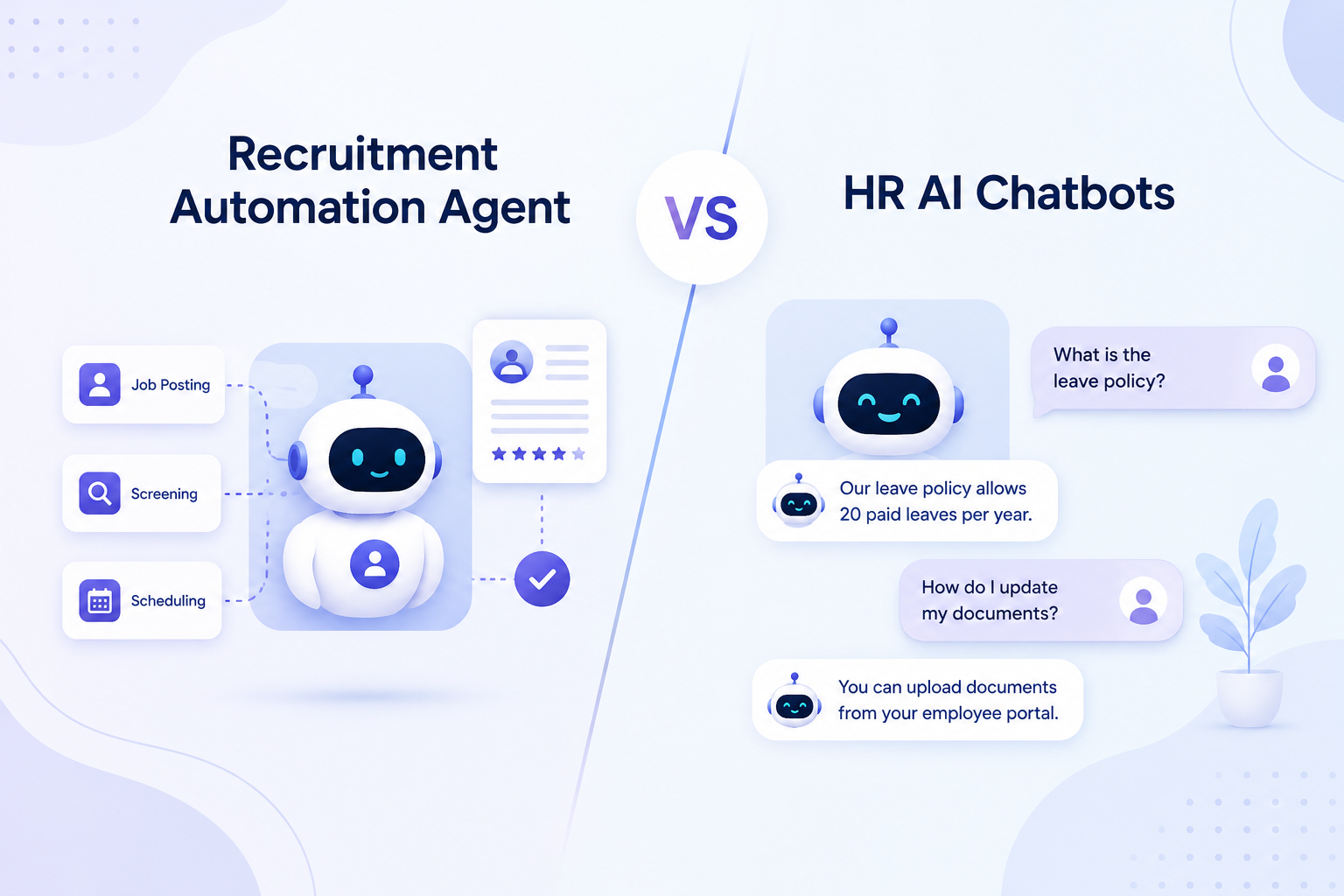
An AI chatbot for HR is a conversational interface built to handle high-frequency, low-complexity queries. Think of it as a digital information desk. An employee asks about their leave balance, benefit options or the company holiday schedule. The chatbot retrieves the answer instantly, without any human involvement.
It operates within a defined boundary. It reads from a knowledge base and responds within that scope. It does not take action in other systems, nor does it make decisions independently.
The HR AI Agent Enterprise
An HR automation agent enterprise operates on an entirely different level. It is goal-oriented and context-aware. Rather than answering a question, it completes a workflow.
Consider this scenario: a candidate application arrives. The agent parses the resume, checks recruiter and interviewer availability, schedules the meeting, sends calendar invites to all parties and triggers a follow-up for feedback collection. No manual step required. One responds to queries. The other executes processes across your entire HR tech stack.
The Wrong Tool for the Wrong Problem
The most expensive mistake in enterprise AI adoption is buying a sophisticated tool for a simple problem. Before evaluating any platform, one question should come first: what type of problem do we actually have?
There are two distinct problem types in HR operations:
| Problem Type | What It Looks Like | The Right Tool |
| Knowledge Gap | Employees cannot find the information they need | HR Chatbot |
| Coordination Gap | Teams spend time manually moving data between systems | AI Agent |
- If employees are repeatedly asking HR about policies, onboarding steps or benefits, that is a knowledge gap. Conversational AI for recruitment and employee support resolves this quickly and at scale.
- If your recruiters are copying candidate data from your ATS into another platform, emailing interviewers separately and then chasing feedback manually, that is a coordination gap. A chatbot for talent acquisition will not resolve that. You need a system that executes across platforms.
But if you are not already using AI chatbots in your HR operations, this is a well-defined and low-risk place to start. The implementation is contained, the ROI is measurable, and it builds the data consistency your organisation will need before deploying anything more complex.
Multi-step recruiting automation only delivers its full value when the underlying workflow is already clearly defined and consistently followed.
Recruitment Agent or HR AI Chatbot: Comparing ROI and Business Impact
When deciding which is better for enterprise hiring, between an AI agent or an HR chatbot, the answer depends entirely on what outcome you are measuring. Here is what enterprise data from 2024 to 2026 shows for each tool.
The Chatbot Case: Efficiency at Scale
For high-volume, repetitive HR queries, the performance data is clear. Enterprise deployments now achieve between 70% and 90% autonomous resolution rates for common employee inquiries. Response times that previously took hours or days become instantaneous.
The downstream impact is measurable. Organisations report a 30% to 35% improvement in employee satisfaction scores after deploying an AI hiring assistant enterprise-wide for onboarding and HR support. When applied consistently during the first 90 days of employment, chatbot-led check-ins have been linked to up to an 82% increase in new hire retention. The value is not in complexity. It is in availability and consistency.
The Agent Case: Outcomes at Depth
For talent acquisition teams, performance metrics shift toward output. Enterprises deploying an AI talent acquisition platform with agentic capabilities report a 30% to 50% reduction in time-to-hire. Manual screening hours drop by up to 75% through AI-powered applicant tracking and automated skill-matching.
Career pages using agents to guide candidates through the application process see 40% higher completion rates and 95% more qualified leads. At the 12-month mark, organisations using predictive matching and bias-detection tools report a 35% to 42% improvement in quality-of-hire as measured by performance scores and retention rates.
In a direct HR AI agent vs chatbot ROI comparison for enterprises, the agent numbers carry significant weight. The average ROI on an enterprise recruitment automation platform at this level is 171%, with US deployments reporting 192%. That figure is driven largely by eliminating manual coordination tasks across legacy systems. An AI recruitment agent that integrates with Workday and SAP removes the copy-paste layer that consumes significant recruiter hours every week.
This is where the recruiting AI agent ROI is genuinely earned: not in the AI itself, but in the hours of invisible administrative work it replaces.
How to Choose Between an HR AI Chatbot and a Recruitment Automation Agent
The decision between a recruitment automation agent vs HR chatbot for enterprise hiring is not a one-time binary choice. It is a sequenced progression and the order matters significantly.
Step 1: Map your actual bottlenecks
Identify your top five HR and recruitment pain points. Are people struggling to find information? That is a knowledge problem. Are recruiters losing hours to repetitive data movement between platforms? That is an operational problem. The distinction determines the tool.
Step 2: Start with the chatbot
If you are early in your AI journey, begin with a chatbot deployment. Clear the high-frequency administrative load first. This creates consistent, reliable data flowing through your systems, which is the prerequisite for anything more advanced. It is also the fastest path to visible ROI and internal confidence in AI as a whole.
Step 3: Deploy the agent when your processes are ready
Once your data is consistent and your workflows are clearly mapped, generative AI for recruitment at an agentic level can take over the multi-step, high-value processes that currently drain recruiter capacity. This is also when deep integration with your ATS and HRIS becomes essential. Agents are only as effective as the systems they can access.
For high-stakes decisions such as compensation changes or final hiring approvals, human review should remain part of the process regardless of automation level. Regulatory requirements like the EU AI Act and NYC Local Law 144 are already moving in this direction.
For enterprises that want flexibility across different stages of AI adoption, platforms like GetMyAI provide both HR AI chatbots and workflow-driven AI agents within a single environment. This allows HR teams to start with conversational support for employees and candidates, then expand into recruitment automation as processes mature, without replacing their existing AI infrastructure.
The Right Tool Starts With the Right Question
The question of whether to invest in an HR AI agent vs chatbot ultimately comes down to where your organisation sits on its AI maturity curve.
If your biggest problem is that employees cannot find the information they need, a chatbot resolves that efficiently and measurably. If your recruiters are spending hours on tasks that should be automated, an agent is the right investment. Most enterprises will benefit from both over time, but the sequence in which they are deployed determines whether the investment succeeds or stalls.
Audit your current bottlenecks honestly. Start where the evidence points. Build from there.