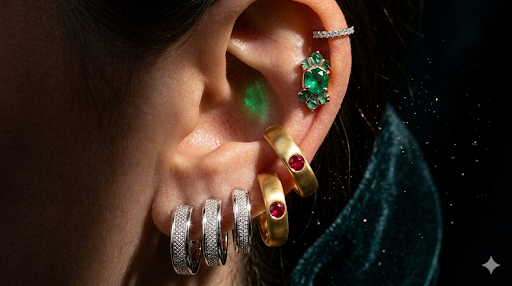
The differences are subtler than you think — and the answer changes depending on your ear.
The curated ear trend has turned the humble earlobe into a considered composition. Two earring formats dominate the conversation: huggies and hoops. Both are circular. Both are versatile. But when it comes to building a stacked look that holds together without becoming visual noise, they behave very differently.
Here’s how to think about both — and how to use them together.
What Separates a Huggie From a Hoop
The distinction is diameter and drape. A hoop earring hangs away from the ear, with a diameter large enough to create movement — typically 25mm and above. A huggie earring sits flush against the lobe or cartilage, with a small diameter (usually 8–14mm) that keeps the piece anchored rather than allowing it to swing.
That difference in behavior is everything when it comes to stacking.
Hoops draw attention through motion and negative space. Huggies draw attention through presence and texture — you notice them because of what they are, not what they do.
Why Huggies Are the Foundation of a Stacked Ear
If you’re building a curated ear with three or more piercings, huggies are the structural logic that keeps it from looking accidental.
Placed at the first or second lobe piercing, a huggie anchors the composition. It occupies space without competing. Larger, more expressive pieces — a statement hoop, a threader, a cartilage cuff — can sit above it and read clearly because the lower ear isn’t fighting for attention.
Huggies also solves a practical stacking problem: movement conflict. When two hoops of similar diameter hang close together, they catch on each other, tangle, and shift out of place throughout the day. Huggies eliminate that. They hold their position, which means everything above them also holds its position.
For active wearers — or anyone who doesn’t want to readjust their ear stack at 2 pm — this is not a minor point.
Where Hoops Win
Hoops earn their place higher on the ear, or as a solo statement at the lobe when the rest of the stack is intentionally quiet.
A medium hoop at the helix or forward helix creates an arc that frames the upper ear and adds dimension to the overall look without requiring additional pieces. One well-placed hoop can make a two-piercing ear feel complete.
Hoops also serve as punctuation for a more minimal stack. If you’re wearing a huggie at the first lobe and a stud at the second, a thin open hoop at the third lobe or cartilage closes the sequence with a different shape language — round but open, versus round and closed.
The contrast between closed (huggie) and open (hoop) is actually one of the more underused techniques in ear styling.
Mixing Both: The Rules That Hold
When combining huggies and hoops in a single stack, a few principles keep things coherent:
Graduate the scale upward. The smallest, most fitted piece belongs at the lobe. Scale increases as you move toward the cartilage. A wide hoop at the second lobe with a tiny stud above it reads backward.
Vary the weight, not the metal. Mixing 925 sterling silver with gold vermeil is a deliberate design choice that the jewelry industry has fully normalized. Mixing thick and thin within the same metal reads more intentional than combining two different weights in two different metals.
Let one piece lead. A curated ear works best when one earring is clearly the hero — usually the largest or the most textured piece. Every other piece should support it, not compete with it. Huggies are almost always the supporting cast. Hoops can go either way.
How Noir KĀLA Approaches the Stacked Ear
Noir KĀLA designs within a framework where every piece carries weight — visually and symbolically. Our hoop and huggie earrings are crafted in 925 sterling silver and gold vermeil (22k gold over 925 sterling silver), with construction built for daily wear: durable noble materials that hold their finish and their form across seasons. What makes them particularly suited to stacking is the design restraint applied to individual pieces.
Our hoops tend toward clean geometry or fine surface detailing — nothing that overwhelms a composed ear. Our close-fitting earring formats sit without shifting, which matters when you’re layering three or four pieces in close proximity. Our aesthetic sits at the intersection of architectural minimalism and darker symbolic undertones — a direction that translates well into stacked ears that feel considered rather than decorated. Whether you’re working with our 925 sterling silver pieces for a cooler, more grounded look, or reaching for gold vermeil to add warmth to the upper ear, our pieces are built to coexist.
Conclusion:
Huggies work better as the foundation of a stacked ear. Hoops work better as the accent or the hero. Used together — with scale graduated upward, one dominant piece, and consistent metal tone — they produce the kind of ear stack that looks like it was meant, not assembled.
The format matters less than the intention behind it.