Here’s a number that should stop every marketer mid-scroll: 76% of online consumers prefer to buy products when information is presented in their native language, according to CSA Research. Yet the vast majority of brand video content is produced in a single language — usually English — and expected to somehow resonate across dozens of markets. The result? Billions of dollars in lost engagement, abandoned carts, and missed connections. The language barrier in video marketing isn’t just an inconvenience. It’s a revenue leak.
For years, the solution was obvious but impractical: hire translators, book voice actors, rent studio time, and repeat the entire production cycle for every language. A single 60-second product video could take weeks and thousands of dollars to localize into just five languages. That economics made multilingual video a luxury reserved for enterprise brands with global budgets.
That’s no longer the case. AI-powered video tools have fundamentally changed the math. What once required a small army of linguists and producers can now be accomplished by a single marketer with a laptop, often in under an hour. This guide walks you through exactly how to do it — from script to publish — while avoiding the pitfalls that turn well-intentioned localization into awkward, culturally tone-deaf content.
Why Multilingual Video Matters More Than Ever
The internet is not as English-dominant as many marketers assume. English accounts for roughly 25.9% of internet users worldwide, according to Statista’s 2024 data. Mandarin Chinese, Spanish, Arabic, Hindi, and Portuguese collectively represent billions of additional users — many of whom are in rapidly growing consumer markets.
The business case for multilingual video goes beyond reach. It directly impacts conversion:
- 72.4% of consumers said they would be more likely to buy a product with information in their own language (CSA Research, “Can’t Read, Won’t Buy” study).
- Localized video ads see 2–3x higher engagement rates compared to non-localized versions, according to Meta’s internal advertising benchmarks.
- YouTube reports that over 80% of its views come from outside the United States, making single-language video strategies a missed opportunity.
- E-commerce brands expanding into new markets with localized video content report an average 1.5x increase in conversion rates within the first quarter, per data from Shopify’s 2024 Global Commerce Report.
The shift isn’t just about selling more products. It’s about building trust. When a viewer hears their language — spoken naturally, not robotically — the psychological distance between them and the brand shrinks dramatically.
Social media algorithms have accelerated this trend. Platforms like TikTok and Instagram increasingly prioritize local-language content in their recommendation engines. A Spanish-language version of your video will surface to Spanish-speaking audiences far more effectively than a subtitled English original.
The Traditional Approach vs AI
| Factor | Traditional Approach | AI-Powered Approach |
| Cost per language | $$1,500$$5,000+ (voice actors, translators, studio time) | $$20$$100 (AI tools, per video) |
| Time per language | 1–3 weeks (scheduling, recording, editing) | 15–60 minutes |
| Voice quality | High (professional actors) | High (neural voices with natural intonation) |
| Lip-sync accuracy | Requires re-shooting or complex post-production | AI-generated avatars with automatic lip-sync |
| Scalability | Linear — each language multiplies cost and time | Near-instant — batch process 10+ languages simultaneously |
| Consistency | Varies by actor and session | Consistent tone and pacing across all versions |
| Cultural adaptation | Requires local consultants | Requires human oversight, but AI handles base translation |
| Revision turnaround | Days to weeks | Minutes |
The traditional approach still has its place for flagship brand campaigns. But for the other 95% of marketing video content — product demos, social ads, explainer videos, email campaigns — AI localization delivers comparable quality at a fraction of the cost and time.
Step-by-Step: Creating Multilingual Videos with AI
Step 1: Write (or Refine) Your Script with Localization in Mind
- Avoid idioms and slang that don’t translate well. “Hit a home run” means nothing in cricket-playing countries.
- Keep sentences short. Aim for 15–20 words per sentence maximum.
- Leave room for text expansion. German text is roughly 30% longer than English. Spanish runs about 25% longer.
- Mark non-translatable elements. Brand names, product names, and technical terms should be flagged.
Step 2: Translate with Context, Not Just Words
- Use AI translation tools that allow you to provide context — product category, target audience, tone of voice.
- Always translate into the formal/informal register appropriate for your market. French marketing typically uses “vous” (formal), while Brazilian Portuguese marketing often uses “você” (informal).
- Review translations with native speakers when possible.
Tools like TopView AI streamline this by integrating translation directly into the video creation workflow.
Step 3: Generate AI Voiceover in Each Language
- Select voices that match your brand personality. Most AI platforms offer multiple voice options per language.
- Adjust pacing and pronunciation. Some AI tools allow fine-tuning speaking speed and phonetic overrides.
- Listen to the full output. AI voices handle 95% of content flawlessly, but proper nouns occasionally trip them up.
TopView AI offers AI voiceover generation in 30+ languages with native-sounding voices.
Step 4: Adapt Visuals and Avatars
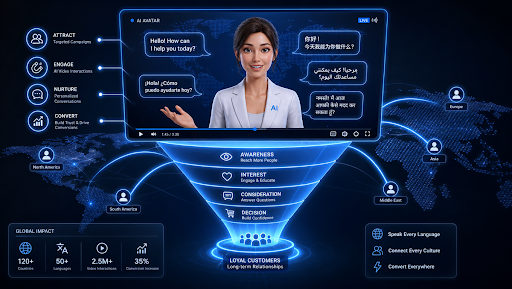
- AI avatars with lip-sync automatically match mouth movements to each language’s voiceover.
- Consider presenter appearance. Some brands use a single global avatar; others select region-specific presenters.
- B-roll and product footage generally doesn’t need to change between languages.
TopView AI’s avatar technology generates lip-synced presentations across languages from a single source video.
Step 5: Localize Text Overlays and Graphics
- Export all on-screen text strings as a separate translatable asset.
- Check text length against design constraints. “Buy Now” may overflow when translated to “Jetzt kaufen.”
- Adjust text direction for right-to-left languages like Arabic and Hebrew.
- Localize number formats, currency symbols, and date formats.
Step 6: Review, Quality-Check, and Publish
- Native speaker review. Even five minutes per language catches credibility-undermining errors.
- Technical QC. Check audio sync, text rendering, and video resolution.
- Batch export and publish. TopView AI supports batch processing for multiple languages simultaneously.
- Track performance by language and region from day one.
Beyond Translation: Cultural Adaptation
- Color psychology varies by culture. White symbolizes purity in Western markets but is associated with mourning in parts of East Asia.
- Music and sound design carry cultural weight. A corporate synth track may feel cold in Latin American markets.
- Humor doesn’t translate. When in doubt, lead with clarity over wit.
- Social proof looks different. In the US, individual testimonials are powerful. In Japan, group consensus carries more weight.
- Pacing expectations vary. North American audiences prefer faster-paced content; Middle Eastern audiences may respond better to deliberate pacing.
- Holiday and seasonal references. Don’t reference Black Friday in markets where it doesn’t exist.
Platform-Specific Localization Tips
| Platform | Key Regional Differences | Localization Tips |
| YouTube | 80%+ views from outside US; subtitles widely used | Add multi-language subtitles; create localized channels for top markets |
| TikTok | Hyper-local algorithm; local trends vary dramatically | Create native-language versions, not just subtitled; follow local trends |
| Reels algorithm favors local-language content | Use language-specific hashtags; adapt caption length by market | |
| Professional tone varies by culture (more formal in DACH) | Adjust formality level; use market-specific case studies | |
| Dominant in Southeast Asia, Latin America, and Africa | Prioritize where Facebook is primary platform; leverage Groups |
ROI of Multilingual Video Content
| Metric | English-Only | Multilingual (5+ languages) | Improvement |
| Total addressable audience | ~1.5B English speakers | ~5B+ in top 10 languages | +230% |
| Avg. engagement rate (social) | 2.1% | 4.8% | +129% |
| Conversion rate (e-commerce) | 2.3% | 3.8% | +65% |
| Cost per acquisition | Baseline | -35% (less competition in non-English markets) | -35% |
| Customer lifetime value | Baseline | +22% (native language = higher loyalty) | +22% |
| Content production cost | Baseline | +15–25% with AI (vs. +400–500% traditional) | Minimal increase |
Sources: CSA Research, Meta Advertising Benchmarks, Shopify Global Commerce Report 2024, HubSpot International Marketing Study 2025
Common Mistakes to Avoid
- ❌ Relying on subtitles alone. Native-language voiceover dramatically outperforms subtitles.
- ❌ Using Google Translate without review. Machine translation is a starting point, not a finished product.
- ❌ Ignoring cultural context. A technically accurate translation can still feel tone-deaf.
- ❌ One avatar for all markets. Testing market-specific presenters often yields better engagement.
- ❌ Forgetting right-to-left languages. Arabic, Hebrew, and Urdu require layout adjustments beyond text translation.
- ❌ Launching all markets at once. Start with your top 3–5 target languages, optimize, then expand.
FAQ
How many languages should I start with?
Start with 3–5 languages where you have existing (or target) audience. Analyze your website analytics and ad account data to identify which non-English markets already show interest. Common high-ROI starting points for global brands: Spanish, Portuguese, French, German, and Japanese.
Is AI voiceover quality good enough for marketing?
In 2026, yes. Neural TTS voices have reached a level of naturalness that most viewers cannot distinguish from human recordings. TopView AI’s 30+ language voices maintain natural intonation and emotion across languages.
Should I create separate social media accounts per language?
For YouTube, yes — localized channels perform significantly better. For TikTok and Instagram, it depends on your scale. If you’re posting 3+ times per week per market, separate accounts make sense. Otherwise, use your main account with language-targeted ads.
How do I measure which language markets are worth investing in?
Track three metrics per market: engagement rate (are people watching?), conversion rate (are they buying?), and customer acquisition cost (is it efficient?). Give each new market 30–60 days of data before making scaling decisions.
What about markets where English is widely understood?
Even in English-proficient markets like the Netherlands, Scandinavia, or India, native-language content outperforms English content by 20–40% in engagement. People may understand English, but they prefer their own language.