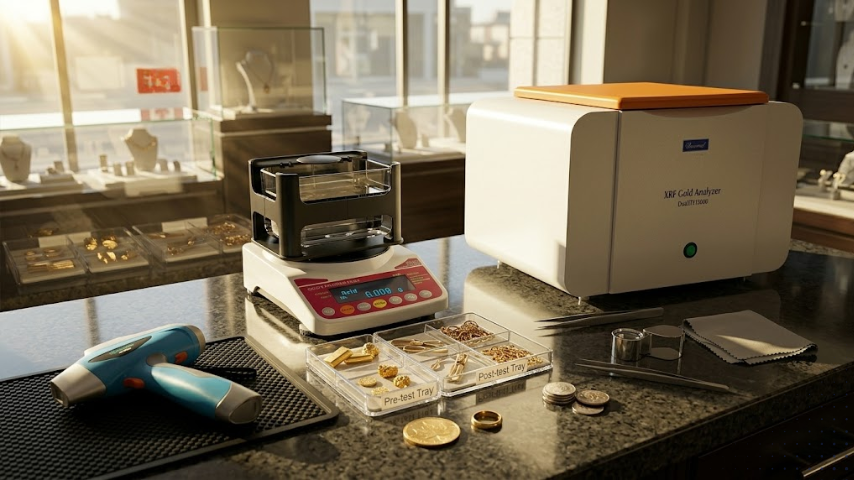
Precious metal traders depend on accurate valuations to maintain profitability and avoid costly errors. Whether managing a high-end jewelry boutique, a busy pawn shop, or a large-scale scrap refining operation, the pressure to verify purity remains constant. Relying on “gut feel” or outdated methods like acid scratch tests remains slow, hazardous, and dangerously subjective.
Professional gold tester systems provide a fast, non-destructive way to verify karat value with hard data. The ideal system depends on the specific items handled daily: delicate jewelry, mixed industrial scrap, or heavy investment-grade bullion.
This guide outlines the selection logic necessary to select a system that matches a specific business model. To see the full range of professional instruments available, gold tester solutions on Qualitest North America provides a way to evaluate which configuration fits specific volume and precision requirements.
How a Gold Tester Supports Business Operations
A gold tester serves as a core business asset by providing several advantages for daily operations:
- Purchase Accuracy: Confirming that a “14K” chain is actually 14K rather than a high-quality 10K imitation.
- Valuation Confidence: Providing customers with a transparent, scientific basis for an offer to build trust and improve closing rates.
- Risk Reduction: Protecting margins from sophisticated counterfeits or “filled” items that standard visual inspections might miss.
- Faster Customer Handling: Reducing wait times at the counter during peak hours or high-volume scrap intake.
- Consistent Pricing: Securing uniform results across all staff members, regardless of their individual experience levels.
Integrating a reliable electronic gold tester into a workflow replaces guesswork with a repeatable, defensible process.
Why More Buyers Prefer Non-Destructive Testing
The industry is rapidly shifting away from the acid bottle toward non-destructive electronic and densitometric methods for several practical reasons:
- Safety and Cleanliness: Traditional testing involves corrosive acids that require careful handling and disposal. An electronic gold tester remains clean and requires no chemical consumables.
- Preserving Value: Acid testing requires scratching the item on a stone, which removes metal and leaves a permanent mark. This remains unacceptable for high-end jewelry, antiques, or coins where physical condition determines value.
- Removing Subjectivity: Comparing the color of an acid reaction to a chart is inherently subjective. Digital testers provide a clear, numerical readout that removes human error from the equation.
- Speed in Retail: Acid testing is often a “back-room” activity. Modern testers are counter-friendly, allowing the test to happen in view of the customer.
Start With the Workflow: Jewelry, Scrap, or Bullion
The primary filter for choosing a gold karat tester is the type of material handled most frequently.
Jewelry Counters
Retailers and small-scale buyers typically handle lightweight pieces like chains, earrings, and rings. Precision on small masses remains the top priority. Because a 1-karat discrepancy on a light ring changes profit margins quickly, these environments require high resolution for small items.
Scrap and Refining Workflows
Scrap gold buyers or recyclers handle larger, heavier mixed lots. Throughput and the ability to handle bulkier samples matter in these environments. These workflows require a machine with a higher weight capacity and a larger testing chamber.
Bullion and Coin Handling
Bullion dealers and coin collectors handle high-value, high-purity items that are often quite heavy. Consistency is the main requirement here. Because bullion often involves thick pieces, a precious metal karat tester must provide confidence in valuation for larger solid masses by verifying the core of the bar matches the surface.
High Precision vs. High Capacity vs. Basic Counter Workflow
The search for a system can be narrowed by instrument class once the primary material type is identified.
High Precision Systems
These systems serve fine jewelry retailers and quality control labs. They provide accurate readings on extremely light items where every milligram counts. If inventory consists mostly of delicate 18K or 22K pieces, the higher resolution of these systems provides a necessary advantage.
High Capacity Systems
Gold refiners, industrial recyclers, and bullion dealers require systems with reinforced weighing platforms and larger volume capacities. These units withstand the daily demands of processing heavy metal batches and provide the durability needed for high-volume scrap intake.
Basic or Standard Systems
Pawn shops and standard “cash-for-gold” counters find a standard electronic gold tester to be an ideal balance of cost and utility. These units handle the most common items—standard rings and chains—and provide a fast, reliable valuation for everyday transactions.
Selection Framework: Which Gold Karat Tester Fits Your Business?
The procurement process can be simplified using this “Choose This When” framework:
- Choose a precision-focused gold tester when… buying lightweight jewelry, delicate antiques, or premium fine-jewelry pieces where accuracy on a per-gram basis is the primary risk factor.
- Choose a high-capacity precious metal karat tester when… handling large lots of scrap, industrial recovery batches, or heavy bullion bars and coins.
- Choose a standard electronic gold tester when… running a high-traffic pawn shop or general buying counter that requires a fast, durable, and cost-effective solution for everyday rings and chains.
What to Define Before You Request Quotes
Audit counter activity to provide the following information before requesting a quote:
- Smallest Item Weight: The lightest piece required for accurate testing (e.g., a 0.5g earring).
- Largest Item Weight: The heaviest single item or batch expected (e.g., a 500g bullion bar).
- Daily Volume: The number of tests performed on an average day.
- Metals Handled: Whether the workflow handles gold exclusively or also requires silver and platinum verification.
- Testing Environment: Whether the unit will sit on a public-facing retail counter or in a back-room sorting area.
- Operator Training: Whether the machine will be used by a single expert or by multiple staff members with varying levels of experience.
Multi-Metal Workflows: Beyond Gold Testing
Modern digital systems often support multi-metal modes for businesses handling silver flatware or platinum jewelry. A precious metal karat tester with these capabilities allows a user to switch modes with a single button, providing accurate purity data for silver and platinum alongside gold readings. This consolidates the workflow into a single instrument and reduces the need for separate training for each metal type.
Common Buying Mistakes
- Choosing Only by Price: A “budget” tester that provides inconsistent results will cost more in overpayment errors than the initial savings.
- Mismatched Capacity: Buying a precision unit for a scrap refinery leads to constant “over-range” errors, while a high-capacity unit for a fine jeweler may result in poor resolution on light chains.
- Ignoring Throughput Speed: A tester that takes 60 seconds to provide a result can disrupt a retail sale. Systems that offer results in under 10 seconds are preferred for customer-facing environments.
- Ignoring Silver/Platinum Needs: Many buyers realize too late that they need to verify silver or platinum. Selecting a gold karat tester with multi-metal capabilities provides more long-term utility.
Example Buyer Profiles
- Fine Jewelry Retailer: Requires high precision for lightweight items and premium pieces to confirm estate jewelry purchases are accurately valued before display.
- Pawn Shop or Loan Office: Requires a rugged, fast electronic gold tester to quickly verify collateral for a loan while the customer is present.
- Gold Refiner or Scrap Recycler: Requires a high-capacity system to handle bulk lots of dental gold, industrial scrap, and jewelry fragments for melting and refining.
- Coin and Bullion Dealer: Requires a consistent, non-destructive platform to verify the purity of sovereign coins and investment bars without damaging numismatic value.
Why Buyers Compare Gold Testers on Qualitest North America
Qualitest North America presents different gold tester models mapped to specific commercial workflows, from retail counters to refining plants. Compare precious metal karat testers on Qualitest provides a clear selection logic based on user type. This helps buyers compare systems by real business needs rather than simple instrument labels.
Explore gold karat tester options on Qualitest allows users to request a quote for the gold karat tester that fits a specific jewelry, scrap, or bullion workflow.