Priya studied mechanical engineering at the University of Manchester. In her third year, she started using the faculty’s laser cutter to prototype parts for her final project — a compact kinetic sculpture driven by a spring mechanism. Her supervisor suggested she enter it in a joint exhibition with the art school. Three months later, she had commissions from two galleries. She hadn’t planned to be an artist. But the laser showed her that the boundary between what an engineer builds and what an artist makes is thinner than either department had ever suggested.
Bridging engineering and creative practice is not a new idea in Greater Manchester. The city that powered the Industrial Revolution, hosted the world’s first stored-program computer, and gave rise to one of the UK’s most vibrant contemporary art scenes has always been a place where technical skill and creative ambition collide. What’s different now is the tool doing the bridging — laser technology has become the common language between engineering labs and design studios across the city. OMTech’s laser engraving and cutting machines are used by university departments, independent makers, creative studios, and product developers throughout the region.
Greater Manchester’s Creative-Technical Ecosystem
According to Wikipedia’s laser engraving overview, laser engraving uses a focused beam to permanently mark or cut material through vaporization or surface modification. What this technical definition doesn’t capture is what the technology feels like to someone who’s just made their first precise cut through 6mm plywood in under two minutes — the immediate translation of a digital idea into a physical object, with tolerances that manual craft tools can’t reliably achieve.
Greater Manchester is home to two of the UK’s most significant higher education institutions for this convergence: the University of Manchester and Manchester Metropolitan University. The University of Manchester’s engineering faculty runs some of the most advanced fabrication labs in the country. Manchester Metropolitan’s School of Art houses one of the UK’s most respected design programmes. These institutions sit less than a mile apart, and in recent years, the students passing between them — and the independent makers building studios in Ancoats, Salford, and Stockport — have made laser technology central to how both communities work.
| COMMUNITY | PRIMARY USE OF LASER TECHNOLOGY | OUTPUT |
| Engineering students | Prototype enclosures, structural testing models, jigs | Functional prototypes, competition entries, final projects |
| Art & design students | Sculptural forms, decorative panels, installation pieces | Exhibition work, degree show pieces, portfolio |
| Independent product designers | First-article prototyping, presentation models | Client pitches, production-ready designs, market testing |
| Creative studio makers | Custom furniture, lighting, architectural models | Commissions, limited-edition runs, retail products |
| Community makerspaces | Member projects, workshops, community commissions | Local craft, education, accessible making |
What Laser Technology Actually Bridges
The word ‘bridging’ here is specific. It isn’t simply that engineers and artists use the same machine. It’s that laser technology forces both communities to develop skills the other has always had — and neither has traditionally valued enough.
Engineering students learning to laser-cut prototype enclosures quickly discover that material choice, surface finish, and visual composition matter to how a product feels. A technically perfect mechanism inside a box that looks like an afterthought doesn’t impress — and the laser machine, which can produce a precision-cut, beautifully finished enclosure just as easily as a plain one, removes the excuse for not caring. The aesthetic dimension becomes part of the engineering process because the tool makes it accessible.
FROM THE LAB TO THE GALLERY
A product design team at Manchester Metropolitan spent two terms developing a modular exhibition system — interlocking laser-cut aluminium panels that could be configured into different spatial arrangements. The project began as a practical design brief but won a regional award for spatial design and was later installed in a temporary exhibition at Manchester’s Whitworth Gallery. The students credited the laser cutter specifically: without the ability to iterate quickly on connection geometry — testing twelve variations of their interlocking joint in an afternoon — the project would have remained at the rough prototype stage.
Art and design students discovering laser technology face the mirror version of the same experience. Precision at scale — a 40mm grid of 2mm holes, perfectly spaced, across a 600mm panel — is simply not achievable by hand at any practical speed. The laser makes it routine. Suddenly, work that would have taken a week to produce can be made in an afternoon, and iterated the same day. Design students who engage with this capability don’t just work faster — they think differently, designing for repeatability, geometric complexity, and material efficiency in ways that hand-craft practice never prompted.
The Engineering Side: Prototyping and Physical Testing
Functional Prototype Development
Engineering departments at Manchester universities use laser cutting as a core prototyping tool throughout undergraduate and postgraduate programmes. The most common application is enclosure and housing development — cutting acrylic or plywood to create the physical form of a device while the electronics are still being tested. Laser-cut prototypes allow teams to test mounting, access, thermal management, and user interaction before committing to injection-moulded production tooling.
Structural Testing Models
Civil and structural engineering students use laser-cut models to test structural geometry under load. A laser-cut acrylic truss model can be tested to failure in a lab session to validate the student’s structural analysis. The precision of the laser ensures the model’s dimensions match the student’s design calculations exactly — something hand-cut models can never guarantee. The connection between the theoretical calculation and the physical result is cleaner, and the educational value is higher.
Engineering Prototype Studio — Salford
Context: Product design and engineering consultancy
Material: Acrylic, MDF, mild steel
Laser: CO2 + Fiber laser
A small product design consultancy near MediaCityUK runs a CO2 laser for rapid enclosure prototyping alongside a fiber laser for metal component marking. Their primary clients are hardware startups in the Greater Manchester region who need physical prototypes for investor presentations and user testing. The combination lets them produce a complete first-article prototype — acrylic housing, machined aluminium buttons, metal back panel with model number and compliance marks — in a single day. ‘Our clients used to wait two weeks for a prototype from a bureau,’ the founder says. ‘Now they walk out with it the same afternoon.’
The Creative Side: Art, Design, and Material Exploration
Laser-Cut and Engraved Sculptural Work
Manchester’s independent design and craft community — concentrated around the Northern Quarter, Ancoats, and the creative quarter near Stockport — has embraced laser technology as a primary fabrication tool. OMTech’s CO2 laser engraver machines handle the full range of materials these studios work with: birch plywood, MDF, acrylic, leather, cork, textile, and a wide range of surface-treated panels. The combination of cutting and engraving in a single setup — where one job file can cut an outer form and engrave a surface pattern in the same session — enables work that would be laborious or impossible by hand.
Independent Studio — Northern Quarter
Context: Bespoke furniture and installation art
Material: Birch plywood, smoked acrylic
Laser: CO2 laser engraver
A Manchester-based maker produces limited-edition laser-cut plywood furniture sold through independent design fairs and online. Every piece uses the same design vocabulary: parametric joint geometry that lets panels self-assemble without fixings, combined with laser-engraved surface patterns derived from mathematical functions. The designs started as engineering geometry — the maker’s background is structural engineering — but the output is entirely aesthetic. ‘People don’t see the equations behind the patterns,’ she says. ‘They see a beautiful object. That translation is what the laser does.’
Parametric Design and Generative Making
One of the most interesting currents running through Greater Manchester’s design community is the use of parametric design software — Grasshopper, Rhino, Processing — to generate laser cutting files directly from mathematical or data-driven parameters. According to Wikipedia’s parametric design overview, parametric design uses algorithms to define relationships between design elements, enabling forms that would be impractical to design manually. In laser-cutting practice, this means designs that are genuinely impossible to produce by hand — not just difficult, but geometrically underdetermined without computational tools.
Engineering students at the University of Manchester are exposed to parametric tools through computational design courses. Art and design students at MMU encounter them through digital craft modules. The students who engage most deeply with both tend to be the ones who end up in the crossover space — making work that has computational rigour and material beauty in equal measure.
Materials: The Physical Vocabulary of Bridging
The range of laser engraving materials available to Greater Manchester makers and studios covers most of what both engineering and creative practices require. CO2 lasers handle wood, acrylic, leather, fabric, cork, rubber, and coated metals — the palette of the studio maker. Fiber lasers handle steel, aluminum, stainless, brass, and titanium — the materials of the engineer. The crossover happens when a designer wants to combine a laser-cut wooden frame with metal hardware marked with a part identifier, or when an engineer wants to add a decorative surface treatment to a functional aluminium panel.
| MATERIAL | LASER TYPE | ENGINEERING USE | CREATIVE USE |
| Birch plywood | CO2 | Prototype enclosures | Furniture, sculptural panels, installation |
| Cast acrylic | CO2 | Testing models, display | Signage, lighting diffusers, layered art |
| Aluminium sheet | Fiber | Structural models, brackets | Decorative panels, architectural cladding |
| MDF / HDF | CO2 | Jigs, fixtures, housing | Flat-pack furniture, wall art |
| Leather | CO2 | Gaskets, protective pads | Fashion accessories, bags, upholstery |
| Stainless steel | Fiber | Brackets, hardware marking | Jewellery, architectural details |
OMTech Machines for the Manchester Maker Community
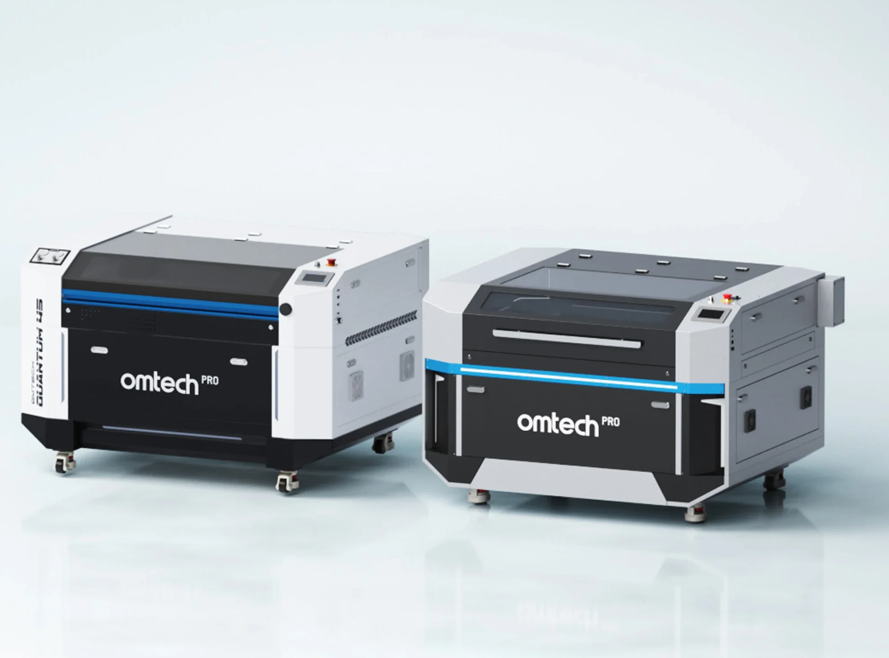
Two OMTech systems are particularly relevant to the engineering-art crossover community in Greater Manchester:
| Solis Duo 50W Fiber + 40W Diode — Mixed Material • Studio & Engineering • Dual Laser
Dual laser system combining a 50W fiber laser and 40W diode laser with autofocus. Handles both the metal component marking that engineering applications require (fiber) and the wide-format acrylic, wood, and leather work of a studio practice (diode). This is the right machine for a maker or studio that works across materials — product design studios, engineering consultancies producing physical prototypes, and university lab spaces serving both technical and creative programmes. Autofocus handles material thickness variation across mixed-material workflows. |
|
| Galvo Fiber 20/30/50W Autofocus Laser — Metal Art • Engineering Parts • High Speed
Galvo scanning head for fast, precise marking on metal components and metal art substrates — aluminum, steel, stainless, brass, and titanium. Used by designers producing limited-edition metal art pieces, jewellers working in steel, and engineering studios marking prototype components. The autofocus system maintains precision across slightly varying material heights. Compatible with LightBurn and EzCad for design-to-mark workflows that match how creative practitioners work. |
|
| GETTING STARTED IN GREATER MANCHESTER
Whether you’re a student transitioning from campus lab access to your own setup, an independent designer adding in-house fabrication, or an engineering studio adding creative capability, OMTech’s laser machine training provides remote setup guidance and operator training. OMTech’s fiber laser engraving machines ship to the UK and most European destinations. |