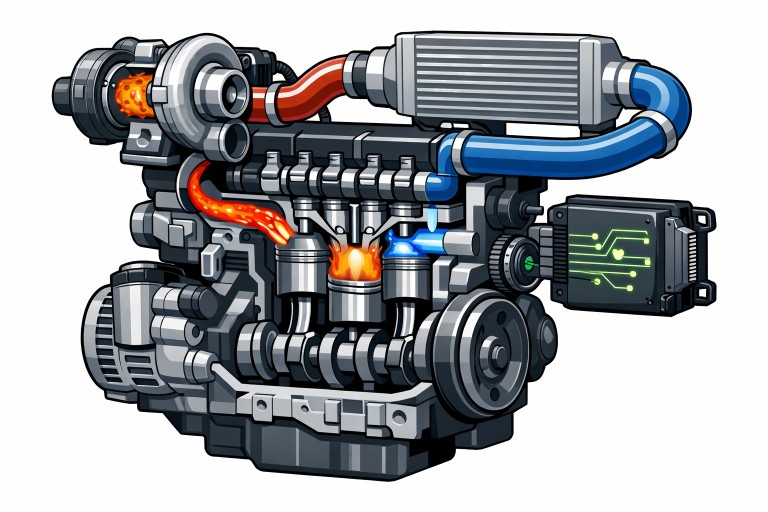
Modern diesel engines are engineered to deliver strong performance while meeting increasing demands for fuel efficiency and emissions control. Advances in fuel injection systems, turbocharging, and electronic engine management enable these engines to deliver higher power without excessive fuel consumption. By precisely controlling combustion timing and air-fuel ratios, manufacturers can optimize energy use and reduce waste, resulting in a more balanced, efficient operation.
At the same time, innovations such as variable-geometry turbochargers and improved aftertreatment systems help maintain this balance across varying workloads. Engines like the Cummins ISX engine illustrate how design refinements can support both durability and efficiency in heavy-duty applications. Overall, modern diesel technology reflects a careful integration of power, control, and environmental considerations.
Turbocharging and Intercooling
Turbocharging is now a defining technology in modern diesel engines. By using exhaust gases to spin a turbine, turbochargers compress incoming air before it enters the combustion chamber. This increased air density supports more fuel injection and facilitates a more complete and powerful combustion event. The addition of an intercooler further refines this process by cooling the compressed air, increasing oxygen content for improved combustion and engine responsiveness. Together, turbocharging and intercooling enable engines to create more power and use fuel more efficiently than non-turbocharged predecessors.
Common-Rail Fuel Injection
Common-rail fuel injection systems have dramatically improved diesel engine operation. Unlike older systems, common-rail technology delivers fuel at consistently high pressure through a shared rail, with electronically controlled injectors ensuring precise timing and measurement for each cylinder. This allows for multiple injection events per cycle, reducing emissions and noise while increasing efficiency and smoothness. As a result, engines are not only more environmentally friendly but also offer improved performance characteristics, appreciated by both operators and fleet owners.
High Compression Ratios
Another critical strategy for enhancing both power and efficiency in diesel engines is operating at high compression ratios. This means the air-fuel mixture is compressed to a much greater extent before ignition compared to gasoline engines. Higher compression translates to more energy per combustion cycle and allows the engine to extract more mechanical work from each drop of fuel. This feature is a significant reason diesel engines frequently outperform gasoline engines in applications demanding torque and efficiency, such as heavy-duty trucks and agricultural equipment.
Advanced Aftertreatment Systems
As emissions regulations have grown stricter, the role of aftertreatment systems in diesel engines has become increasingly important. Technologies like selective catalytic reduction (SCR) and diesel particulate filters (DPF) target specific pollutants emitted by diesel engines, such as nitrogen oxides and soot. SCR systems treat exhaust gases using a urea-based fluid, converting harmful compounds into nitrogen and water, while DPFs physically capture and incinerate soot. These solutions are instrumental in achieving compliance with environmental standards, as highlighted by resources like the Environmental Protection Agency’s emissions guide.
Electronic Engine Management
The integration of electronic control units has revolutionized the functionality of diesel engines. ECUs process data from multiple sensors, automatically adjusting injection timing, fuel delivery, turbo boost, and aftertreatment actions on the fly. This orchestration ensures that engines always run at peak efficiency while quickly adapting to varying operating conditions or driver demands. With electronic management, manufacturers can achieve greater precision while optimizing both yardstick metrics, such as horsepower, and subtler factors, such as drivability and emissions control.
Lightweight Materials and Design
Reducing engine and vehicle weight is another essential factor in boosting power and fuel economy. Using materials such as aluminum alloys, high-strength steels, and composites allows for lighter components without sacrificing structural integrity or durability. Additionally, redesigning engine internals to reduce friction and improve thermodynamic efficiency reduces energy loss as heat or mechanical resistance, yielding further efficiency gains. Streamlined designs have become a hallmark of modern engines across all market segments.
Future Trends in Diesel Engine Technology
The diesel engine’s future is marked by the adoption of increasingly sophisticated technologies. Developments such as variable-geometry turbochargers, advanced fuel-mixing techniques, and hybrid-electric drivetrain integration are emerging trends. Innovations targeting ultra-low emissions and greater automation will keep diesel relevant for critical niche roles and developing markets. Ongoing research and collaboration, such as that spearheaded by major manufacturers and academic institutions, are expected to set new benchmarks for efficiency, emissions, and durability.
Conclusion
Modern diesel engines combine advanced technologies like turbocharging, precise fuel injection, and emissions control to deliver strong performance and efficiency. Continuous innovation in design, materials, and electronic systems ensures compliance with environmental standards while maintaining reliability, positioning diesel engines as a vital solution for demanding and evolving transportation needs.