There’s a gap between looking great in a mirror and looking great in graduation photos — and the gap is the graduation gown. Most people don’t test the combination until they’re dressed and already running late. Graduation dresses that look stunning hanging up can read as completely wrong once they’re under six pounds of polyester robe in auditorium lighting.
My friend Emma graduated from the University of Michigan in May 2024. She’d found the most beautiful fitted white midi dress online — exactly what she’d envisioned. What she didn’t anticipate: the university’s academic regalia hit mid-calf, and her dress hem peeked out below it at an angle that made it look like a costume malfunction in every photo.
Half an inch higher on the hem, and nobody would have noticed. So. Let’s talk about the actual formula.
The core photogenic test: put on the dress, then put on the robe. Walk in front of a mirror. What are you seeing? If the dress peeks below the gown in an awkward way, that’s your photo problem — not the dress style itself. The fix is usually hemline height, not starting over.
Length: The One Variable That Changes Everything
| Length | How It Works Under the Gown | The Catch |
| Mini (above knee) | Clean clearance — nothing shows | Stage photos without a gown show a lot of leg — fine, but think about it |
| Midi (mid-calf) | Most elegant under most robes | Hem position needs to clear the robe bottom by 2+ inches |
| Maxi/floor | Works for college-style longer robes | Stage steps, outdoor terrain — can be genuinely difficult |
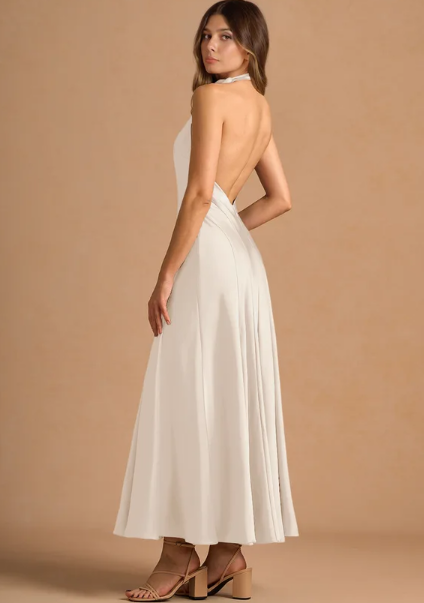
For most traditional US graduation ceremonies, the safest choice is a white midi graduation dress that ends at least two inches above the bottom of your robe. Two inches sounds precise because it is. Anything less and the hem starts showing from certain angles, particularly when you’re seated, and the robe rides up slightly.
A mini works too — arguably better for photos where you’re not in the gown, since it shows more of the dress. The thing people underestimate about minis: they often photograph more elegantly than midis when you’re out of the robe, because the proportions are cleaner and there’s no mid-calf visual cut.
Silhouette: What Reads Well on Camera vs. What Just Looks Good in Person
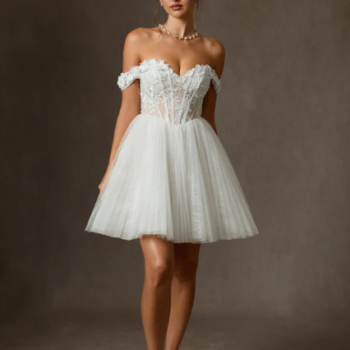
A-Line — Universally Photogenic for a Reason
A white graduation dress is the workhorse of graduation photography for one specific reason: it creates a defined waistline without clinging to the hips and thighs. The camera flattens the dimension. An A-line compensates by creating shape through structure rather than through fitted fabric tension.
Fitted dresses that look great in person can look completely different under flash photography in a gymnasium — they can read as either boxy (if slightly loose) or unflattering (if slightly tight). A-line avoids both problems.
What Doesn’t Translate as Well
Bodycon and very fitted styles are tricky. Under a graduation robe, they lose all their shape anyway, and for the ceremony photos, they’re not visible. When the robe comes off — congratulations photos outside, dinner after — they can be stunning. But they require a very precise fit, and they’re not forgiving of anything being off.
Mermaid silhouettes are gorgeous in real life. Under a robe, they’re invisible, and they make navigating auditorium steps and crowds genuinely awkward. They can work for college graduation ceremonies that are more relaxed about regalia — but as a practical choice for a full-day ceremony, they’re asking a lot.
Neckline and Fabric — The Two Details That Show Above the Gown
Necklines That Work With a Robe
Square necklines photograph cleanly. They sit well against graduation gown collars because the horizontal line creates a visual frame. V-necks add elongation and look elegant when the robe is open for the diploma photo. Strapless is the most controversial — it reads great in photos but requires either the robe to be zippered closed (which hides the dress anyway) or dealing with strapless security for several hours.
High necklines — mock neck, crew neck — can get visually busy against a graduation gown collar that’s doing similar work. If you love a high neckline, it’s not a dealbreaker, but the overlap of collar-on-collar can read as cluttered in photos.
Fabric: What Actually Shows in Photos
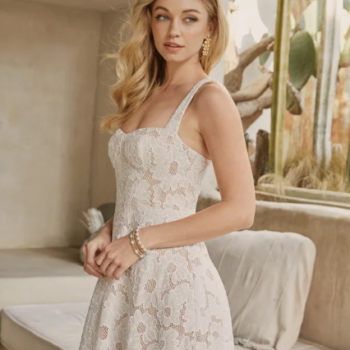
Smooth fabrics — satin, quality crepe — photograph cleanly. Texture and embellishment add dimension that reads well. Lace graduation dresses specifically photograph with a richness that solid white doesn’t — the texture creates depth under flash lighting that helps the dress read as more elaborate than it might feel in person.
The fabric concern that doesn’t get enough attention: opacity. White fabric under bright auditorium lighting and flash photography can be sheer in ways that simply don’t appear on your phone screen when you’re shopping. Double-lined or heavier fabrics avoid this completely.
The opacity test: take the dress outside in bright daylight and hold it up to the light. If you can see your hand through it easily, it will likely be sheer in graduation photos. This is less about modesty and more about avoiding the look of a dress that reads as unintentional or low-quality in photos that you’ll be looking at for decades.
The Photo-Ready Checklist: Six Things to Verify Before the Day
| 3 |
Sit in the dress for 15 minutes and then stand.Graduation ceremonies involve a lot of sitting, waiting, and then standing and moving. Test that the dress doesn’t shift, ride up, or require adjustment after the sitting period. Any dress that needs constant management on a regular day will need constant management on a day when you’re also managing a cap, a diploma folder, and trying to find your family in a crowd. |
| 4 |
Check the heel height against the robe length.Block heels and low wedges are genuinely better graduation shoe choices than stilettos, regardless of what photographs better. You will be on your feet for several hours, walking across a stage, and navigating parking lots. The heel you choose also affects where the robe hem falls relative to your dress. Test this combination specifically. |
Different Ceremonies, Different Formulas
High school ceremonies tend to be more formal with longer traditional robes, which means the dress is almost entirely hidden during the processional and stage walk. The dress choice matters primarily for pre-ceremony photos and post-ceremony celebrations. High school graduation dresses can prioritize a photogenic post-ceremony style, since the gown is worn for most of the ceremony.
College ceremonies vary significantly. Some universities have shorter, more casual regalia. Some have very formal, floor-length academic dress. College graduation dresses often benefit from the slightly longer midi option because college ceremonies tend to feature more standing and outdoor photos where the full dress is visible from the beginning.
The rule that works across both is: measure the actual robe before you finalize the dress. Not the standard robe size chart. The actual robe from your school’s rental or purchase. They vary more than you’d expect.
Closing
The formula isn’t complicated — it’s just specific. Length clears the gown by two inches. Fabric holds up to daylight and flash. Neckline doesn’t compete with the robe collar. Shoes you can actually wear for six hours. If you want a starting point, the Azazie graduation collection offers 70+ styles in mini, midi, and floor lengths, in white and neutral tones, and in sizes 0 through 30, with made-to-order options.
What nobody tells you: the photos you’re most proud of won’t be the formal stage walk ones. They’ll be the ones taken an hour after, standing outside in the afternoon light with the robe off, holding the diploma. That’s when the dress matters most.