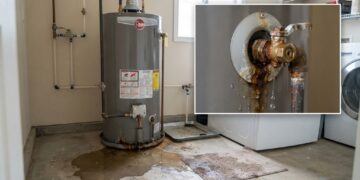
Your water heater is lying to you. Not intentionally, but every month it’s drawing more power, running longer cycles, and giving you less hot water than you’re paying for — and the reason is probably dissolving minerals you can’t see, taste, or smell. Hard water doesn’t announce itself. It just keeps working, quietly, until the repair bill does it for you.
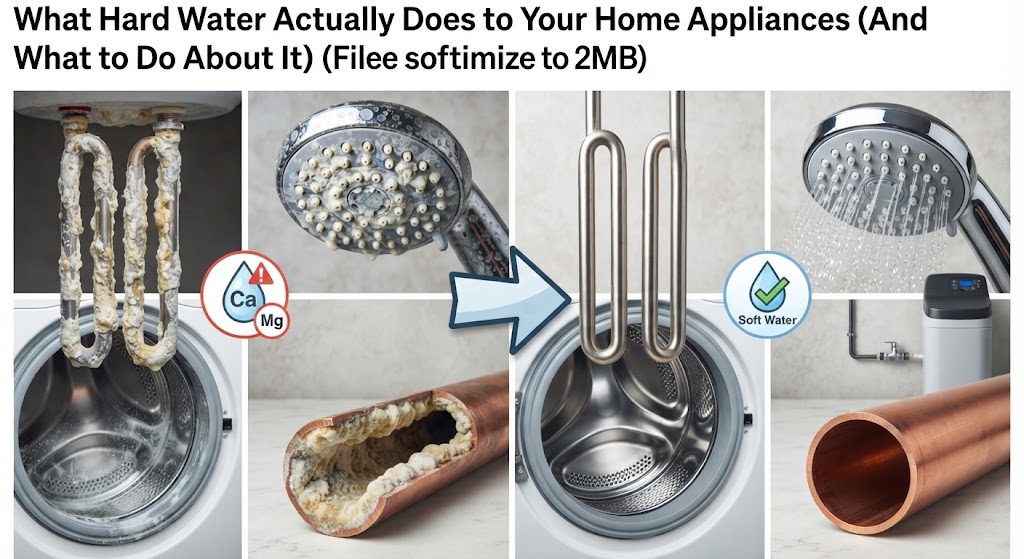
This is the thing most homeowners miss: hard water damage isn’t dramatic. It’s a slow accumulation of calcium and magnesium scale that coats heating elements, narrows pipe openings, and forces every water-using appliance to compensate. By the time you notice it, the damage is already months or years old.
The Mineral Tax Your Appliances Are Already Paying
Think of scale buildup as a mineral tax on every appliance that touches your water supply. The tax is small at first — a thin film on a heating element, a slight reduction in a pipe’s interior diameter. But it compounds. Calcium carbonate doesn’t dissolve back into the water. Once it plates onto a surface, it stays there and builds upward.
Here’s how that plays out in real terms across the appliances in a typical American home:
| Appliance | How Hard Water Damages It | Likely Consequence
|
|---|---|---|
| Water heater (tank) | Scale insulates the heating element from the water | Higher energy bills; shortened lifespan |
| Dishwasher | Mineral deposits clog spray arms and coat the interior | Spotty dishes; heating element failure |
| Washing machine | Scale builds inside hoses, valves, and drums | Reduced cleaning power; premature valve failure |
| Coffee maker | Deposits narrow the water path and coat the boiler | Slower brew; off-flavors; frequent descaling required |
| Showerhead | Mineral crust blocks individual spray nozzles | Reduced flow rate; uneven spray pattern |
| Pipes and fittings | Internal diameter shrinks as scale layers accumulate | Lower water pressure throughout the home |
The water heater example is the one that hits the wallet hardest. A research paper published through the U.S. Department of Energy’s Office of Scientific and Technical Information tested residential gas and electric water heaters under accelerated hard water conditions and found that scale accumulation caused gas water heater efficiency to decline by about 5% over a simulated 20-year period, while scale in electric heaters caused the heating element to fail periodically. That’s the kind of long-term drag that never shows up as a single event on your utility bill, but adds up to real money across a decade.
How Widespread Is This Problem, Really?
Hard water isn’t a regional quirk or a well-water issue. It’s the default condition for most American homes. More than 43 million people, about 15 percent of the U.S. population, rely on domestic private wells as their source of drinking water , according to the U.S. Geological Survey, and those wells pull groundwater that has traveled through mineral-rich rock for years. But municipal water users aren’t off the hook either.
Groundwater picks up calcium and magnesium as it filters through limestone, chalk, and dolomite formations. By the time it reaches your tap, the mineral load is already baked in. Your municipal treatment plant removes bacteria and regulates chlorine levels. It does not soften your water. That part is on you.
The EPA estimates that more than 23 million households rely on private wells for drinking water in the United States. Many of those households sit in the mid-Atlantic corridor, the Great Lakes region, and the Carolinas, areas where geologic formations push mineral concentrations particularly high. If you’re in eastern Pennsylvania or Delaware, that’s not a hypothetical problem. That’s your Tuesday morning shower.
“The buildup of scale in electric heaters caused the heating element to fail periodically, and in gas-fired heaters, it caused the tank metal temperatures near the burner to operate hotter.” — U.S. Department of Energy sponsored research, Battelle Columbus Laboratories, published via OSTI.GOV
What “Hard” Actually Means in Numbers
Water hardness is measured in grains per gallon (gpg) or milligrams per liter (mg/L). The U.S. Geological Survey classifies water as soft below 60 mg/L, moderately hard from 61 to 120 mg/L, hard from 121 to 180 mg/L, and very hard above 180 mg/L. Most of the damage described in this article starts showing up in the “hard” range and accelerates sharply into “very hard” territory.
The USGS tracks groundwater hardness across the country through its National Water Quality Program, which also monitors concentrations of arsenic, manganese, nitrate, and other contaminants that frequently co-occur with hardness minerals in private wells. Hard water and contamination risk often travel together because both come from the same source: untreated groundwater moving through varied geology.
That’s worth sitting with for a moment. If your well water is hard, the same conditions that concentrate calcium and magnesium may also be concentrating other substances. Hardness is the symptom you can see on your faucets. It’s not always the only thing worth testing for.
The Appliance Damage Playbook, Step by Step
Scale doesn’t destroy appliances overnight. It follows a predictable sequence, and knowing that sequence lets you catch problems early.
- Thin film stage (months 1 to 6): A nearly invisible layer coats heating surfaces. No noticeable performance drop yet. This is when treatment is cheapest and easiest.
- Efficiency drag stage (months 6 to 24): The insulating layer thickens. Your water heater runs longer. Your dishwasher starts leaving spots. Soap lathers less effectively. Bills creep upward, but not dramatically enough to alarm most people.
- Mechanical failure stage (year 2 onward): Valves stick. Spray arms clog. Heating elements burn out because the scale is acting as insulation between the element and the water it’s supposed to heat. This is where repair costs spike.
- Pipe restriction stage (ongoing): Scale inside pipes is irreversible without professional intervention. Flow restriction compounds over years. By the time water pressure drops noticeably, the interior diameter of affected pipes has already narrowed significantly.
Choosing the Right Fix for Your Situation
The treatment decision depends on three factors: your water source (well vs. municipal), your hardness level (get it tested, not guessed), and your household size. A couple in a two-bedroom home has different flow demands than a family of five with a dishwasher, washing machine, and multiple showers running on the same morning.
Salt-based ion exchange softeners are the most proven technology for hardness reduction. They swap calcium and magnesium ions for sodium ions, preventing scale formation entirely. Salt-free conditioners and template-assisted crystallization systems change how minerals behave without removing them, which works for mild to moderate hardness but typically can’t keep pace with very hard water above 15 gpg.
Reverse osmosis units are excellent for drinking water at the point of use, but a single under-sink RO system won’t protect your water heater, pipes, or appliances. For whole-home protection, you need whole-home treatment upstream of your plumbing, not at the tap.
If you’re in the greater Philadelphia corridor or along the Delaware shore, a local specialist like Suburban Water Technology can test your water on-site and recommend a system sized to your actual conditions rather than a generic online quiz result. That distinction matters more than most people realize. A system undersized for your hardness level will soften partially and still allow scale to accumulate.
The Practical Checklist: Signs You’re Already Past Stage One
- White or yellow crust around faucet bases and showerhead nozzles
- Soap that doesn’t lather well in the shower or sink
- Dishes with a cloudy film after the dishwasher cycle
- Water heater making popping or rumbling sounds during heating cycles
- Noticeable reduction in water pressure over the past year or two
- Laundry that feels stiff or looks dull even after washing
Any two of those signs together is a reasonable signal to get your water tested. A single sign could be something else. Two or more point toward a hardness problem that’s already in the efficiency-drag stage.
Water treatment isn’t a luxury purchase. For most American households, it’s deferred maintenance that compounds exactly like any other deferred maintenance. The appliances waiting to fail don’t care that you haven’t thought about your water hardness recently. Your pipes don’t send reminders. The time to deal with it is before the repair invoice does it for you.