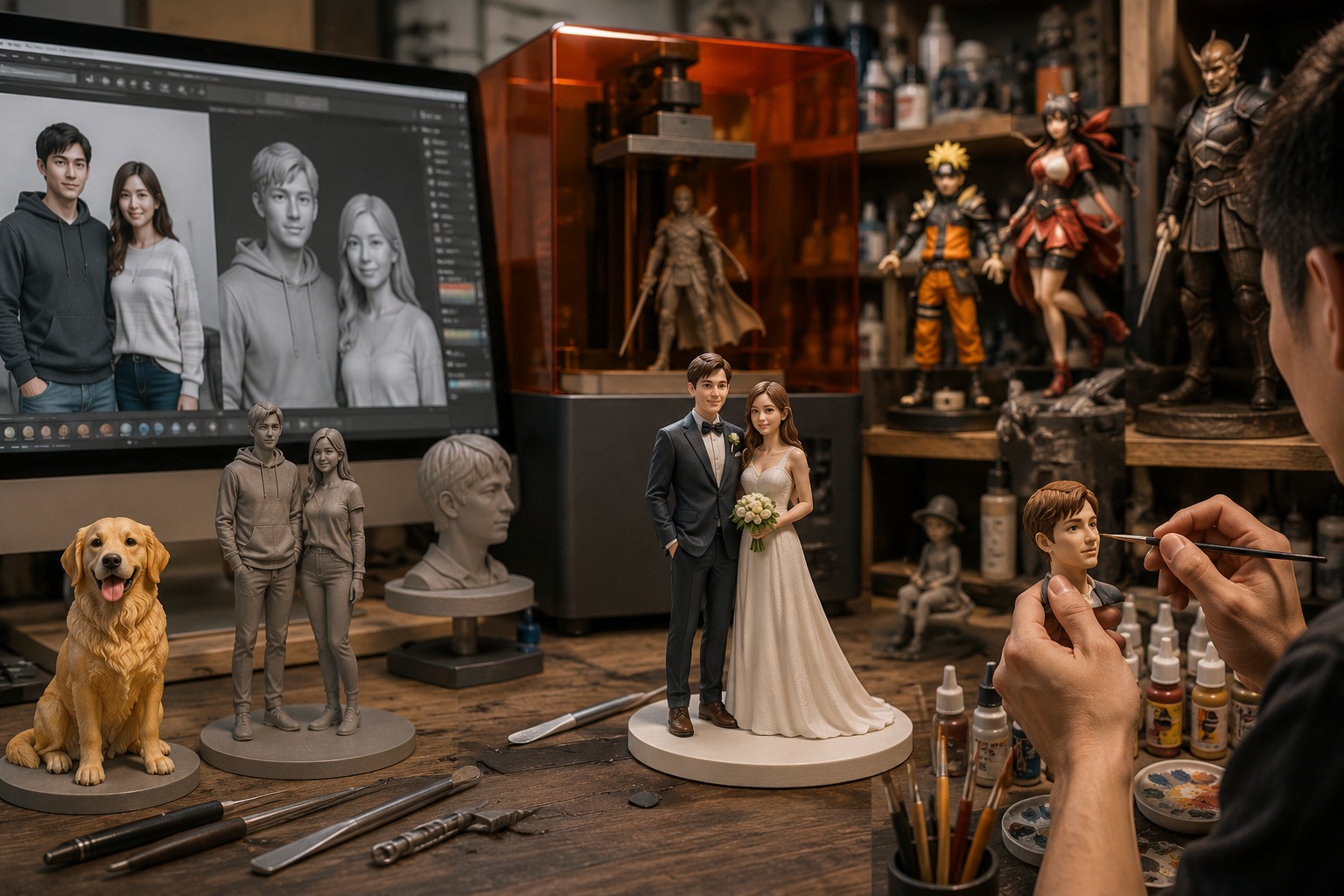
The future growth of custom figures will likely be driven by improvements in artificial intelligence, 3D modeling automation, and high-resolution printing technologies.
Production times are expected to become shorter while accuracy continues to improve. Customers may eventually generate realistic digital models directly from smartphone photographs without requiring manual sculpting adjustments.
At the same time, demand for highly personalized products shows little sign of slowing down. Consumers increasingly value products that preserve memories, celebrate important milestones, and express personal identity.
The Rise of Personalized Products in Modern Consumer Markets
Over the last decade, personalization has become one of the strongest trends in consumer goods. Customers increasingly prefer products that reflect their identities, memories, hobbies, and relationships rather than purchasing generic mass-produced items. From customized sneakers to engraved jewelry, personalization has transformed multiple industries. Custom figures are one of the newest and fastest-growing categories within this movement.
Custom figures, sometimes referred to as personalized figurines or custom statues, are three-dimensional representations created specifically for an individual customer. Unlike factory-produced collectible figures that are manufactured in large quantities, custom figures are designed to match a specific person, character, pet, or memory. Every detail, from facial expressions to clothing and poses, can be tailored according to customer preferences.
As digital manufacturing technologies become more affordable, custom figures are becoming accessible to a much larger audience than ever before.
What Exactly Are Custom Figures?
A custom figure is a personalized miniature sculpture created based on customer-provided references such as photographs, illustrations, sketches, or written descriptions. The purpose of a custom figure is not simply decoration but representation. It captures the identity, appearance, or personality of a person, pet, fictional character, or important life event.
Unlike traditional collectible figures that reproduce licensed characters from movies, games, or anime series, custom figures are unique creations. Even if two customers request similar products, the final result will often differ because each figure reflects individual characteristics.
This uniqueness is one of the major reasons why custom figures have gained popularity in recent years. Consumers are increasingly seeking products that carry emotional value rather than purely functional value.
How Custom Figures Differ from Traditional Mass-Produced Figures
The distinction between custom figures and conventional figures lies primarily in the production model.
Mass-produced figures are manufactured using molds and assembly lines designed to create thousands of identical units. Their strength lies in efficiency and lower production costs. However, customers have little or no influence over the final design.
Custom figures operate under an entirely different approach. Production usually begins only after an order is placed. Artists or digital designers create a unique model specifically for one customer. This process allows for personalized clothing, poses, accessories, facial features, and even environments.
As a result, custom figures often require more labor, longer production times, and higher costs. However, buyers generally view them less as products and more as personal keepsakes or collectible artworks.
Why Are Personalized Figurines Becoming More Popular?
Several market trends explain the growing demand for personalized figurines.
First, social media has increased consumer interest in visually distinctive products. Personalized figurines are highly shareable and often generate strong engagement because they tell individual stories.
Second, advances in 3D scanning, digital sculpting software, and resin printing technologies have significantly reduced production barriers. What was once only available through professional sculptors can now be produced more efficiently and at a lower cost.
Third, consumers increasingly prioritize experiences and emotional value over material ownership. A figure that recreates a wedding moment, graduation ceremony, or beloved pet carries sentimental significance that ordinary gifts often cannot achieve.
This emotional connection creates long-term value that extends far beyond the initial purchase price.
The Expanding Applications of Custom Figures
The market for personalized figures has expanded well beyond collectors and hobbyists.
Wedding figurines have become popular alternatives to traditional cake toppers. Pet owners commission miniature replicas of their animals as memorial keepsakes. Tabletop role-playing players order custom miniatures to represent game characters. Businesses also use customized figures as promotional gifts or executive awards.
The increasing diversity of applications suggests that custom figures are evolving from a niche collectible category into a broader personalized product industry.
As production technologies continue to improve, the range of potential use cases will likely expand even further.
Types of Custom Figures: Anime Figures, Wedding Figurines, Pet Models, and More
When many consumers first hear the term “custom figure,” they often imagine personalized versions of traditional anime or gaming collectibles. While these remain an important segment of the market, the custom figure industry has expanded far beyond its origins in hobby communities and collector culture.
Today, personalized figurines are produced for weddings, memorials, tabletop gaming, corporate branding, and family celebrations. The increasing accessibility of digital sculpting and 3D manufacturing technologies has enabled manufacturers to create highly specialized products for a wide variety of customer needs.
Anime and Character-Based Custom Figures
Anime-inspired custom figures remain one of the largest segments of the personalized figurine market. Unlike officially licensed figures that reproduce existing characters, custom anime figures allow customers to create entirely original designs or personalized versions of themselves in anime form.
Some customers request original characters designed specifically for novels, games, or online content creation. Others prefer transforming personal photographs into stylized anime representations while maintaining recognizable facial characteristics.
This category attracts collectors because it combines the emotional connection of personalization with the artistic appeal of anime aesthetics. It also provides creative freedom that is often impossible with commercial figure collections.
The popularity of online gaming communities and virtual identities has further accelerated demand for this type of customization.
Wedding and Couple Figurines
Wedding figurines have become one of the fastest-growing applications for custom figures. Traditionally, wedding cake toppers were simple decorative objects with limited customization options. Modern manufacturing techniques now allow couples to commission highly accurate miniature versions of themselves wearing customized outfits and poses.
Some couples recreate their wedding ceremony attire, while others prefer more humorous or creative concepts that reflect their personalities and shared interests. These figurines often become long-term display pieces rather than temporary event decorations.
Anniversary celebrations and engagement gifts have also become important drivers of demand within this category. Because the figurines preserve a specific moment in time, they frequently carry stronger sentimental value than conventional gifts.
The emotional significance attached to major life events makes this segment particularly resilient even during economic uncertainty.
Custom Pet Figurines and Memorial Models
Pet ownership has become another major contributor to the growth of personalized figurines. Many owners view pets as family members and seek meaningful ways to celebrate or preserve memories associated with them.
Custom pet figures are commonly commissioned to commemorate birthdays, adoption anniversaries, or important milestones. In other cases, they serve as memorial pieces following the loss of a beloved animal companion.
Unlike photographs, three-dimensional figurines offer a physical representation that can be displayed within a home environment and integrated into everyday life. This tangible quality contributes significantly to their emotional appeal.
As spending on premium pet products continues to increase globally, custom pet figurines are expected to remain an important market segment for years to come.
Tabletop RPG and Gaming Miniatures
The growth of tabletop role-playing games has created substantial demand for customized gaming miniatures. Players increasingly prefer unique character representations rather than generic models supplied by game publishers.
These figures often incorporate highly specific equipment, armor designs, weapons, and poses that correspond directly to a player’s in-game character development.
Unlike decorative figurines, gaming miniatures must balance aesthetics with practical functionality. Durability, scale consistency, and portability become important considerations during production.
The continued popularity of role-playing games and fantasy franchises has contributed to sustained growth in this category.
Family Figurines and Personalized Home Decor
Family-themed custom figures represent another emerging segment within the industry. Parents often commission figurines featuring children, grandparents, or multiple generations as decorative centerpieces for homes and offices.
Graduation ceremonies, retirements, newborn celebrations, and family reunions provide common opportunities for these commissions. Some customers also choose to recreate memorable vacations or important family events using personalized figurines.
Compared with traditional framed photographs, custom figures provide a more interactive and visually distinctive method of preserving memories.
As consumers continue to prioritize meaningful experiences and emotional storytelling, demand for family-oriented figurines is expected to increase.
What Materials Are Used in Custom Figures? Comparing Resin, PVC, PLA, and Premium Materials
When customers order a personalized figurine, most attention naturally goes to appearance, facial accuracy, clothing details, and pose design. However, one of the most important factors determining the final quality of a custom figure is often invisible to first-time buyers: the material itself.
Different materials influence surface smoothness, fine detail reproduction, durability, production cost, weight, and long-term preservation. A figure designed primarily as a collectible display piece may require a completely different material from one intended for tabletop gaming or frequent handling.
Resin Has Become the Standard for Premium Custom Figures
Resin is widely regarded as the preferred material for high-end custom figures because of its exceptional ability to reproduce small details. Facial expressions, hair strands, fabric textures, and accessory elements can all be captured with remarkable precision.
Modern photopolymer resin used in high-resolution printers can achieve layer heights that are nearly invisible to the naked eye after post-processing. This makes resin particularly suitable for portrait figurines and personalized statues where facial resemblance plays a critical role.
Another advantage of resin is its smooth surface finish, which allows painters to apply gradients and subtle color transitions more effectively than many alternative materials.
The primary disadvantages are cost and fragility. Resin figures generally require careful handling and are better suited for display environments rather than frequent transportation or play.
For customers prioritizing realism and visual quality, resin remains the benchmark material in the custom figure industry.
PVC Dominates the Mass-Market Collectible Industry
Polyvinyl chloride, commonly known as PVC, is the material most frequently associated with commercial anime figures and large-scale collectibles.
PVC offers excellent flexibility and impact resistance, making it less likely to crack or chip during shipping. Its durability makes it ideal for products intended for wider consumer markets and larger production volumes.
However, PVC manufacturing relies heavily on mold production and injection molding processes. Because tooling costs can be extremely high, PVC becomes economically efficient only when producing large quantities of identical figures.
For this reason, PVC is rarely used for one-off personalized figurines or low-volume custom projects.
Although PVC figures can achieve impressive visual quality, they generally provide less customization flexibility than resin-based production methods.
PLA Became Popular Through Consumer 3D Printing
Polylactic acid, or PLA, gained popularity with the rapid growth of desktop 3D printers. As a biodegradable plastic derived partly from renewable resources such as corn starch, PLA became attractive because of its affordability and accessibility.
PLA works well for concept models, prototypes, and larger decorative objects where extremely fine details are not essential.
Compared with resin, however, PLA often produces visible layer lines that require additional sanding and finishing work to achieve a premium appearance. Complex facial details can also become less defined during printing.
As a result, PLA is commonly used for hobby projects, educational models, and entry-level figurines rather than collector-grade personalized statues.
Its low production cost nevertheless makes it a useful option for customers with strict budget constraints.
ABS and Engineering Plastics Prioritize Durability
Acrylonitrile butadiene styrene, commonly known as ABS, is another material frequently used in manufacturing applications that require mechanical strength and impact resistance.
ABS performs better than resin in environments where figures may be handled regularly or exposed to minor impacts. Some gaming miniatures and articulated models benefit from the material’s durability and flexibility.
However, ABS generally cannot match resin’s ability to reproduce highly intricate textures or realistic facial features. Surface finishing requirements are also higher in order to achieve premium visual results.
Consequently, ABS is often selected when functionality and durability are more important than display-quality detail.
Emerging Premium Materials Are Expanding Possibilities
The custom figure industry continues to experiment with new materials that combine the strengths of existing options.
Hybrid resin formulations improve impact resistance while maintaining high detail accuracy. Advanced polyurethane compounds offer lighter weight without sacrificing durability. Some manufacturers have also introduced composite materials designed specifically for larger display statues.
Metal components are increasingly incorporated into internal support structures to improve stability for complex poses or oversized figures. Transparent materials are also being used to simulate magical effects, water elements, or dynamic movement in fantasy-themed projects.
These innovations demonstrate that material development remains an active area of technological progress within the figurine industry.
How Personalized Figurines Are Made: The Complete Process from Photos to Finished Custom Figures
One of the most common questions asked by first-time buyers is simple: how does a photograph become a physical figure?
Unlike mass-produced collectibles that rely on molds and standardized manufacturing lines, personalized figurines require an entirely different workflow. Every project begins with a unique customer request and proceeds through multiple stages of digital design, artistic interpretation, manufacturing, and finishing.
The Process Begins with Reference Collection
The foundation of every successful custom figure is accurate reference material. Most manufacturers request several photographs from different angles to capture facial structure, hairstyle, clothing details, and body proportions.
Front-facing images are usually essential for facial modeling, while side and rear photographs improve the accuracy of hairstyles and clothing silhouettes. For figures recreating specific events such as weddings or graduations, customers often provide close-up images of accessories, jewelry, bouquets, or ceremonial outfits.
The quality of input information directly influences the quality of the final product. Even the most advanced production technologies cannot compensate for missing visual references.
Some customers also provide sketches, written descriptions, or examples from movies and games to communicate stylistic preferences.
Digital Sculpting Converts References into Three-Dimensional Models
Once references are collected, artists or digital sculptors begin transforming two-dimensional information into a three-dimensional model.
This stage is often the most labor-intensive part of the entire process. Sculptors create facial structures, body proportions, clothing folds, hair volume, and accessories while balancing realism with the desired artistic style.
Some projects aim for highly realistic portrait reproduction, while others intentionally adopt stylized aesthetics inspired by anime, cartoons, or collectible toy designs.
Modern sculpting software allows artists to refine extremely small details that would have been difficult or impossible to achieve using traditional clay sculpting methods.
The level of customization required at this stage significantly influences both production time and pricing.
Customer Review and Design Revisions Improve Accuracy
Before physical production begins, many manufacturers provide customers with digital previews or rendered images for approval.
This review stage reduces misunderstandings and allows adjustments to hairstyles, poses, facial expressions, clothing colors, or accessories before manufacturing costs are incurred.
Revision policies vary between companies. Some providers include several rounds of modifications within the purchase price, while others charge additional fees for major structural changes.
For highly personalized projects, this approval stage often becomes one of the most important factors determining customer satisfaction.
Because custom figures are usually produced as single units, correcting mistakes after printing is considerably more difficult than making digital adjustments beforehand.
High-Resolution Printing Creates the Physical Figure
After approval, the finalized digital model enters production.
For premium figurines, high-resolution resin printers are commonly used because they can reproduce intricate textures and facial details with exceptional accuracy. Layer thickness is often small enough to become nearly invisible after finishing and painting.
Larger figures may be divided into multiple components before printing in order to improve structural stability and printing efficiency. Heads, arms, accessories, and display bases are frequently manufactured separately and assembled later.
Printing duration varies depending on model size and complexity. Small miniatures may require only a few hours, while larger collectible statues can require several days of machine time.
This stage represents the transition from digital design to physical manufacturing.
Post-Processing Determines Final Quality
Raw prints emerging from production equipment are rarely ready for immediate display.
Support structures must be removed carefully to avoid damaging delicate features. Surfaces are cleaned, cured, sanded, and polished to eliminate visible imperfections and prepare the figure for painting.
Assembly technicians may reinforce joints or internal structures to improve long-term durability. Larger models sometimes receive additional support systems hidden inside the body or display base.
Although often overlooked by customers, post-processing can account for a significant portion of total labor costs in premium figure production.
The difference between average and exceptional custom figures frequently depends on the quality of finishing work rather than the printer itself.
Hand Painting Adds Personality and Realism
Painting transforms an uncolored model into a recognizable character or person.
Professional painters apply multiple layers of color to create realistic skin tones, clothing textures, shadows, highlights, and weathering effects. Fine details such as eye reflections, hair gradients, and fabric patterns often require extensive manual work.
Even with advances in automation, painting remains one of the least automated aspects of custom figure manufacturing. Human artistic judgment continues to play a critical role in achieving natural and expressive results.
For portrait figurines in particular, subtle differences in painting quality can dramatically influence perceived resemblance.
As a result, premium painting services often represent a major component of total project cost.
Packaging and Delivery Complete the Process
Once quality inspections are completed, figures are prepared for shipment using protective packaging designed to minimize transport damage.
Fragile components are often wrapped individually, while larger statues may use foam inserts or custom packaging structures. International shipments require additional consideration due to long transit distances and handling conditions.
Production timelines vary widely depending on complexity, revision requirements, and seasonal demand. Personalized figurines often require several weeks from order placement to final delivery.
While this timeline may seem long compared with standard online purchases, it reflects the reality of producing a unique object that exists nowhere else in the world.