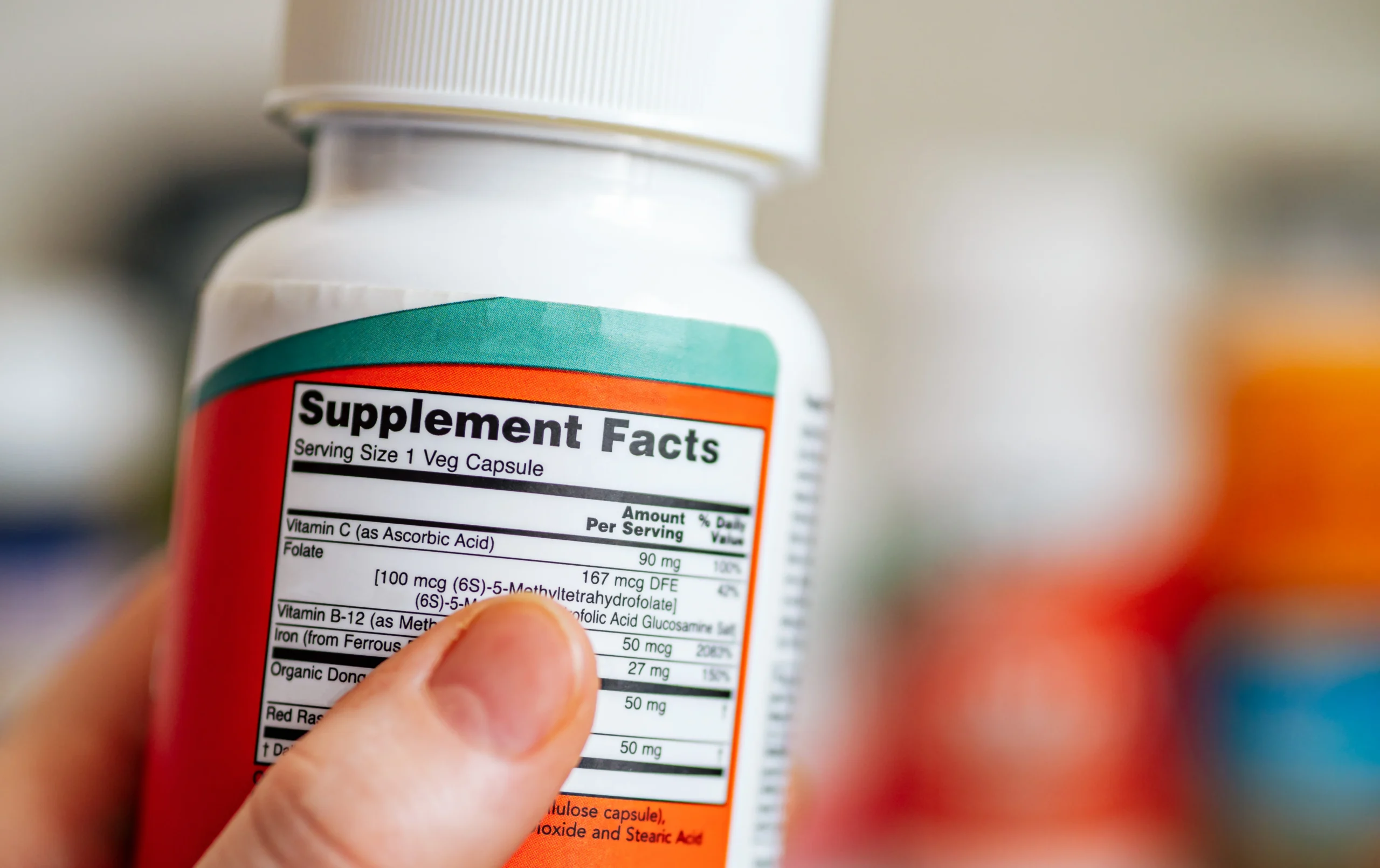
Natural vitamin E appears on a label as d-alpha-tocopherol (or RRR-alpha-tocopherol), while synthetic vitamin E appears as dl-alpha-tocopherol (or all-rac-alpha-tocopherol). That single letter is the whole distinction, and it is the most consequential detail on the back of the bottle, because natural vitamin E is retained by the body roughly twice as efficiently as the synthetic version at the same stated dose.
The reason comes down to molecular shape. Natural vitamin E exists as one stereoisomer, and your liver has a transport protein that recognizes it and preferentially loads it into circulation. Synthetic vitamin E is a blend of eight stereoisomers produced by chemical synthesis, and only about one eighth of that mixture matches the form your transport protein is looking for. The other seven are cleared faster and contribute far less to tissue levels, which is why two bottles claiming identical milligram amounts can deliver very different results.
What the Letters and Prefixes on a Vitamin E Label Actually Mean
The prefix is doing all the work. A lowercase d means the natural form; dl means synthetic. Manufacturers are not hiding anything by using these terms, but they are counting on the fact that most shoppers scan for the number and skip the chemistry.
You will also see ester forms, most often tocopheryl acetate and occasionally tocopheryl succinate. Esterification adds a molecule that protects the vitamin from oxidizing on the shelf, and your digestive enzymes strip it off before absorption. The prefix rule still applies here, so d-alpha-tocopheryl acetate is natural and dl-alpha-tocopheryl acetate is synthetic. Skincare products almost always use the acetate form for stability reasons, which is worth knowing if you are comparing an oral supplement to a serum.
Then there is the unesterified form, sometimes labeled simply as d-alpha-tocopherol with no acetate or succinate attached. It is less shelf-stable and generally requires a softgel with an oil base and light-blocking packaging. Some formulators consider it preferable because nothing has to be cleaved off before absorption, though the practical difference for a healthy adult is modest.
Why the Switch From IU to Milligrams Changed How You Compare Products
Older labels expressed vitamin E in International Units, which quietly built the natural-versus-synthetic difference into the math. Under that system, one IU equaled about 0.67 mg of natural d-alpha-tocopherol but about 0.45 mg of synthetic dl-alpha-tocopherol, an acknowledgment that the two are not equivalent. US labeling rules have since moved to milligrams of alpha-tocopherol, with a daily value of 15 mg for adults.
That change made labels simpler and comparison shopping harder. A bottle listing 200 mg of dl-alpha-tocopherol and a bottle listing 200 mg of d-alpha-tocopherol now look like the same product on the front panel, even though the biological delivery differs substantially. Some brands still print the IU equivalent in parentheses, which is genuinely helpful, and some do not.
If you are converting an old dose in your head, the rough rule is that 400 IU of natural vitamin E corresponds to about 268 mg, while 400 IU of the synthetic form corresponds to about 180 mg. Human studies using labeled tracers have generally found the natural form maintains roughly double the plasma and tissue concentration of the synthetic form, which is a wider gap than the old IU conversion implied.
Mixed Tocopherols and What Gets Left Out of Alpha-Only Formulas
Vitamin E is not one compound. It is a family of eight, four tocopherols (alpha, beta, gamma, delta) and four tocotrienols, and dietary vitamin E from nuts, seeds, and vegetable oils arrives as a mixture. Gamma-tocopherol is actually the most abundant form in a typical American diet, yet most supplements contain none of it.
That matters because the forms are not interchangeable in function. Research has linked gamma-tocopherol to neutralizing reactive nitrogen species that alpha-tocopherol handles poorly, and studies have repeatedly observed that taking high doses of isolated alpha-tocopherol lowers circulating gamma-tocopherol. You can end up correcting one number while depressing another.
This is the argument for mixed tocopherol formulas, and products such as Unique E are built around delivering the full complement of naturally occurring tocopherols rather than an isolated fraction. When you evaluate one of these, read the supplement facts panel closely, because some products list mixed tocopherols only as an ingredient in the carrier oil, present in trace amounts to prevent rancidity rather than to contribute a meaningful dose. A genuine mixed tocopherol supplement will quantify the non-alpha content instead of just naming it.
What the Price Difference Comes Down To
Natural vitamin E is extracted and concentrated from vegetable oil distillates, most commonly soybean and sunflower, which is a purification process with real yield limits and agricultural input costs. Synthetic vitamin E is built from petrochemical precursors in a controlled reaction and can be produced at scale for a fraction of the price. Expect natural forms to cost roughly two to four times more per milligram.
That gap explains most of what you find on shelves. Multivitamins, fortified cereals, and value-tier products lean synthetic almost universally, because vitamin E is one line item among thirty and the cost per unit has to stay low. Standalone vitamin E supplements from brands positioning on quality are where you find the natural and mixed tocopherol formulations. Animal feed, incidentally, runs on synthetic almost entirely.
Adjusted for the roughly two-to-one retention difference, the real cost gap narrows considerably, and in some comparisons it closes almost completely. A 268 mg natural softgel taken daily might run $12 to $30 a month depending on brand and whether mixed tocopherols are included, against maybe $5 to $10 for a synthetic equivalent that your body treats as substantially less.
Reading a Label in Practice
Start at the supplement facts panel rather than the front of the bottle. Front-of-package language like “natural source” or “from natural ingredients” is marketing text and does not reliably indicate the d form, whereas the ingredient listing has to be specific. Find the vitamin E line, check for d versus dl, then check whether the panel lists any tocopherols beyond alpha.
Look at the carrier and packaging too. Vitamin E is fat-soluble and oxidizes with exposure to heat and light, so an oil-based softgel in an opaque or amber container is a better bet than a chalky tablet in a clear bottle. Take it with a meal containing some fat, because absorption drops meaningfully on an empty stomach. Plasma levels take several weeks to shift, so if you switch forms, give it a month or two before drawing conclusions about how you feel.
One point that deserves more attention than it usually gets: high-dose vitamin E has a mild antiplatelet effect, so if you take warfarin, another anticoagulant, or a daily aspirin, or if you have surgery scheduled, that is a conversation to have with your doctor before you start.
The practical question is not really which form is better, since that one has a clear answer, but whether the dose you are taking makes the difference worth paying for. At a low daily amount inside a multivitamin, the natural-versus-synthetic gap is small in absolute terms. At 200 mg or more taken deliberately for a specific reason, you are either getting most of what you paid for or roughly half of it, and the label tells you which within about ten seconds once you know where to look.