Mobile app localization has evolved from a secondary consideration into a fundamental growth mechanism for digital products targeting international markets. As mobile ecosystems expand and competition intensifies globally, users increasingly expect apps to feel native to their language and cultural environment. This expectation directly affects how products are discovered, how long users stay engaged, and how willing they are to convert into paying customers. Localization, therefore, is no longer just about translation – it is a strategic capability that shapes the entire user experience and defines a product’s ability to scale across regions.
Choosing the right localization approach requires more than comparing costs or turnaround times. It involves understanding how localization integrates with development, how content evolves over time, and how teams manage multilingual complexity at scale. Whether a company decides to outsource to an agency or build workflows around a platform, the decision will influence product velocity, consistency across markets, and long-term operational efficiency.
As organizations expand into multiple countries and increase release frequency, relying on a structured mobile app localization service becomes essential. It allows teams to combine automation with human expertise, ensuring that updates are delivered quickly while preserving linguistic quality and cultural accuracy. Companies that embed localization into their product strategy from the start gain a significant competitive advantage by delivering experiences that feel tailored rather than translated.
Understanding the Modern Localization Landscape
The process to localize app experiences has changed dramatically over the past decade. What used to be a manual and linear workflow – extracting strings, sending them for translation, and reintegrating them into the product – has become a continuous and iterative process. Modern applications are updated frequently, often multiple times per week, which requires localization to operate at the same pace as development.
This shift has given rise to new expectations around speed and scalability. Localization is no longer a bottleneck at the end of a release cycle but an integrated function that operates alongside development and product teams. As a result, companies increasingly rely on localization application tools and infrastructure that allow them to manage multilingual content dynamically.
At the same time, traditional app translation services remain an important part of the ecosystem. Agencies provide linguistic expertise, cultural adaptation, and structured quality assurance that technology alone cannot fully replicate. This duality has created a landscape where organizations must decide how much control they want to retain internally and how much they prefer to delegate to external partners.
The evolution of localization reflects a broader shift in how digital products are built. It is no longer enough to translate static content; companies must create systems that allow them to adapt continuously, ensuring that every update is reflected across all supported languages without delay.
Defining Localization Scope and Strategic Depth
Before selecting a localization approach, companies must define the scope of their efforts. This decision determines not only the complexity of workflows but also the level of investment required and the quality of the user experience delivered in each market.
Some organizations adopt a minimal strategy, focusing only on translating critical components such as onboarding flows, navigation, and app store descriptions. This approach allows for rapid market entry and can be effective for testing demand in new regions. However, it often results in an inconsistent experience that may limit user engagement and retention.
Other companies pursue a more comprehensive approach, fully adapting their product for each target market. This includes not only translating all user-facing content but also adjusting tone, visuals, and even feature sets to align with local expectations. While more resource-intensive, this strategy tends to produce stronger long-term results by creating a more immersive and culturally relevant experience.
In practice, many companies begin with a limited scope and expand over time as they refine their localization application processes and gain a deeper understanding of their target markets. This iterative approach allows them to balance speed with quality while continuously improving their localization strategy.
Internationalization as the Foundation for Scalability
Effective localization is impossible without proper internationalization. Internationalization, or i18n, refers to the technical preparation of an application to support multiple languages and regional variations. It is the foundation upon which all localization efforts are built.
This process involves separating text from code, designing flexible interfaces that can accommodate variations in text length, and ensuring compatibility with different character sets and formats. Without these considerations, teams often encounter issues such as broken layouts, truncated text, or functional inconsistencies when introducing new languages.
The absence of internationalization creates friction at every stage of localization. Developers may need to manually adjust UI components, translators may struggle with context limitations, and releases may be delayed due to unforeseen technical issues. These challenges increase costs and reduce efficiency, particularly as the number of supported languages grows.
By investing in internationalization early, companies create an environment where they can efficiently localize app content without reworking core systems. This not only accelerates time-to-market but also ensures that localization remains sustainable as the product evolves.
Agencies and Platforms: Two Distinct Approaches
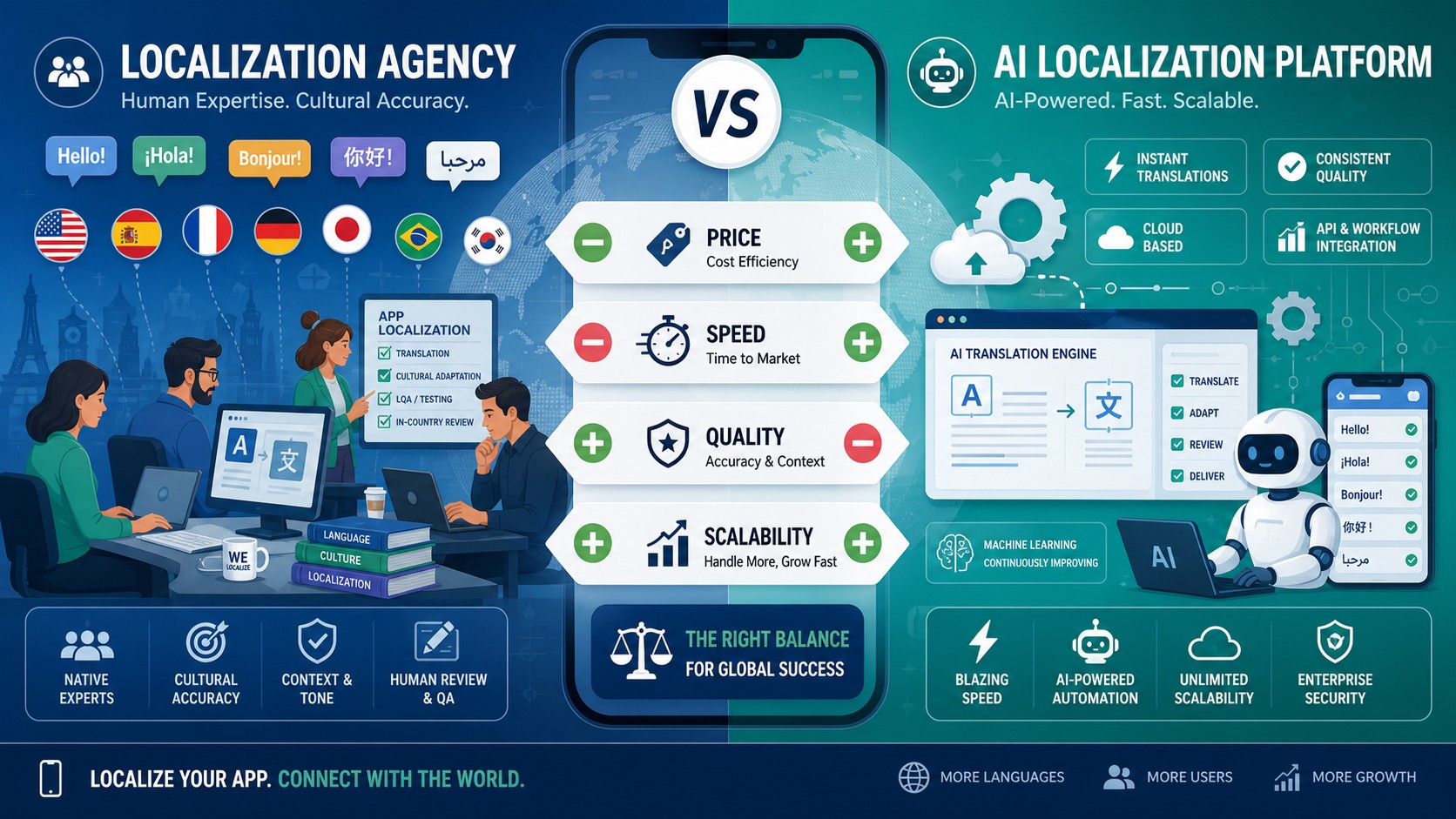
The choice between a localization agency and a platform represents two fundamentally different approaches to managing multilingual content. Agencies provide a service-oriented model in which external teams handle translation, quality assurance, and project management. Platforms, in contrast, offer a technology-driven model that enables internal teams to manage localization through automated workflows and integrations.
Agencies are particularly valuable when linguistic quality and cultural adaptation are priorities. They bring human expertise that ensures translations are contextually accurate and aligned with local expectations. This makes them well-suited for applications where user perception and brand voice play a critical role.
Platforms focus on efficiency and scalability. By integrating with development pipelines, they allow teams to automate repetitive tasks and maintain synchronization between source and localized content. This approach is especially effective for applications with frequent updates, where manual processes would quickly become a bottleneck.
Rather than viewing these options as mutually exclusive, many organizations treat them as complementary components of a broader localization strategy. The key is understanding how each approach aligns with specific business needs and operational constraints.
The Value and Constraints of Agency-Based Localization
Localization agencies provide a level of depth and precision that is difficult to achieve through automation alone. Their strength lies in their ability to interpret context, adapt messaging, and ensure that content resonates with local audiences. This is particularly important for user-facing content, where subtle nuances can significantly impact user perception.
Agencies also offer structured quality assurance processes that include multiple stages of review and validation. These processes help identify potential issues before they reach users, reducing the risk of errors and improving overall quality.
However, agency-based localization is not without its limitations. The reliance on human workflows can introduce delays, particularly when dealing with frequent updates or large volumes of content. Additionally, the cost of app translation services can increase significantly as the scope of localization expands.
For companies with dynamic products and rapid release cycles, these constraints can make it difficult to maintain alignment between development and localization. As a result, many organizations explore alternative or complementary solutions.
Platform-Driven Localization and Its Advantages
Localization platforms address many of the challenges associated with scalability and speed. By providing tools for automation and integration, they enable teams to incorporate localization directly into their development workflows. This allows updates to be translated and deployed alongside code changes, ensuring that all language versions remain current.
One of the key advantages of platforms is their ability to reduce manual effort. Features such as translation memory and glossary management allow teams to reuse existing translations, improving consistency and reducing costs over time. These capabilities are particularly valuable for applications with iterative content, where similar strings appear across multiple updates.
Platforms also empower teams to take ownership of their localization efforts. By building internal localization application workflows, companies can tailor their processes to match their development practices and business goals. This level of control can lead to greater efficiency and faster decision-making.
At the same time, platforms require a certain level of internal expertise. Without proper oversight, automated processes may produce inconsistent or contextually incorrect translations. This highlights the importance of balancing automation with human input.
Hybrid Models and the Balance Between Speed and Quality
As localization requirements become more complex, many companies adopt hybrid models that combine the strengths of agencies and platforms. This approach allows them to leverage automation for efficiency while relying on human expertise for quality and cultural adaptation.
In a hybrid setup, platforms typically handle the operational aspects of localization, including content management, automation, and integration. Agencies or freelance linguists are then involved in reviewing and refining translations, particularly for high-impact content. This division of responsibilities creates a balanced system that supports both speed and quality.
Hybrid models also offer flexibility. Companies can adjust their approach based on the type of content, the importance of specific markets, and the pace of development. For example, routine updates can be processed automatically, while major releases undergo more thorough human review.
This adaptability makes hybrid localization particularly well-suited for companies operating in multiple markets with diverse requirements. By combining different approaches, they can create scalable and resilient localization application strategies.
Embedding Localization into Product Development
Modern localization is most effective when it is fully integrated into product development. Rather than being treated as a separate phase, it becomes part of the overall workflow, ensuring that multilingual content evolves alongside the product itself.
This integration requires collaboration across teams. Developers must design systems that support localization, designers must create flexible interfaces, and content teams must prepare materials for translation from the outset. When these elements are aligned, localization becomes a natural extension of the development process.
The benefits of this approach are significant. It reduces delays, minimizes rework, and ensures that all users have access to the latest features regardless of language. It also enables companies to respond more quickly to market feedback, improving their ability to compete in global markets.
User Experience and Cultural Relevance
Localization plays a critical role in shaping user experience. Beyond language, it influences how users perceive and interact with an application. Differences in culture, behavior, and expectations can all affect how a product is received.
Design considerations such as layout flexibility, text expansion, and visual hierarchy must be carefully managed to ensure consistency across languages. Cultural factors, including color symbolism and imagery, also need to be adapted to avoid misunderstandings and create a sense of familiarity.
By addressing these elements, companies can create experiences that feel authentic rather than translated. This not only improves user satisfaction but also strengthens brand loyalty in international markets.
Measuring Success and Optimizing Performance
Localization should be evaluated through both operational and business metrics. While translation accuracy is important, it does not fully capture the impact of localization on product performance.
Metrics such as user acquisition, engagement, and conversion rates provide a more comprehensive view of success. By analyzing these indicators across different markets, companies can identify areas for improvement and refine their strategies accordingly.
Efficiency metrics, including time-to-market and cost per update, are also critical. They help determine whether a localization approach is sustainable and scalable over time. By balancing performance and efficiency, organizations can build systems that support long-term growth.
Scaling Across Markets
As companies expand, their localization needs become increasingly complex. Scaling requires not only the addition of new languages but also the ability to manage larger volumes of content and more diverse user requirements.
A phased approach is often the most effective way to scale. Companies begin with key markets and gradually expand based on performance data. This allows them to refine their localization application processes and address challenges before increasing complexity.
By combining platforms and app translation services, organizations can create flexible systems that adapt to changing needs. This approach ensures that localization remains efficient and effective as the product grows.
Conclusion
Choosing between a localization agency and a platform is ultimately about defining how localization fits within a company’s broader product strategy. Agencies provide depth, expertise, and structured quality assurance, while platforms offer speed, scalability, and integration with development workflows.
For most organizations, the optimal solution lies in combining these approaches. By leveraging automation to handle routine tasks and human expertise to ensure quality, companies can create systems that are both efficient and reliable.
As global competition continues to intensify, the ability to localize app experiences effectively will become a defining factor in product success, a trend consistently supported by industry findings from CSA Research on the measurable impact of localization on global growth.