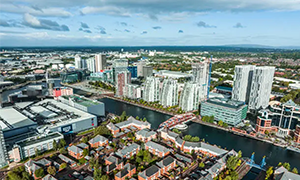
Salford is one of Greater Manchester’s fastest-changing cities, with some 20,344 homes having been built in the past decade and the City Council planning to create 40,000 new homes by 2040. Current property prices stand at around £231,000, with rents exceeding £1,100 per month, reflecting sustained demand. Amidst new developments, however, it is vital to note that the built environment accounts for around 40% of the UK’s carbon footprint, underscoring the need for better, more sustainable housing performance. By 2050, around 80% of the homes that will exist will already have been built, meaning a large percentage of Salford’s property market will comprise older homes. Sustainability is therefore a priority not only for new builds but also for existing ones, with green renovation playing a key role in the city’s future.
Sustainability Now a Key Design Priority
New developments and renovations in Salford are strongly centred on sustainability, particularly through improved insulation, airtight construction, heat pumps, renewable energy, low-carbon materials, energy-efficient communal systems, and higher EPC standards. For instance, the Greenhaus development, which was completed in 2024, comprises 96 Passivhaus apartments—ultra-low-energy, multi-family homes built to strict Passivhaus standards. These homes utilise between 70% and 90% less energy than standard homes owing to features such as thicker insulation, airtight seals, and solar heat capture. They drastically reduce energy bills, while also allowing residents to live comfortably, enjoying benefits such as cleaner air, well-heated homes, and fewer respiratory problems. The Regeneration Framework for MediaCity Phase 2, meanwhile, strongly emphasises low-carbon buildings, sustainable drainage, biodiversity and active travel. These initiatives are strongly echoed in Salford City Council’s regeneration strategy, which highlights sustainable growth as one of its core objectives.
Energy House 2.0 a Pioneer in Low-Carbon Design
Salford is also leading the UK when it comes to building science, thanks in no small part to the University of Salford’s £16 million Energy House 2.0 facility on the Frederick Road Campus. Featuring climate chambers capable of simulating temperatures from -20°C to +40°C, alongside rain, snow, and solar radiation, this world-first lab tests next-generation housing concepts such as Barratt Developments’ and Saint-Gobain’s eHome2, and Bellway’s The Future Home. These prototypes test technologies ahead of the Future Homes Standard—testing mechanical ventilation with heat recovery (MVHR), roof-mounted air-source heat pumps, and infrared heating panels under extreme weather conditions. These experimental projects are also creating skilled jobs. Professional services, such as those offered by engineers and electricians in Greater Manchester, are in demand for everything from testing mechanical ventilation with heat recovery (MVHR) and roof-mounted air-source heat pumps to evaluating infrared heating panels under extreme weather conditions. As such, sustainability goes hand in hand with job creation and economic prosperity.
The Modernisation of Existing Salford Homes
Because many homes in Salford predate modern building regulations, retrofits are vital for improving energy efficiency and comfort. Work is currently being carried out on Victorian and Edwardian terraced homes in areas such as Eccles, Swinton, and Higher Broughton, many of which have ageing electrical setups and suffer from high thermal loss. Renovations are centred on tasks such as insulation, double glazing, solar panels, new heat pumps, and smart heating controls, which help minimise phantom energy loads. Supported by local council initiatives, Warm Homes Grants, and zero-rated VAT on clean technology, these measures are helping residents use dynamic 30-minute time-of-use tariffs.
Embracing Smart Infrastructure
New developments at MediaCity and Colliers Yard are finding new ways to manage energy through features such as smart thermostats and meters, Home Energy Management Systems (HEMS), solar monitoring, EV chargers, and battery storage. HEMS, for instance, connects and controls these homes’ energy devices through a single, smart hub, monitoring real-time electricity use and generation and intelligently adjusting devices to run more efficiently. For instance, HEMS can delay heat pump or electric vehicle charging to off-peak times, or prioritise solar energy use when available. These systems are managed via software dashboards or apps that give residents visibility and control over their energy flow.
Salford is playing a leading role in the search for more sustainable housing solutions. The high-tech research conducted at Energy House and renovations of Victorian and Edwardian homes are enabling the city to reduce costs and energy consumption. Blending smart tech and local retrofits has transformed Salford into a benchmark for other cities seeking to achieve the UK’s goal of reaching net zero by 2050.