Supply chain organizations are under pressure to improve resilience, control costs, manage working capital and deliver consistently against customer expectations. Yet fragmented processes, disconnected data and different operating models across regions can make it difficult to achieve these goals. Global Business Services can help organizations address this complexity by bringing common processes, capabilities and expertise into a more integrated service delivery model.
For Supply Chain Performance, the opportunity extends beyond reducing administrative costs. A well-designed GBS model can improve process consistency, data visibility, analytics and coordination across planning, procurement, logistics and other supply chain activities. This can give supply chain leaders a stronger foundation for making decisions and continuously improving performance.
This article explores how Global Business Services can support Supply Chain Performance, the capabilities organizations can centralize, key performance measures, business benefits and priorities for successful implementation.
What are Global Business Services?
Global Business Services, commonly referred to as GBS, is an enterprise operating model that brings together services, processes and capabilities from multiple business functions into an integrated organization.
GBS can include finance, human resources, procurement, IT, analytics and selected supply chain activities. Unlike traditional Shared Services that may focus on individual functions, Global Business Services typically emphasizes cross-functional processes, common governance and enterprise-wide service delivery.
The objective is to improve efficiency and scalability while providing more consistent services, better data and stronger business support.
What is Supply Chain Performance?
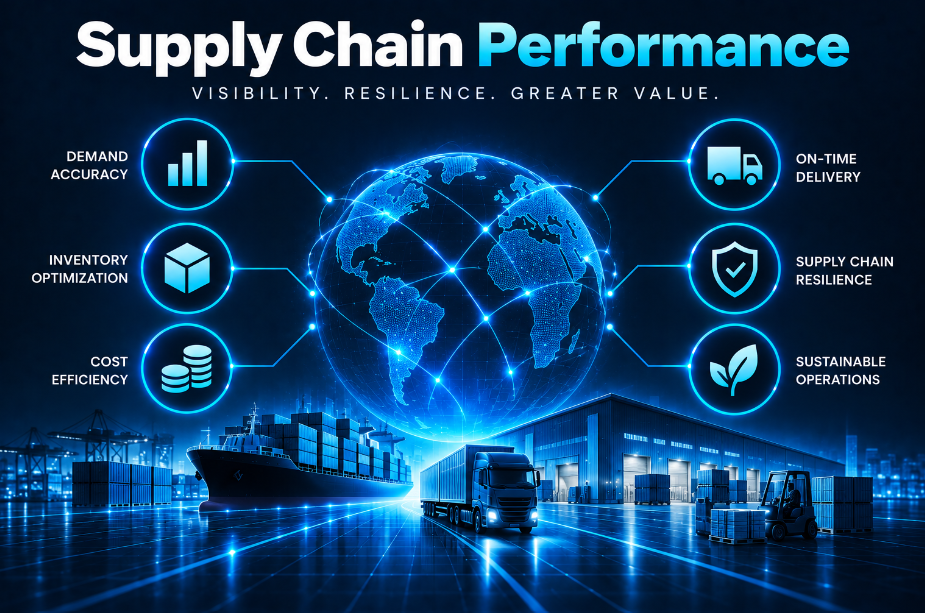
Supply Chain Performance refers to how effectively an organization’s supply chain balances cost, service, working capital, productivity and resilience while meeting business and customer requirements.
It can be evaluated across planning, sourcing, manufacturing, inventory, logistics and fulfillment. Measures may include forecast quality, inventory performance, service levels, logistics costs, supplier performance and process productivity.
No single metric provides a complete view. Strong Supply Chain Performance requires organizations to understand trade-offs across multiple dimensions and how decisions in one area affect outcomes elsewhere.
Why Global Business Services matters for supply chains
Supply chain activities often span countries, business units, suppliers and technology platforms. This complexity can create duplicated work, inconsistent processes and limited visibility into end-to-end operations.
Global Business Services can provide a common service infrastructure for selected activities that do not need to remain distributed across individual business units.
Standardized master data management, analytics, supplier administration, transactional procurement and planning support are examples of capabilities that may benefit from a coordinated model.
By consolidating appropriate activities, organizations can reduce process fragmentation while enabling supply chain specialists to focus more capacity on strategic decisions.
How GBS can support end-to-end Supply Chain Performance
Improving performance requires more than optimizing individual supply chain processes. Organizations need coordination across the end-to-end value chain.
For example, demand changes affect inventory requirements, procurement activity, production capacity and logistics. When information is fragmented across functions, understanding these relationships can take significant time.
Global Business Services can create shared data, analytics and process capabilities that support more consistent decision-making across these areas.
This provides a foundation for supply chain teams to identify performance issues faster and coordinate responses more effectively.
Supply chain capabilities that can fit within GBS
Not every supply chain activity should be centralized. Organizations need to determine which processes benefit from scale and standardization and which require local or specialized expertise.
Supply chain analytics
GBS teams can provide standardized reporting and analytics across demand, inventory, suppliers, manufacturing and logistics.
Master data management
Centralized governance of supplier, material and other supply chain data can improve consistency across enterprise systems.
Planning support
Selected planning activities, data preparation and reporting can be delivered through centralized capabilities while strategic planning decisions remain with business teams.
Procurement operations
Transactional purchasing, supplier onboarding and procurement support can be integrated into Global Business Services.
Logistics administration
Routine freight administration, documentation and reporting can potentially benefit from standardized service delivery.
Supply chain knowledge management
GBS can provide common repositories, processes and tools for accessing operational knowledge across regions.
These capabilities can improve the foundations required for stronger Supply Chain Performance.
Key metrics for measuring Supply Chain Performance
Organizations should use a balanced set of measures that reflects business priorities.
Customer service
Measures such as order fulfillment and on-time delivery can show how effectively the supply chain meets customer commitments.
Inventory performance
Inventory turns, days of inventory and related working capital measures can help organizations understand how efficiently inventory is being managed.
Planning performance
Forecast and planning measures can provide insight into how well organizations anticipate demand and coordinate supply.
Supply chain costs
Organizations can evaluate logistics, planning, warehousing and other operating costs to identify efficiency opportunities.
Supplier performance
Delivery, quality, service and risk measures can provide visibility into supplier contribution and potential issues.
Productivity
Workload and process measures can help leaders understand how effectively supply chain resources are being utilized.
Global Business Services can support consistent data collection and reporting across these performance areas.
Business benefits of GBS for supply chains
When designed around clear business priorities, GBS can improve several dimensions of supply chain operations.
Greater process consistency
Standardized processes can reduce variation between business units and regions while making performance easier to compare.
Improved productivity
Consolidating repeatable activities can reduce duplicated work and allow supply chain professionals to focus on higher-value responsibilities.
Better data visibility
Common data standards and analytics can provide leaders with a clearer view of end-to-end Supply Chain Performance.
Greater scalability
Centralized capabilities can help organizations manage increasing business volumes without duplicating support structures across every region.
Stronger decision support
GBS analytics and expertise can provide supply chain teams with faster access to information needed for planning and operational decisions.
The role of AI and automation in Global Business Services
Artificial intelligence and automation can expand the value of GBS beyond traditional labor efficiency.
Automation can execute repetitive transactional processes, while machine learning can identify patterns across supply chain information. Generative AI can summarize operational data, improve knowledge retrieval and help employees interpret complex information.
AI agents may eventually coordinate multistep activities across enterprise systems, allowing Global Business Services to support more intelligent workflow orchestration.
These capabilities can release additional capacity while improving the speed at which supply chain teams access relevant information.
How GBS can improve supply chain resilience
Resilience depends partly on how quickly organizations can identify disruption and understand its potential impact.
A centralized analytics capability within Global Business Services can help consolidate supplier, inventory and logistics information across regions.
If a supplier issue emerges, teams may be able to identify affected materials, inventory positions and business units faster. This gives supply chain leaders more time to evaluate alternative suppliers, inventory movements or production options.
GBS therefore can support resilience by improving information flow and coordination, even when strategic decisions remain within the supply chain organization.
Best practices for aligning GBS with Supply Chain Performance
Organizations should design Global Business Services around performance outcomes rather than simply moving activities into a centralized organization.
- Identify supply chain processes that benefit from standardization and scale.
- Keep strategic and market-sensitive decisions close to appropriate business teams.
- Establish clear service ownership and decision rights.
- Standardize supply chain data and performance definitions.
- Integrate GBS capabilities with planning, ERP, procurement and logistics platforms.
- Use automation and AI to simplify work rather than replicate inefficient processes.
- Establish performance baselines before transitioning services.
- Measure GBS against supply chain outcomes as well as service delivery metrics.
This approach helps ensure centralization contributes to business performance rather than becoming an objective in itself.
Common implementation challenges
One challenge is determining which supply chain processes should move into GBS. Excessive centralization can reduce responsiveness when activities require local market knowledge or specialized operational expertise.
Data fragmentation can also limit the value of centralized analytics. Organizations may need common definitions and governance before performance information can be compared reliably.
Another challenge is accountability. Supply chain and GBS leaders need clear decision rights so employees understand who owns service delivery, operational outcomes and strategic decisions.
Change management is equally important as employees adjust to new roles, processes and service relationships.
Measuring the impact of Global Business Services
GBS performance should not be measured only through service cost. Organizations should determine whether the operating model is improving broader Supply Chain Performance.
Relevant measures can include process cycle time, productivity, data quality, planning efficiency, inventory performance, service levels and operating costs.
Organizations should establish baselines before implementing changes and monitor whether expected improvements are being realized.
This provides leaders with evidence to determine which GBS capabilities should be expanded, redesigned or further automated.
The future of GBS and supply chain operations
Global Business Services will increasingly evolve from transactional service delivery toward integrated business operations supported by analytics, AI and intelligent automation.
AI agents may coordinate routine activities across procurement, planning, logistics and finance while employees focus on exceptions and strategic decisions.
GBS may also become an important source of enterprise intelligence by consolidating data and analytical capabilities across functions.
For supply chains, this could enable faster identification of performance issues and more coordinated responses across the value chain.
Conclusion
Global Business Services can provide supply chain organizations with standardized processes, scalable capabilities and stronger access to enterprise data and analytics. Its value extends beyond reducing support costs when GBS is designed around end-to-end business outcomes.
Supply Chain Performance depends on coordinated decisions across planning, sourcing, inventory, manufacturing and logistics. Organizations that use Global Business Services to improve process consistency, data visibility and decision support can create a stronger foundation for productivity, resilience and service performance.
The long-term opportunity is to build an integrated service model that enables supply chain teams to spend less time managing fragmented processes and more time improving enterprise performance.