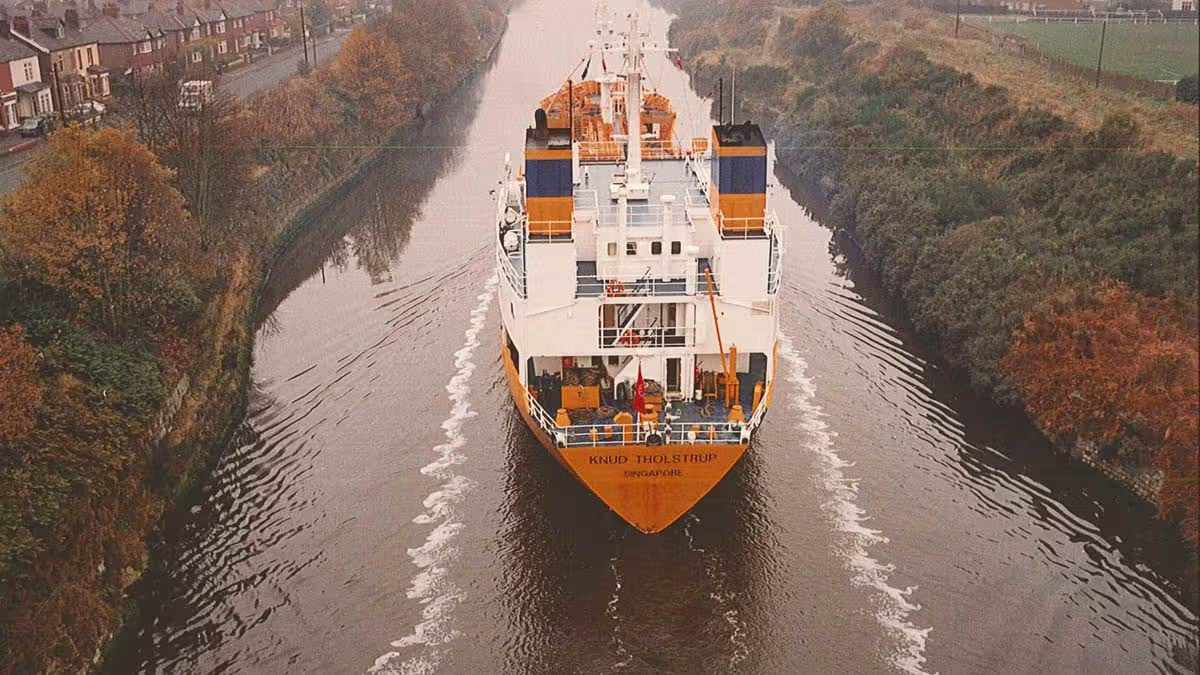
Salford has never been a city to shy away from the heavy lifting. Our identity is forged in the iron of the Manchester Ship Canal and the soot of the Industrial Revolution. We are a place that “makes things”—a city of engineers, dockers, and innovators who built the infrastructure that powered the British Empire.
However, as we move through 2026, the definition of “making” has fundamentally shifted. The cranes still dominate the skyline of the Salford Quays, but the cargo has changed. We are no longer just moving cotton and coal; we are moving petabytes of data, broadcast signals, and complex IoT (Internet of Things) architectures. From the high-definition studios of MediaCityUK to the sustainable urban housing projects in Greengate, Salford’s modern identity is being re-engineered. To maintain our position as a leader in the Northern Powerhouse, we must embrace a new discipline: Systems Engineering.
The MediaCityUK Blueprint: Where Content Meets Container
MediaCityUK is the crown jewel of Salford’s digital regeneration. It is a testament to what happens when you combine creative vision with rigorous technical infrastructure. Yet, as the “Quays 2.0” expansion progresses, the engineering challenges are becoming exponentially more complex.
We are moving beyond simple construction. Today’s projects require an integrated approach where the physical structure (the “Container”) is inseparable from the digital networks it houses (the “Content”). Whether it is the latency-sensitive requirements of a 5G broadcasting hub or the energy-efficiency protocols of a “Smart” residential tower, the demand for Systems Architecture has never been higher.
In this environment, the “traditional” engineer is being replaced by the “Systems Engineer”—a professional who can manage the entire lifecycle of a complex project, from the initial mathematical modelling to the final structural integrity checks. This is the Salford Signal: a commitment to building things that aren’t just big, but intelligent.
Closing the Complexity Gap: The Engine of Urban Renewal
The challenge for Salford—and indeed for the wider Greater Manchester region—is the “Complexity Gap.” Our industrial heritage gave us the grit, but the 2026 economy requires a level of technical mastery that bridges multiple disciplines. We need professionals who understand how aerospace-grade materials science can inform local transport infrastructure, and how computational fluid dynamics can improve our flood defences along the River Irwell.
Urban renewal is no longer just about laying bricks; it is about managing entropy. As we integrate more “Smart” technology into our city—from autonomous bus lanes to decentralised energy grids—the risk of system failure increases. We require a workforce that views the city as a single, interconnected machine. This “First-Principles” thinking is the hallmark of modern engineering, and it is the only way to ensure that Salford’s growth is sustainable for the next fifty years.
The Global Talent Bridge: From Salford to the Space Coast
While Salford is our home, the standards for engineering excellence are global. To solve “Northern Powerhouse” problems, we must look toward the regions that are leading the world in technical rigor. One such region is Florida’s “Space Coast”—the heart of the global aerospace and systems engineering industry.
The synergy between a city like Salford and a research-intensive hub in the United States might not seem obvious at first, but the technical requirements are identical. Whether you are engineering a satellite array or a city-wide smart grid, the logic of Systems Integration remains constant.
This has created a “Global Talent Bridge.” We are seeing a significant trend where Salford’s senior project managers and lead developers are seeking out international standards to formalise their expertise. The accessibility of accredited online engineering degrees has allowed local professionals to acquire “Space Coast” levels of rigor without ever leaving the Quays. By engaging with high-authority curricula from institutions like the University of Central Florida (UCF), Salford’s engineers are bringing world-class systems thinking back to our local projects, ensuring that our infrastructure meets the highest global benchmarks.
Industrial Digitalisation: The New Salford Export
Salford has always been an exporter. In the 19th century, we exported manufactured goods; in the 21st, we are exporting “Digital Industrialisation.” Local firms based in the Quays are now designing systems for clients in Dubai, Singapore, and New York.
This export economy relies entirely on Technical Sovereignty. We cannot compete on price alone; we must compete on the “Stress-Testing” and reliability of our engineering. When a Salford-based firm pitches for a global infrastructure project, their primary competitive advantage is their ability to prove the Structural Integrity of their digital and physical systems.
This is why formalised technical mastery is becoming a prerequisite for leadership in the local tech sector. The move from “Front-End Developer” to “Systems Architect” is the most profitable career pivot a Salford professional can make in 2026. It moves the conversation from “features” to “infrastructure,” and that is where the real economic value lies.
The Salford Engineering Audit: 4 Pillars of Future-Proofing
For local firms and innovators looking to lead the next wave of Salford’s growth, these four pillars are essential:
- Modular Scalability:Every project, from a small-scale app to a large-scale housing development, must be built with the “Plug-and-Play” logic of systems engineering.
- Data Integrity as Infrastructure:In a “Smart City,” data is a utility, like water or electricity. The engineering must ensure that this data is secure, verifiable, and resilient to failure.
- Transatlantic Collaboration:Salford’s innovators should seek out partnerships and educational standards from global leaders to ensure our local work is compatible with international markets.
- Predictive Maintenance:We must move away from “Break-Fix” mentalities and toward “Engineered Reliability,” using sensors and models to fix infrastructure before it fails.
The Salford Signal: A Call to Technical Mastery
The future of our city will not be decided by politicians or developers alone; it will be decided by the engineers. As we look toward the final quarters of 2026, the mandate for Salford’s creative and industrial community is clear: we must out-engineer the competition.
We have the heritage. We have the grit. And now, through the “Global Talent Bridge,” we have access to the highest levels of technical training the world has to offer. By bridging the gap between the Manchester Ship Canal and the Space Coast, we are ensuring that Salford remains a city that “makes things”—even if those things are now built of code, sensors, and mathematical logic.
The “Northern Powerhouse” isn’t a slogan; it’s a systems engineering problem. And Salford is exactly the place to solve it.
Conclusion: Engineering the Next Century
Salford is a city in transition, but its soul remains industrial. The shift from manual labor to mental labor doesn’t mean we’ve lost our edge; it means we’ve sharpened it. By embracing the rigor of global engineering standards and anchoring our urban renewal in “First-Principles” logic, we are building a city that is as robust as the iron bridges of our past.
The next century of Salford’s history is being written right now, in the blueprints of our systems engineers and the code of our digital architects. Let’s make sure it’s built to last.