In earlier times, art and science were considered to be two very different disciplines, one characterized by its emotional and intuitive aspect, and the other being purely based on reason and calculation. However, this dichotomy is now beginning to blur, as joint ventures between both areas create new ways of understanding the world around us. Scientists can be found working in sculpture studios, while astronomers invite composers into their observatories. In addition, this interaction yields new experiences that question our sense of perception and broaden our conceptual approach.
CERN and Contemporary Art: Visualizing the Invisible Universe
At the CERN research laboratory, scientific exploration of subatomic particles has led to an unexpected artistic conversation. Partnerships with visual artists enable difficult physics data to be conveyed as interactive environments, sounds, and mechanical art forms. Rather than merely presenting information in graphs and formulas, viewers are presented with depictions of collisions and cosmic events rendered through the use of light and movement. Through this process, intangible ideas such as dark matter and subatomic decay can be felt through an emotional connection. By translating invisible processes into tangible experiences, artists working alongside physicists expand public engagement with fundamental questions about the structure of the universe.
NASA and Creative Exploration: Art Beyond Earth’s Horizon
At NASA, collaborations with artists have made space exploration more humane. Artists who are painters, musicians, and digital artists create artwork from space images, space data, and the experiences of astronauts. The collaboration changes people’s perceptions from one of technology and science to one of an artistic experience of being in space and seeing the views of Earth or Mars from up above. The idea behind artistic residencies at NASA is to make storytelling a counterpart to scientific reporting about space exploration. Through this synergy, space becomes not only a subject of study but also a source of cultural reflection and imagination.
Immersive Art Spaces and Miami’s Cultural Laboratory
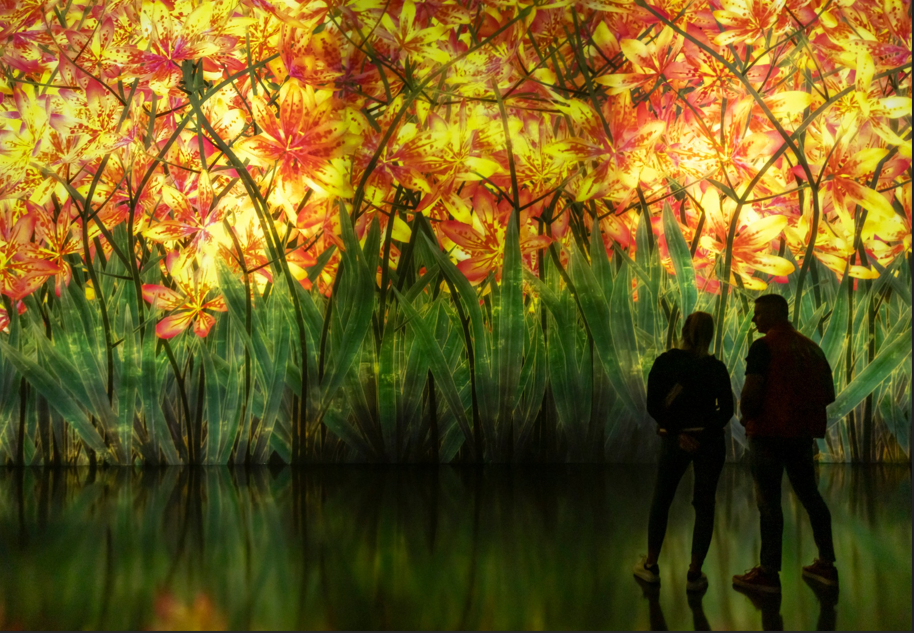
It is also becoming apparent that world-famous artists create immersive spaces for their audiences to experience a continually changing landscape of senses rather than static art pieces. This trend can be seen in many interactive art spaces created in Miami, which blend elements of architecture, projection, and live performances. One of these places is called Superblue, which features works by famous international artists. In this setting, visitors encounter awe-inspiring immersive art experiences at Superblue that transform perception through light, sound, and spatial design. Miami’s broader cultural landscape reinforces this movement, positioning the city as a laboratory for experiential creativity where artistic practice and technological innovation continuously intersect.
MIT Media Lab: Engineering Imagination Through Hybrid Thinking
MIT Media Lab serves as an intersection where engineering, design, and experimental art come together. Engineers and artists collaborate in designing devices that react to human actions. Many of these projects defy clear definitions of tools or art objects, leading to creations that can grow and adapt to their environment. This context allows for risk-taking from multiple angles, resulting in prototypes used both as science laboratories and art pieces. It creates a cycle of inspiration, where one field feeds into another, leading to innovation in both areas.
BioArt and Living Systems: Collaboration Inside Cellular Worlds
In the realm of bio-art, institutions like SymbioticA delve into the use of living beings as materials for artistic creation. Collaborating with scientists, artists generate tissues and play around with cells in order to create living sculptures that question issues of ethics and identity and the very nature of life itself. By seeing biology not just as information but as a constantly evolving medium, practitioners get to experience biology in an entirely different manner. The studio thus becomes a laboratory and gallery space where living things are grown rather than painted. Through this convergence, viewers confront unfamiliar perspectives on life, mortality, and biological agency.
Artificial Intelligence and Generative Creativity: Machines as Co-Authors
Development in machine learning technology has created innovative modes of collaboration between human beings and computers for creating art. Computer science researchers from companies like Google DeepMind create systems that are able to produce visual arts, sound, and narratives. These artists collaborate with such computer programs while receiving unexpected results due to the process of inference on the side of the machine. The outcome of the collaboration represents an interesting approach to authorship that combines human intentions and computer inferences during the creative process.
The blending of imagination and science has had a lasting impact on the way humans understand the world. Whether in laboratories, art studios, or the digital realm, the partnership brings about novel modes of communication that cross all barriers of discipline. Rather than simply serving as illustrations of scientific concepts or as decoration for data, they help us to see things differently. As art takes on computing and science incorporates storytelling, a common space for discovery is created.