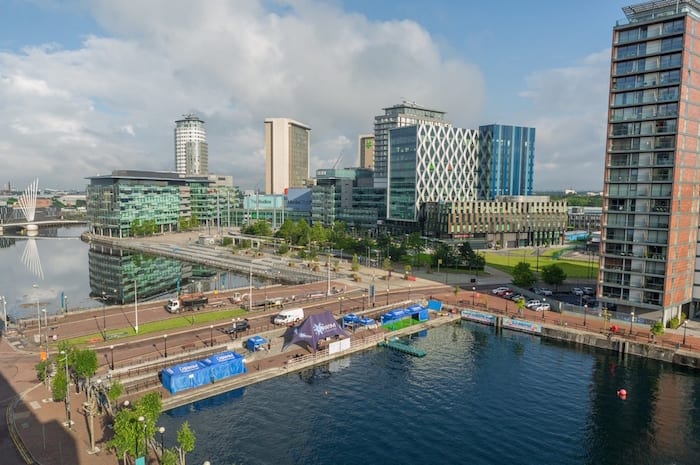
Family life in Greater Manchester looks different now to how it did before the old docks at Salford Quays were rebuilt. Land that once handled cargo carries flats, offices, studios, a tram line and a shopping centre, and the people using it are no longer only workers passing through. Households with young children live in buildings designed with couples and commuters in mind, and the pressure that creates has spread into school places, nursery hours and waiting lists for family support.
Most coverage of the Quays deals in floorspace and investment totals, which says very little about raising children nearby. Rent, childcare, the school run and the question of who helps when a family is struggling all work differently now than they did fifteen years ago.
Who actually lives around the water now
Many of the apartments built in the early waves went to single people and couples, plenty of whom have since had children and stayed put rather than moving out towards Worsley or Prestwich. Salford’s population grew faster than anywhere else in the North West between the last two censuses, and the framework for the next stage adds around 3,000 more homes to the area. Two-bedroom flats now hold families who would once have been counted as future movers, which matters far more to schools and clinics than the skyline does.
Services that grew alongside the population
Recruitment across children’s services has widened as a result, and the agencies handling fostering in Manchester draw carers from Salford, Trafford and the boroughs around them rather than a single postcode. Nurseries, GP practices and dentists have stretched in the same way to cover people who weren’t in anyone’s projections a decade ago. Families moving here often find a service exists but sits further away than expected, so it pays to check travel times on a weekday morning rather than assuming the nearest option is genuinely near.
Schools, childcare and the weekly routine
Demand for primary places climbed through the 2010s and then fed into secondary, which is why parents around the Quays discuss catchments in a way residents of the old docks never had to. Most people weighing up a move work through a short list.
- Whether the nearest primary is walkable with a buggy and a scooter in tow
- What wraparound childcare costs once tram fares are added on top
- How far the nearest secondary sits if siblings are split across two schools
- Whether there’s green space that still works in February, not only in July
What the next phase could mean
Council papers on the next stage of building at the site set out more homes and more commercial floorspace than earlier versions did. For families already here, what counts is how much of that housing suits three or four people rather than one, and whether schools and health services arrive at the same pace as the flats.
Greater Manchester’s family population has moved towards the water faster than the services around it, and the gap is closing gradually rather than neatly. Anyone choosing a neighbourhood here would learn more from a Tuesday morning than a Saturday afternoon, when the tram, the nursery run and the queue at the surgery say more than any masterplan does.