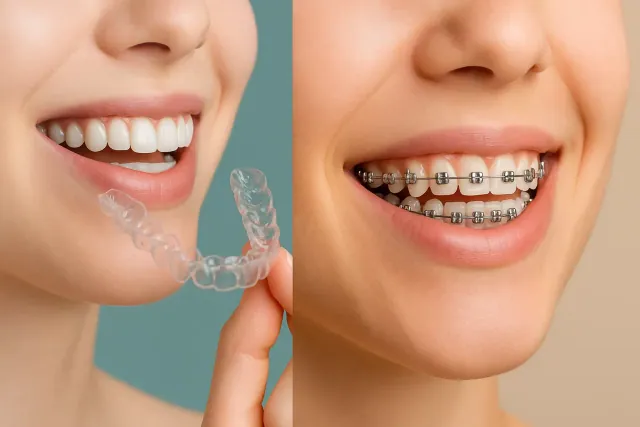
For most straightforward adult cases, Invisalign and fixed braces will get you to a similar finish, and the real decision comes down to lifestyle, discipline and budget rather than clinical superiority. Fixed braces still hold an advantage where teeth need significant rotation, extrusion or root movement, particularly after extractions. Aligners hold the advantage on appearance, hygiene and the fact that you can take them out.
The part that surprises people is how much the outcome depends on the person rather than the appliance. Aligners only work while they are in your mouth, and the standard instruction is 20 to 22 hours a day. Fixed braces remove that variable entirely, which is why an orthodontist assessing an adult who travels constantly, eats out several times a week or simply knows they will forget, may quietly steer them towards brackets.
Which Cases Suit Aligners and Which Still Need Brackets
Clear aligners handle mild to moderate crowding, spacing, mild relapse after childhood braces and a lot of arch levelling perfectly well. Small attachments (tooth coloured bumps bonded to the enamel) give the plastic something to push against, and interproximal reduction, where a fraction of a millimetre of enamel is polished from between teeth, creates space without extractions. Between those two techniques, aligner systems now cover far more than they did a decade ago.
Where they still struggle is anything demanding heavy root control. Closing large extraction gaps, uprighting badly tipped molars, correcting substantial skeletal discrepancies or bringing down an impacted canine all tend to go more predictably on a fixed appliance, because a wire in a bracket slot delivers continuous three dimensional control that a removable tray approximates rather than replicates.
Adults also arrive with complications that teenagers rarely have: existing crowns and bridges, missing teeth, gum recession, previous root canal treatment, worn edges from years of grinding. Aligners bond poorly to some ceramic surfaces, which affects attachment placement. Periodontal health matters more too, since moving teeth in bone that has already receded requires lighter forces and closer monitoring whichever appliance is used.
What Each Option Costs in the UK
Private fixed metal braces for a full adult case commonly land between £2,000 and £4,000, with ceramic (tooth coloured) brackets adding roughly £500 to £1,000 on top. Invisalign is usually quoted between £2,500 and £5,500 depending on how many aligners the case needs, and single arch or short course versions sit lower, often £1,500 to £2,800. Lingual braces, fitted behind the teeth, are the expensive outlier at £5,000 to £8,000 because every bracket is custom made.
Those bands move with geography and with who is treating you. A specialist orthodontist in a major city generally charges more than a general dentist offering aligners as part of a broader practice, and the gap between a central London fee and a regional one can be 30 to 40 percent for identical treatment. Neither is automatically better value. What matters is how many cases the clinician has finished, not the postcode on the door.
Watch what the fee includes. Some quotes cover refinement aligners (extra trays ordered when the teeth do not track exactly as planned, which happens in a meaningful share of cases), retainers and a year of review appointments. Others price those separately, and finding out afterwards that a set of retainers costs another £300 is a poor way to end treatment. Payment plans spread over 12 to 24 months are standard for both options now.
How Long Treatment Takes and How Often You Attend
Mild adult cases finish in six to nine months on either system. Moderate crowding typically runs 12 to 18 months, and complex work involving extractions or bite correction can reach two years or beyond regardless of which appliance you choose. Anyone promising a full correction in three months is either treating something very minor or straightening only the six teeth you see when you smile, which is a cosmetic exercise rather than orthodontics.
Appointment patterns differ more than total duration. Fixed braces need adjusting roughly every six to eight weeks, and each visit takes 20 to 40 minutes. Aligner patients change trays at home every seven to ten days and often attend only every eight to twelve weeks, sometimes with remote monitoring by phone scans in between. For someone whose work makes daytime appointments awkward, that difference is worth real money.
Breakages skew the maths. A dislodged bracket or a poking wire needs an unscheduled visit, and over an eighteen month course most people have at least one. A lost aligner is usually solved by wearing the previous set again and moving on, though clinics such as Harley Street Dental Studio will normally want to see you promptly to check that the sequence has not slipped. Neither problem is serious. Both are inconvenient at the wrong moment.
What Each One Is Actually Like to Live With
Aligners are almost invisible from conversational distance, which is the main reason adults choose them. They come out for meals, so nothing is off limits, and brushing and flossing continue as normal. The trade offs are less publicised: a mild lisp for the first week or two, dry mouth, the discipline of removing them for anything other than water, and the reality that a working day with lunch, coffee and a couple of snacks eats into your wear time quickly.
Fixed braces are visible, though ceramic brackets soften that considerably and lingual braces hide them altogether. The compensation is that you fit them and forget them. There is no daily decision to make, no case to lose in a restaurant, and no risk of treatment stalling because a busy fortnight got in the way. The genuine downsides are dietary (hard and sticky foods can break brackets), the ulceration of the first fortnight, and the extra hygiene effort, since research has consistently linked poor brushing around brackets with white spot decalcification that can outlast the braces themselves.
Professionally, most adults find either manageable. Presenting and client facing work is where aligners earn their premium, but plenty of people in those roles wear ceramic brackets without much comment after the first week.
Why Retainers Decide Whether Any of It Lasts
Teeth drift for life. That is not a failure of treatment, it is biology, and orthodontic literature has long shown some degree of relapse in untreated cases regardless of appliance. Whatever you choose, the finish line is a retainer, and the honest expectation is nightly wear indefinitely rather than for a tidy twelve months.
Most adults end up with a combination: a thin wire bonded behind the lower front teeth and a clear removable retainer worn overnight. Bonded wires can debond silently, so they need checking annually. Clear retainers wear out and typically need replacing every two to four years, which is a small recurring cost worth building into your thinking now rather than discovering later.
Before committing, ask to see the full digital treatment plan and specifically what happens to your bite, not just your front teeth. A simulation that produces beautifully aligned incisors while leaving the back teeth meeting badly is a common source of disappointment, and it is far easier to question at the planning stage than after twenty aligners.
The other question worth asking is what the clinician will do if the teeth stop tracking. Every experienced practitioner has cases that need a mid course correction, and the ones who answer that question comfortably, with a plan involving refinements or a switch to fixed appliances for a stubborn tooth, are usually the ones you want holding the file.