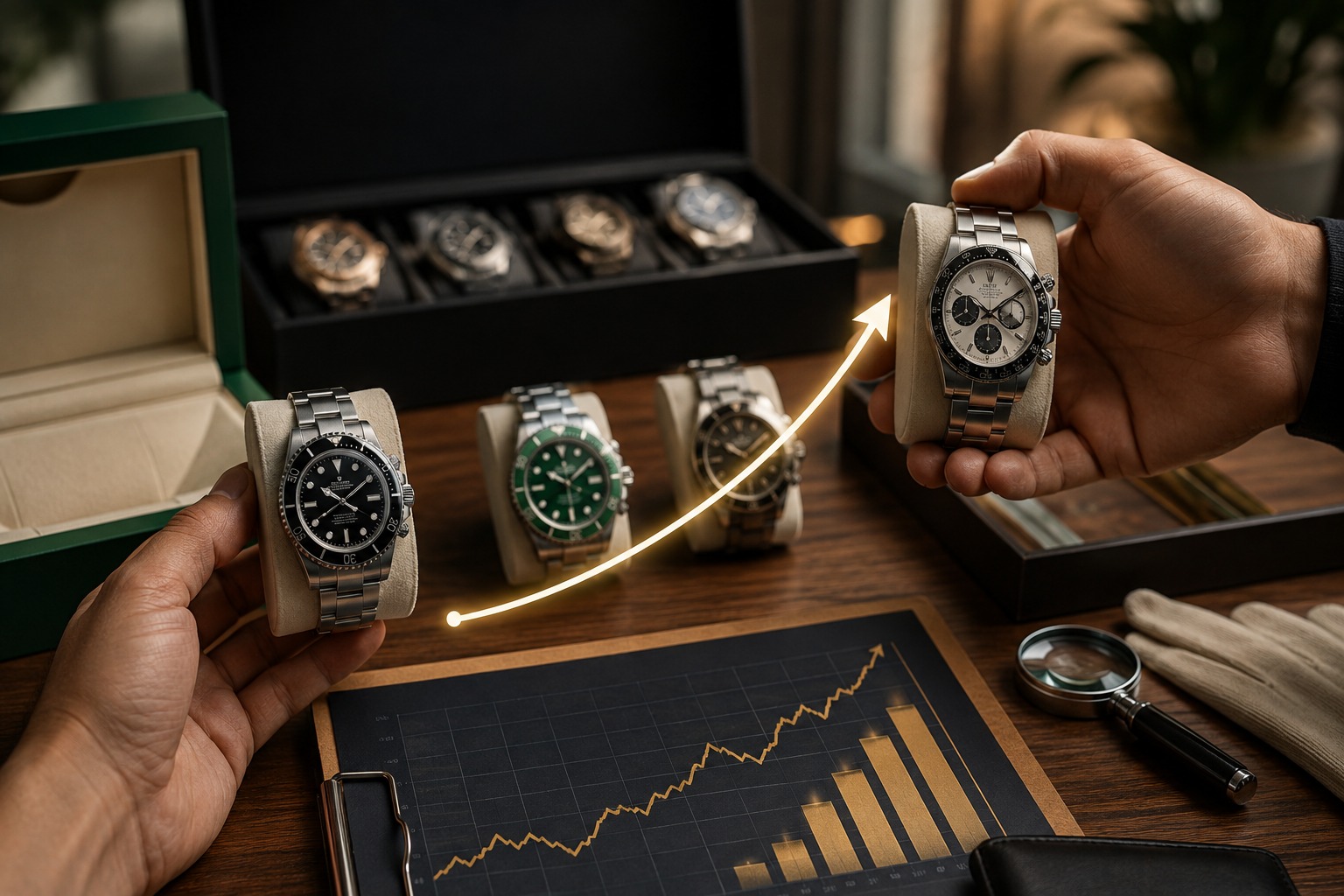
Most collectors reach a point where a watch they loved at purchase starts to feel like a placeholder. Not because the watch changed, but because their taste did. Trading up is the natural next step, but the process is far less straightforward than it looks on paper. Get the sequencing wrong, mis-read the market, or walk into a sale without understanding what dealers actually look for, and you can easily leave thousands on the table.
This guide walks through the full picture: when a trade-up makes financial sense, how to time the market, what buyers and dealers are really evaluating when they make an offer, and the mistakes that consistently cost sellers real money.
When Trading Up Actually Makes Financial Sense
Not every watch deserves to be traded. Before deciding to sell, it helps to think about the piece objectively, separate from whatever emotional weight it carries.
The clearest case for trading up is when your current watch holds strong secondary market value relative to what you paid. References like the Rolex Submariner, Daytona, and GMT-Master II have historically retained or appreciated in value, which means a well-timed sale can fund a meaningful portion of a more significant acquisition. Patek Philippe and Audemars Piguet pieces in desirable references tend to behave similarly.
The harder case is when you’re sitting on a piece that has depreciated. Generic dress watches from mid-tier luxury brands, or anything with condition issues, tend to underperform at resale. If a watch is worth substantially less than you paid, selling at this point compounds the loss. In that scenario, holding and waiting for a more favourable position can make more sense than rushing the process.
A useful mental framework: calculate the actual cost per year of ownership. If you paid £8,000 for a watch four years ago and can sell it today for £7,200, that watch effectively cost you £200 per year to own. That’s a very different framing than “I’m taking a £800 hit.”
Reading the Market Before You Sell
Watch market values fluctuate more than most people expect. Grey market prices for Rolex Sports models dropped noticeably through 2022 and 2023 after several years of historic highs. Anyone who sold at peak 2021 prices secured returns that may not be available again for years.
The practical takeaway: tracking secondary market pricing over a period of months before committing to a sale gives you a much clearer sense of whether you’re at a high, a low, or somewhere in the middle.
A few reliable signals to monitor:
- Chrono24 and WatchCharts data for live pricing across references
- Auction results from Phillips, Sotheby’s, and Christie’s, which reflect what motivated buyers actually pay
- Dealer asking prices across multiple reputable sources, which help bracket realistic sale expectations
- Volume of available listings for your specific reference, since an oversupply of a given model tends to compress offers
Dealers and well-connected buyers often have a clearer read on where prices are heading than the average seller. Building a relationship with a trusted source before you’re ready to sell gives you access to that kind of market intelligence rather than going in cold.
What Dealers Actually Look For When Making Offers
Understanding the dealer’s perspective is one of the most underrated advantages a seller can have.
Dealers buy to resell. That means every offer they make has to account for their cost of acquisition, authentication, photography, marketing, financing, and margin. The offer you receive will always sit below retail secondary market pricing because it has to. That is not a sign of bad faith; it is simply how the business works.
What dealers look for when evaluating a piece:
- Completeness of set: Original box, papers, hang tags, and links dramatically improve offer values. A Rolex Submariner with a complete set can command 10 to 20 percent more than the same watch sold without documentation.
- Dial originality: Refinished or repainted dials reduce collector value substantially. Dealers will flag any dial work immediately.
- Service history: Documented servicing from authorised service centres supports authenticity and condition claims.
- Reference and configuration: Desirable references sell faster and command better offers. A platinum dial Daytona is not the same conversation as a base entry model.
- Condition and case sharpness: Polished cases on sport watches typically reduce value among serious collectors. A watch with original unpolished surfaces will generally attract a stronger offer.
The team at Wrist Aficionado approaches buying with exactly this lens. Every piece is assessed for authenticity, condition, and completeness before an offer is made, which means sellers who come prepared with full documentation typically secure more competitive pricing.
Sequencing the Transaction to Avoid Being Caught Out
One of the most common mistakes in a trade-up is poor sequencing. Sell your watch before you have a clear path to the next acquisition, and you may find yourself with cash but no watch. Buy the next piece before selling, and you’re temporarily carrying two watches and the financial exposure that comes with it.
Neither scenario is ideal, but there are ways to manage the transition cleanly.
Option 1: Sell first, then buy. This is the lower-risk approach financially. You know exactly what you have to work with before committing to a purchase. The risk is that the specific piece you want may sell before your funds arrive.
Option 2: Identify the target piece before you list your current watch. If you’re working with a dealer who has both a buy and a sell function, you can sometimes negotiate a near-simultaneous transaction. This dramatically reduces the window where you’re either over-exposed or without a watch.
Option 3: Use a sourcing service. For collectors chasing a specific reference that isn’t readily available, a sourcing service can run parallel to your sale process. While your watch is being evaluated and sold, the search for your next piece is already underway. Services like the “Find a Watch” function that some specialist dealers offer are built precisely for this.
Browsing a curated watches collection from a specialist dealer before you sell is a practical way to calibrate your expectations and confirm that the piece you want is achievable within your likely budget, rather than discovering a significant gap after the sale is already done.
Mistakes That Cost Sellers Real Money
Even experienced collectors make avoidable errors when selling. A few of the most common:
Accepting the first offer without comparison shopping. Offer values vary meaningfully across buyers. Getting two or three independent offers before deciding is standard practice in any other high-value transaction. It should be standard practice here.
Selling at the wrong time in the price cycle. If secondary market prices for your reference are in a documented trough, waiting three to six months can sometimes recover a significant percentage of value. Not always, but often enough to be worth considering.
Neglecting pre-sale presentation. A watch with a grimy bracelet, a fogged crystal, or mismatched paperwork tells a poor story before an offer is even discussed. A professional service can be worth the cost if it meaningfully improves condition. Though note: for sport watches, original condition typically beats a post-service polish.
Overestimating what “like new” means. Sellers often describe condition more generously than buyers interpret it. Being honest about wear, scratches, or bracelet stretch upfront builds credibility and avoids offer revisions after inspection.
Ignoring tax implications. In various jurisdictions, significant gains on luxury asset sales can be taxable. It is worth getting clarity on this before completing a transaction, particularly for watches that have appreciated substantially.
Key Takeaways
- Trade-up timing matters enormously. Selling during a market high and buying during a relative low is achievable with patience and proper market tracking.
- A complete set (box, papers, original accessories) can add 10 to 20 percent to your offer value. Gather and preserve documentation from the day you buy a watch.
- Understand the dealer’s cost structure before interpreting an offer as low. The gap between offer price and retail secondary pricing reflects operating costs, not bad faith.
- Sequence the transaction carefully. Identify your target piece before or simultaneously with selling, not after.
- Get multiple offers. The difference between the highest and lowest offer for the same watch is often meaningful enough to justify the time.
FAQ
How do I know if my watch is worth selling now or if I should wait? Track secondary market pricing for your specific reference across platforms like Chrono24 and WatchCharts over several months. If prices have been declining steadily, waiting may recover value. If you are near a local high relative to recent history, it can be a reasonable time to sell.
Will a dealer offer me less than a private buyer would? Generally, yes. A private buyer does not have the overhead a dealer carries, so they can sometimes pay more. However, private sales carry higher risk, require more effort, and offer no recourse if something goes sideways. The price difference is often the cost of convenience, security, and speed.
Does having a full set (box and papers) really make that much difference? For most desirable references, yes. Collectors place real value on completeness, and dealers know that a complete set resells more easily and at a higher price. The premium varies by brand and reference, but 10 to 20 percent is a realistic range for sought-after models.
How long does a typical trade-up transaction take from start to finish? It depends on how quickly your current watch sells and how readily available your target piece is. A dealer-assisted simultaneous buy and sell can sometimes be completed in a matter of days. A private sale followed by sourcing a specific grey-market reference could take weeks or months.
What is the biggest mistake first-time sellers make? Underestimating the importance of pre-sale preparation. Sellers who arrive without documentation, with condition issues they haven’t disclosed, or without a clear sense of market value consistently receive lower offers and have less negotiating power. Doing the homework before the conversation starts changes the dynamic significantly.
Final Thought
Trading up is one of the smartest strategies in a long-term collecting journey, but it rewards preparation more than impulse. Knowing your watch’s true market position, understanding what a buyer needs to see, and sequencing the transaction thoughtfully are what separate sellers who feel satisfied with the outcome from those who feel like they left something on the table.
The secondary market for fine watches is active, nuanced, and full of opportunity for collectors who approach it seriously. That starts with treating the sell decision with the same care you gave the original purchase.