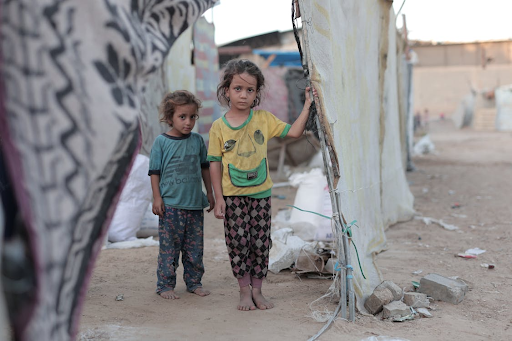
When conflict disrupts a child’s life, school is often one of the first things to disappear.
Classrooms close, teachers are displaced, buildings are damaged, and families are forced to move with little warning. In many cases, education stops quietly, not because it matters less, but because survival takes priority.
Yet the absence of school affects far more than academics. For children living through war, education often provides the only sense of routine left. It creates structure in the middle of uncertainty, offers protection from exploitation, and gives children a place where life feels temporarily normal again.
According to UNESCO, more than 224 million crisis-affected children worldwide need support to access quality education. Many of them are growing up in places where learning is interrupted for years, not weeks.
In this context, kids in war are not only losing lessons, but they are losing stability, confidence, and the chance to imagine a future beyond conflict.
Across humanitarian response, long-term recovery becomes stronger when education is treated as essential rather than something that can wait until after the crisis.
The impact becomes clearer when we look at what education actually gives children during a crisis.
Here are 6 reasons explain why education in conflict zones often becomes one of the strongest forms of protection during a crisis.
1. School creates stability when everything else feels uncertain
Conflict removes routine very quickly.
Families leave home suddenly. Familiar places disappear. Children lose the daily structure that once made life predictable.
That uncertainty affects more than comfort. It affects emotional safety.
School creates something simple but powerful, routine. A regular place to go, familiar faces, and a sense that life still has order even when everything outside feels unstable.
This is one reason education in emergencies matters so much. It helps children hold on to normalcy when normal life has been disrupted.
Sometimes recovery begins with something as basic as knowing what tomorrow will look like.
2. Education protects children from exploitation
When children are not in school, the risks that surround them multiply. Without it, they become more vulnerable to child labour, trafficking, early marriage, and forced recruitment, exploitative practices that tend to spread during conflict.
School keeps children connected to safer spaces and trusted adults, offering a layer of protection that extends well beyond the classroom. It also gives families a way to invest in their children’s long-term well-being, rather than being pushed toward short-term decisions that put children at risk.
Schooling for displaced children is often the only support structure still available, making access to education a critical part of any humanitarian response. Protection is not always physical. Keeping a child in school can be enough to shield them from serious harm.
3. Learning helps children rebuild confidence
Most children, as a result of the war, have reshaped their perception of themselves.
Learning helps children rebuild their confidence and provides a sense of long-dormant hope. It is a reminder that confidence was not lost completely.
Not only does education provide children with the knowledge and skills that were erased by the war, but it also allows children to overcome the system of war that had people stuck, especially children.
According to UNICEF, access to safe learning environments significantly improves emotional well-being and resilience for children affected by crisis.
School does not remove trauma, but it helps children see themselves as more than victims of it.
4. Refugee children need education to rebuild belonging
Displacement often creates a second layer of loss.
Children leave not only their homes, but also their friendships, language familiarity, and sense of belonging. Starting over in a new place can feel isolating.
This is where refugee education access becomes critical.
Education helps displaced children reconnect with the community. It creates friendships, builds confidence in new environments, and reduces the feeling of being permanently outside of normal life.
Without that access, displacement becomes more than a temporary movement. It becomes a long-term exclusion.
School helps children feel that they still belong somewhere.
5. Communities recover faster when children stay learning
Education is not only about individual children. It shapes how entire communities recover after conflict.
When children remain connected to learning, families hold on to hope more easily. Parents make decisions differently when they believe their children still have a future.
Teachers, schools, and local education systems also help communities rebuild trust and shared responsibility.
Recovery becomes stronger because education creates continuity between crisis and what comes next.
Without learning, rebuilding often stays focused only on survival. With education, recovery begins to include possibility.
That difference matters over generations.
6. Education gives children something war cannot take away
Conflict takes many things quickly – homes, safety, routines, and often childhood itself.
Education offers something different. It gives children knowledge, confidence, and the ability to imagine a life beyond the present crisis.
That kind of hope is not abstract. It shapes real decisions.
Children who stay connected to learning are more likely to remain engaged, avoid harmful coping paths, and see themselves as part of a future worth building.
Education is not simply preparation for later. In conflict zones, it is part of survival now.
Sometimes the strongest path forward begins with a child returning to school.
Closing Thoughts
Education in conflict settings is often treated as something to restore later, after food, shelter, and immediate safety are addressed.
But for children living through war, learning cannot wait.
School provides protection, emotional stability, and the belief that life can move forward instead of staying trapped in crisis.
That is why education must be treated as a core part of humanitarian response, not an afterthought.
For many children, the classroom is not only where they learn. It is where recovery begins.