A small home can feel messy before anyone has even stepped fully inside. Shoes gather near the door. Bags land on the floor. Keys disappear into a spot that always seems to require a 30-second search. The entryway slowly becomes a daily drop zone for everything that hasn’t yet found a proper place.
For homes without a dedicated mudroom, a wide hallway, or a built-in front closet, the entryway has to work harder than the floor plan suggests. It needs to welcome guests, support busy mornings and after-work returns, hold the small daily essentials of a household, and stay visually calm — often within just a few square feet.
The good news is that a more organized entryway does not require a renovation. With the right storage pieces, a few simple daily systems, and one or two thoughtful design choices, even a compact entry can feel cleaner, calmer, and more genuinely welcoming. The best entryway storage ideas are not about adding more furniture. They’re about making the right small piece do more work.
Why the Entryway Matters More Than People Think
The entryway sets the tone for the rest of the home. It is the first thing people see when they walk in and the last thing they touch on the way out. When it feels cluttered, the whole home reads less organized — even if the bedroom and living room are perfectly tidy.
This is especially true in small homes and apartments. Without a separate mudroom, coat closet, or garage transition area, shoes, mail, backpacks, umbrellas, dog leashes, and packages all end up competing for the same small zone. Whatever does not have an obvious place ends up on the floor.
A working entryway system does three things:
- It keeps daily items easy to reach when you actually need them.
- It hides what does not need to be visible the moment a guest walks in.
- It leaves enough open floor space for people to move comfortably.
The goal is not a magazine-perfect foyer. The goal is a repeatable system that smooths out everyday life — quickly enough that nobody has to think about it.
Start With the Shoes: The Biggest Source of Entryway Clutter
Shoes are usually the first problem to solve. They spread quickly, take up floor space, and make even a clean entryway feel crowded. A handful of pairs is enough to make a small entrance look chaotic.
Open shoe racks are convenient, but they rarely solve the visual problem. Shoes are still on display. Different colors, shapes, and heel heights create instant visual noise — sneakers, work shoes, sandals, kids’ shoes, and slip-ons rarely look neat together, no matter how carefully the rack is arranged.
That is why closed shoe storage tends to work better in small homes. It gives shoes a defined place while keeping them out of sight.
Before choosing storage, think through:
- How many pairs need to be near the door every day (not in total — just the daily ones).
- Whether boots, ankle boots, or larger shoes need taller compartments.
- Whether the cabinet has to fit a narrow hallway or sit close to a doorway.
- Whether the cabinet top should hold keys and mail, or stay decorative.
- Whether the front door or a closet door swings into the same space.
A shoe cabinet should not just hold shoes. It should make the entryway easier to use first thing in the morning and easier to walk into at the end of the day.
Why Closed Shoe Storage Works Better in Small Homes
Closed storage is one of the simplest ways to make a small entryway feel more organized. When shoes are tucked behind doors or panels, the room reads calmer the moment you step in. There is one piece of furniture, one clean surface, and the everyday mess is invisible — even when, in fact, it is still there.
A shoe cabinet with doors also creates a cleaner first impression for guests. Instead of walking into a pile of shoes, they see a thoughtful piece of furniture. The cabinet can double as a quiet landing spot for keys, mail, or a small lamp, while the shoes stay safely tucked away.
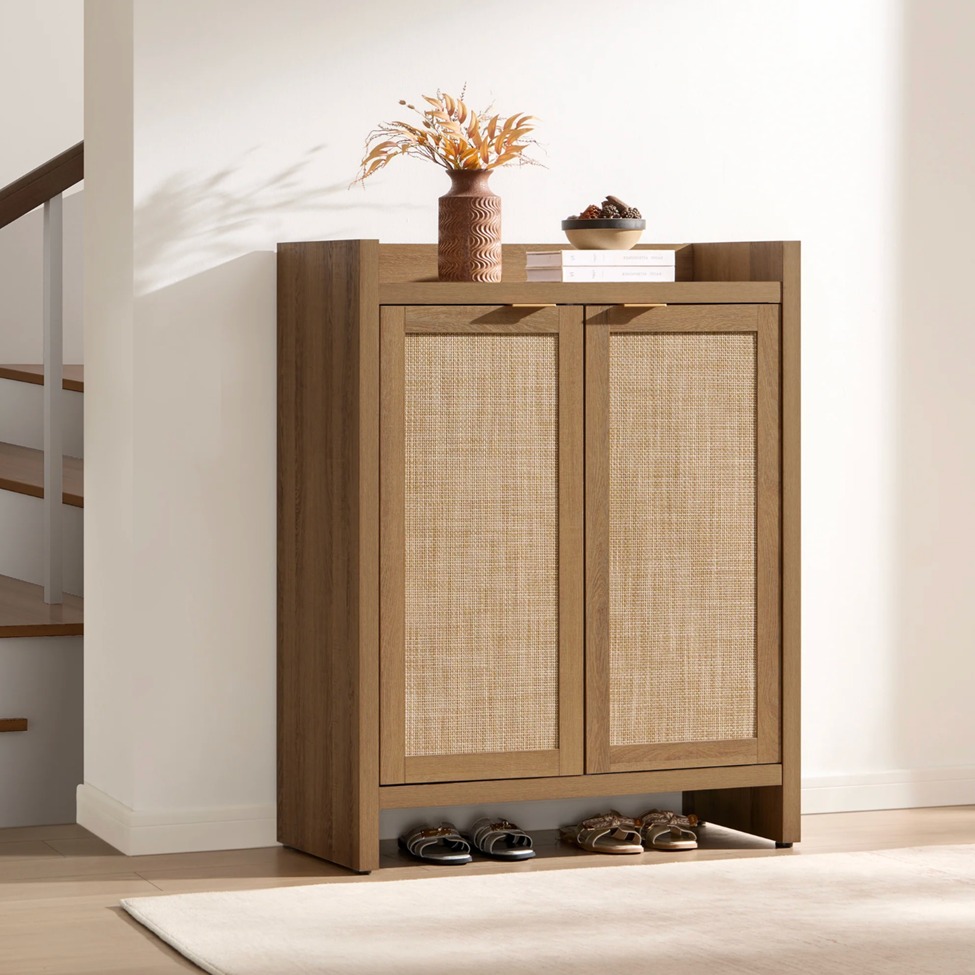
For homes where shoes tend to take over the front door, the Savanna 24-Pair Rattan Shoe Cabinet is a strong example of how closed storage can hide daily clutter while adding warm texture to an entryway. A 24-pair capacity covers most households comfortably — daily shoes for two adults, a child or two, plus a season’s worth of overflow — and the rattan-fronted doors keep the piece from reading as purely utilitarian.
That balance matters in small homes. Storage should solve the problem without making the entryway feel cold, boxy, or aggressive in a tight space.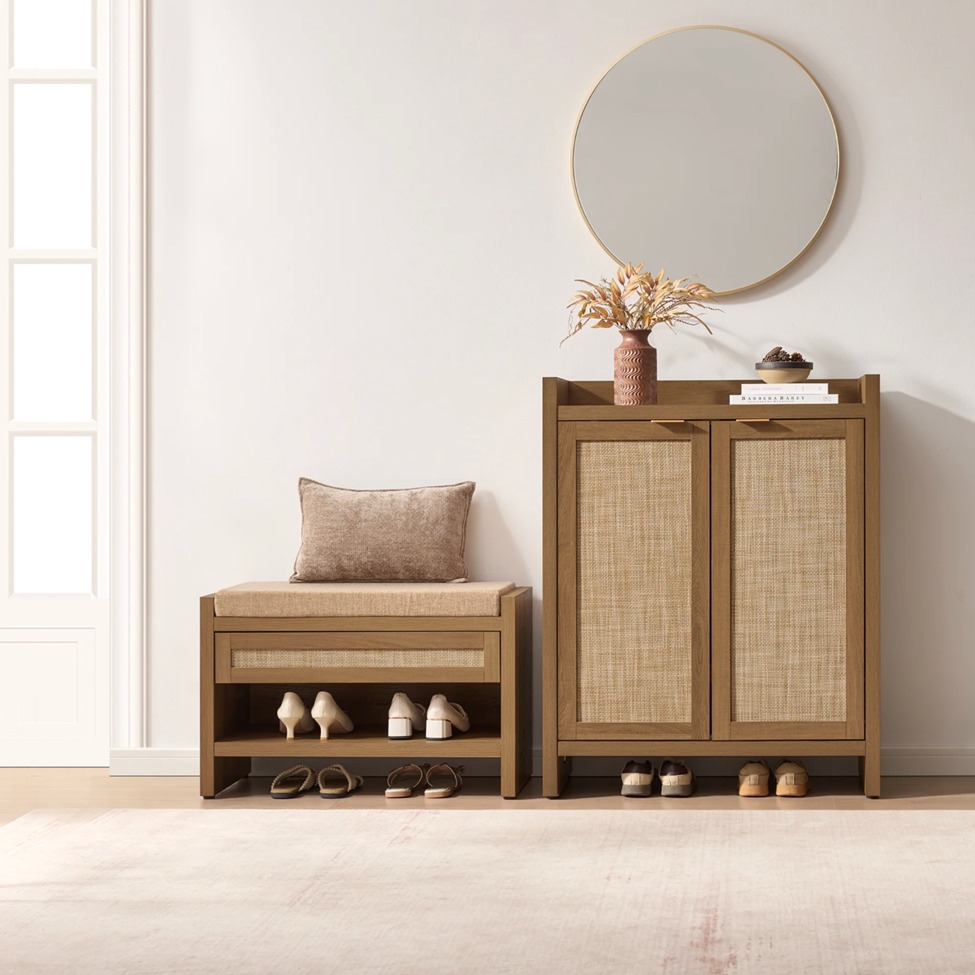
Choose Slim Furniture That Keeps the Walkway Clear
In a compact entryway, furniture depth is just as important as storage capacity. A cabinet that holds many pairs is not helpful if it blocks the path from the front door to the rest of the home, or makes the corridor feel like a squeeze.
Before buying any entryway storage piece, measure the available depth — wall to wall, including baseboards. Check how far the front door swings open. If there is a hallway, measure the walking path with the future furniture footprint mentally placed. A few inches can make a significant difference, especially in older homes where corridors are narrower than expected.
| Entryway Problem | Better Storage Choice |
| Narrow hallway | Slim shoe cabinet (shallow depth) |
| Shoes visible at the door | Closed-door shoe cabinet |
| Family-sized shoe pile | Higher-capacity cabinet (24+ pairs) |
| Need a place to sit | Shoe bench with under-seat storage |
| No surface for keys | Cabinet with usable top |
| Small apartment, no built-ins | Freestanding, slim, no-drill option |
Small spaces need furniture that is useful without feeling bulky. A slim shoe cabinet can hold everyday pairs while keeping the walkway open. A taller cabinet uses vertical space when floor space runs out. A shoe bench may be the better answer if the entryway has the width and the household needs a place to sit while changing footwear.
The best choice depends on the shape of the space, not the number of shoes alone.
Build a Simple Drop Zone for Everyday Items
The entryway is not only about shoes. It is also where people drop the small items they carry in and out of the home every day.
A complete entryway system should account for:
- Keys
- Wallets and phones
- Sunglasses
- Dog leashes
- Small packages
- Umbrellas
- Bags and backpacks
- Children’s school items
The most efficient way to manage this is to create a clear drop zone — not by adding more furniture, but by giving each category a specific home.
| Everyday Item | Simple Storage Solution |
| Shoes | Closed shoe cabinet |
| Keys and wallet | Tray on cabinet top |
| Mail and small packages | Small basket or shallow drawer |
| Bags and jackets | Wall hook or nearby bench |
| Umbrella | Narrow stand or basket |
| Dog leash | Hook by the door |
| Children’s items | Lower drawer or labelled bin |
The trap to avoid is letting the cabinet top become its own clutter zone. Keep it edited. If everything has a defined place, the entryway is dramatically easier to maintain — and stays organized even on the days nobody has time to “tidy up.”
Make the Entryway Look Designed, Not Just Organized
Function comes first, but style still matters. The entryway is the first design moment of the home. Even a strictly practical storage piece should help the space feel welcoming, not just cleared.
Warm finishes, natural texture, and clean-lined silhouettes can make storage feel more considered. Rattan or woven detail works especially well in small entryways because it softens the visual weight of closed storage. A piece with woven panels reads softer than a fully solid cabinet, even at the same dimensions.
A few small design moves can make a compact entryway feel more finished:
- Add a mirror to bounce light and make the space feel larger.
- Use a single tray to control small items.
- Choose closed storage to hide shoes.
- Add one natural detail — a small plant, a ceramic bowl, a woven basket.
- Keep the colour palette quiet (warm white, oat, light oak, caramel).
- Leave some empty space on top of the cabinet.
A small entryway usually looks better edited. One useful cabinet, one mirror, one tray, and one warm accent can be enough — and is often more elegant than three of each.
How to Style a Small Entryway Without Adding Clutter
A common mistake is trying to decorate a messy entryway before solving the underlying storage problem. This usually makes the space feel even more crowded — the surface is still busy, the shoes are still out, and now there are more objects to look at.
Start by deciding what must be stored. Choose one or two pieces that solve those needs cleanly. Only then think about styling whatever remains visible.
| Styling Element | Purpose |
| Closed cabinet | Hides shoes and daily clutter |
| Mirror | Adds light and visual depth |
| Tray | Controls small essentials |
| Small plant or vase | Adds warmth and softness |
| Basket | Holds accessories or rolled items |
| Empty surface area | Keeps the space feeling calm |
The most important styling element on the list is the last one. When every inch of the cabinet top is filled, the entryway starts to feel cluttered again — even when the shoes are perfectly hidden. Negative space is what tells the eye the room is intentional rather than busy.
When a Shoe Bench Makes More Sense Than a Shoe Cabinet
A shoe cabinet is not always the right answer. In some homes, a shoe bench may suit the routine better.
A bench works well when the household needs a place to sit while changing footwear. This can be especially useful for children, older family members, or anyone who regularly wears boots, lace-up shoes, or work shoes that take time to put on. It also works in a wider entryway where the seating won’t block daily traffic — adding a quasi-mudroom function without a dedicated mudroom.
A shoe cabinet, on the other hand, is usually the better answer when the main goal is visual calm. If shoes are what makes the entryway look messy, closed storage will solve the problem more directly than an open bench shelf with shoes lined up underneath.
For shoppers comparing closed storage, benches, and entryway-friendly layouts, browsing a full range of entryway shoe storage makes it easier to choose the right format for the specific space and routine.
The right answer is rarely universal. It is whichever piece fits the household’s actual morning and evening rhythm.
Entryway Storage for Different Types of Homes
Not every home needs the same entryway setup. A city apartment, a family house, a rental flat, and a narrow hallway all have different storage needs — and they reward different choices.
| Home Type | Best Entryway Approach |
| Small apartment | Slim closed shoe cabinet |
| Family home | High-capacity cabinet with hooks nearby |
| Rental home | Freestanding storage that does not require drilling |
| Narrow hallway | Vertical or shallow-depth furniture |
| Coastal or natural interior | Rattan or woven texture |
| Modern minimalist home | Clean-lined closed storage in deeper finishes |
| Busy household | Drop zone with shoe cabinet, tray, and hooks |
For modern or minimalist homes in particular, a piece like the Cas Black Shoe Cabinet works as a quieter, more architectural alternative to rattan-fronted options — clean lines, a darker finish, and no visible hardware fighting for attention. The same problem solved, in a different visual register.
The best entryway storage is the one that works with how a household actually enters and leaves the home. A family may need capacity. A renter may need flexibility. A minimalist may need hidden storage in a darker finish. A small flat may simply need narrow furniture that keeps the walkway open. There is no universal layout — only the layout that makes the day easier.
Where Sicotas Fits Into Small-Home Storage
Small-home storage works best when furniture solves a real problem without making the room feel purely functional. That is where warm, storage-forward DTC furniture has an advantage — pieces that look considered, hold what you actually need, and arrive at a price that fits a real budget.
For homeowners and renters looking for entryway and bedroom storage that feels warm, practical, and easy to coordinate, Sicotas’s home collections offer entryway, bedroom, and living-room pieces designed for real spaces and real budgets. The collections are built to expand over time — a shoe cabinet can be the first step, and a matching bench, sideboard, or bedroom storage piece can follow whenever the household is ready.
That collection-based logic is especially useful in small homes. The room doesn’t need to be finished in one weekend. It needs a first piece that works, and a path that makes the next piece easier to choose.
Entryway Organization Checklist Before You Buy
Before choosing entryway storage, ask a few practical questions:
| Question | Why It Matters |
| How many pairs of shoes need daily storage? | Helps determine cabinet capacity |
| Is the entryway narrow? | Determines how deep the furniture can be |
| Do you need a place to sit? | Helps choose between bench and cabinet |
| Should shoes be hidden? | Points toward closed storage |
| Does the front door swing into the area? | Prevents blocked movement |
| Will the top surface hold keys or mail? | Adds daily function |
| Does the finish match the rest of the home? | Creates visual cohesion |
| Are shipping and returns clear? | Reduces online buying risk |
Taking five minutes to measure before ordering prevents the most common entryway furniture mistakes. Measure the wall, the walkway, the door swing, the cabinet depth. In a small entryway, the storage piece has to fit the routine as well as the room.
A More Organized Home Starts at the Door
A more organized home often starts within the first few feet inside the front door. When shoes, bags, keys, and daily essentials have a clear place to go, the entryway becomes easier to use and more pleasant to walk into — for the people who live there, and for anyone they invite over.
For small homes especially, entryway storage has to be practical, slim, and visually calm. Closed shoe cabinets can hide the clutter. A simple drop zone can make mornings smoother. Warm finishes and natural textures can make functional storage feel welcoming rather than utilitarian.
The goal is not a perfect entryway. It is a small space that quietly works every single day. When the entryway feels organized, the rest of the home feels more settled — and that is one of the easiest, most satisfying upgrades any small home can make.