The yoga and activewear market in the US continues to grow at a pace that shows no signs of slowing. American consumers spend more on studio workout apparel than on any other activewear category, and they’re becoming more selective each season. That combination — high demand, high expectations — means the brands that understand the technical side of fabric selection pull ahead quickly. At the same time, those chasing aesthetics alone spend a lot of time processing returns.
This guide focuses specifically on fabric choices for yoga and Pilates — two disciplines that place genuinely different demands on materials than running or weightlifting do, and where getting the wrong fabric isn’t a minor inconvenience; it’s a product failure.
Why Yoga and Pilates Need Their Own Approach
It’s easy to assume that any stretchy fabric works for studio workouts. It doesn’t. Yoga involves deep static holds, twists, and inversions. Pilates involves controlled, wide-range movements — often on equipment like reformers and Cadillac machines, where fabric is constantly in friction with leather or vinyl surfaces.
What that means practically: your fabric needs to stretch freely in all directions, recover its shape reliably after every rep, resist abrasion, and still feel genuinely soft against skin. Stiff or coarse materials that work fine for running gear get rejected by studio customers at the first try-on. There’s no construction workaround for the wrong base fabric.
Four-Way Stretch: The Baseline, Not a Selling Point
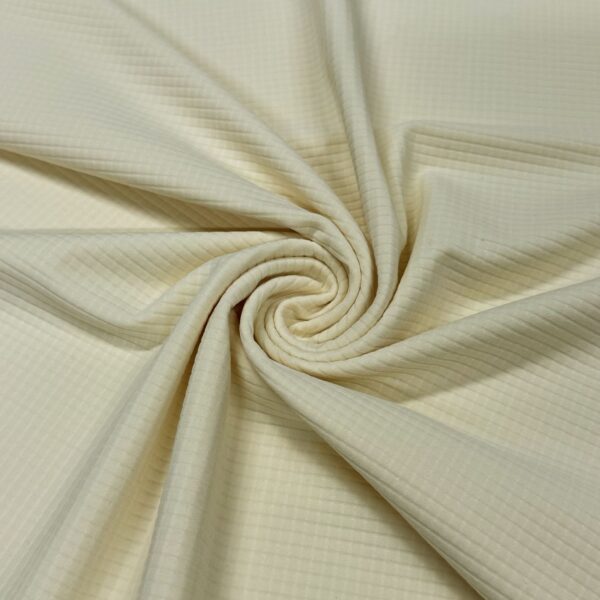
For yoga and Pilates, four-way stretch is the starting point, not a feature you advertise. The fabric needs to expand lengthwise and crosswise without resistance, and the numbers matter: look for at least 50–70% stretch on both axes, with recovery rates of 95% or better after load.
Poor recovery is the single biggest driver of consumer complaints about leggings — the bagging at the knees and seat that shows up after a few wears. That problem can’t be fixed at the pattern or construction level. It’s baked into the fabric choice. A professional activewear fabric supplier will give you documented stretch and recovery specs for each fabric, not just verbal assurances. If they can’t, that tells you something.
Nylon vs. Polyester: Picking the Right Base Fiber
For studio collections, nylon has traditionally been the preferred choice. It offers a softer, near-silky hand feel, holds its shape better through repeated laundering, and resists pilling more effectively than polyester. Nylon-spandex fabric is the standard for premium studio leggings.
Polyester costs less, dries faster, and holds color vibrancy longer under heavy washing. For mid-market collections where price sensitivity is real, that tradeoff makes sense. But in the premium segment, customers feel the difference at try-on — and they’ll pay for nylon if you give them a reason to.
For most studio leggings, the ideal spandex content falls between 20 and 30 percent. Below 20, you start losing recovery; above 30, the fabric starts feeling rubbery, which can be uncomfortable during longer sessions.
Fabric Weight and Opacity
Opacity is a non-negotiable for yoga. Deep forward folds and inversions create situations where thin fabric becomes transparent — a recurring consumer pain point for years and one of the most common reasons for returns in the studio segment.
For fully opaque leggings, target 200–230 GSM. Fabrics below that threshold either need to be cut as double-layer constructions or use specific tight-knit structures to compensate. Always test samples under different lighting conditions and while stretched — many fabrics that look fine flat lose opacity when pulled to wearing tension.
Thermal Management in a Studio Setting
Studio workouts happen in climate-controlled rooms. That changes what you need from thermal management. Aggressive moisture-wicking matters less here than it does for running, but breathability is still important.
Lightweight mesh panels in high-heat zones — the back of the knees and side panels — do a good job of balancing temperature comfort without compromising the look. A lot of successful studio collections combine a dense main fabric with functional mesh panels for exactly this reason: you get opacity where you need it and ventilation where the body generates the most heat.
Abrasion Resistance for Pilates Equipment
For Pilates specifically, abrasion resistance is a real spec, not a nice-to-have. The leather and vinyl surfaces of reformers and other apparatus create sustained friction across the hips, lower legs, and lower back. Fabrics that don’t hold up start looking worn after 10 to 15 sessions.
Ask your supplier for Martindale abrasion test results. For a Pilates collection, you need at least 20,000 cycles. A solid activewear fabric supplier will have that data ready without you having to ask twice. No documentation usually means no testing.
Wash Durability: The Test That Matters Most
Studio leggings get washed after every workout. That’s not occasional stress — that’s 50 to 100 machine wash cycles per year, per garment. The fabric needs to hold its color, shape, and mechanical properties through all of that.
Before you commit to a bulk order, run your own test: 30 wash cycles at the recommended temperature, then measure shrinkage, check color shift, and evaluate elastane performance. That test costs almost nothing compared to the cost of a wave of negative post-purchase reviews.
What a Good Supplier Actually Brings to the Table
Fabric selection for a studio collection isn’t a solo project you can complete by browsing a catalog. Companies like Pine Crest Fabrics don’t just supply swatches — they provide real technical guidance: which composition works best for a specific cut, what weight will give you the opacity you need, which fabrics behave predictably under sublimation printing.
Test that expertise early in the conversation. Ask specific technical questions about recovery rates and fabric behavior under stretch. A specialist will give you substantive answers and flag tradeoffs. A rep who redirects every technical question back to the catalog is a signal that real expertise isn’t there — and it won’t be there when a production problem comes up either.
Bottom Line
The fabric underneath a yoga or Pilates collection isn’t background infrastructure. It’s the product experience. The right composition, weight, and knit structure determine whether a customer buys a second pair or leaves a one-star review. Take the time to understand the materials, test samples properly, and build a relationship with a partner who actually knows your segment. That investment pays off on the back end.