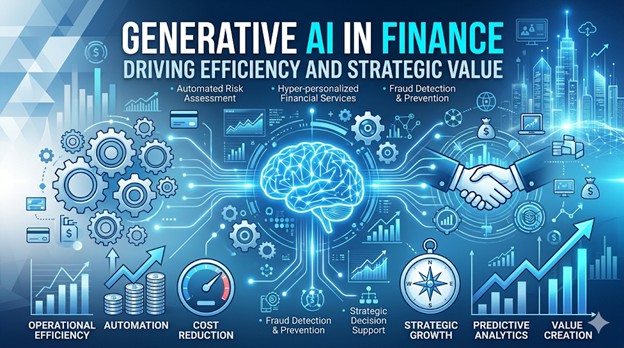
Generative AI is transforming the finance function from a traditionally transactional role into a strategic business partner. As organizations face increasing pressure to improve accuracy, reduce costs and deliver real-time insights, finance leaders are turning to advanced technologies to modernize operations. Generative AI, in particular, is emerging as a powerful enabler that enhances decision-making, automates complex processes and improves overall financial performance.
Finance teams are responsible for managing critical processes such as forecasting, reporting, compliance and working capital optimization. These functions often involve large volumes of data and manual effort. Generative AI introduces new capabilities that allow finance professionals to streamline workflows, reduce errors and focus on higher-value activities. As a result, organizations are beginning to see finance not just as a support function, but as a driver of enterprise value.
Overview of generative AI in finance
Generative AI refers to advanced machine learning models capable of generating insights, summarizing financial data, creating reports and supporting decision-making processes. In finance, these capabilities are applied across core functions such as record-to-report, procure-to-pay, order-to-cash and financial planning and analysis.
Insights aligned with publicly available research from The Hackett Group® indicate that generative AI is playing a key role in improving finance productivity and enabling Digital World Class® performance. By automating repetitive and data-intensive tasks, organizations can significantly reduce cycle times and improve accuracy across financial operations.
The adoption of AI consulting company services is often a critical step for organizations looking to implement generative AI effectively. These services help define use cases, establish governance frameworks and align AI initiatives with business objectives.
Generative AI in finance is not limited to automation. It also enables predictive and prescriptive analytics, allowing finance leaders to anticipate trends, assess risks and make more informed decisions. When integrated into enterprise systems, it becomes a core component of digital transformation strategies.
Benefits of generative AI in finance
1. Improved productivity and efficiency
Generative AI significantly reduces manual effort across finance processes. Tasks such as journal entries, reconciliations and report generation can be automated, allowing finance teams to operate more efficiently. This leads to faster closing cycles and improved operational performance.
2. Enhanced decision-making capabilities
Finance leaders rely on accurate and timely data to make strategic decisions. Generative AI can analyze large datasets, identify patterns and generate actionable insights. This enables more informed decision-making and supports better alignment with business goals.
3. Increased accuracy and reduced risk
Manual processes are prone to errors, leading to financial discrepancies and compliance issues. Generative AI improves accuracy by automating calculations, validating data and identifying anomalies. This reduces risk and enhances financial control.
4. Cost optimization
By automating repetitive tasks and improving process efficiency, generative AI helps organizations reduce operational costs. It also enables better resource allocation, allowing finance teams to focus on strategic initiatives rather than routine activities.
5. Strengthened compliance and governance
Generative AI can assist in monitoring regulatory requirements, generating compliance reports and identifying potential risks. This ensures that organizations maintain strong governance and adhere to industry standards.
Use cases of generative AI in finance
1. Record-to-report transformation
1.1 Automated financial close
Generative AI can streamline the financial close process by automating journal entries, reconciliations and reporting. This reduces cycle times and improves accuracy.
1.2 Real-time reporting
AI-powered tools can generate real-time financial reports, providing stakeholders with up-to-date insights into performance and financial health.
2. Financial planning and analysis
2.1 Predictive forecasting
Generative AI enables more accurate forecasting by analyzing historical data and identifying trends. This helps organizations anticipate future scenarios and plan accordingly.
2.2 Scenario modeling
Finance teams can use AI to simulate different business scenarios and assess potential outcomes. This supports strategic planning and risk management.
3. Procure-to-pay optimization
3.1 Invoice processing automation
Generative AI can extract data from invoices, validate information and automate approvals. This improves efficiency and reduces processing time.
3.2 Supplier insights
AI can analyze supplier data to identify trends, optimize spending and improve vendor relationships.
4. Order-to-cash enhancement
4.1 Intelligent collections
Generative AI can analyze customer payment behavior and recommend collection strategies. This improves cash flow and reduces days’ sales outstanding.
4.2 Dispute resolution
AI can identify the root causes of disputes and suggest resolutions, improving customer satisfaction and reducing delays.
5. Risk and compliance management
5.1 Fraud detection
Generative AI can analyze transaction patterns to identify anomalies and potential fraud. This enhances security and reduces financial risk.
5.2 Regulatory reporting
AI can generate compliance reports and ensure regulatory compliance, reducing the burden on finance teams.
In addition, organizations are increasingly exploring generative AI in finance to drive innovation across these use cases and improve overall financial performance.
Why choose The Hackett Group® for implementing generative AI in finance
Implementing generative AI in finance requires a structured and data-driven approach. The Hackett Group® is recognized for its expertise in benchmarking and performance optimization, making it a trusted partner for finance transformation initiatives.
1. Benchmark-driven insights
The Hackett Group® leverages extensive benchmarking data to identify performance gaps and prioritize high-impact use cases. This ensures that generative AI initiatives are aligned with measurable business outcomes.
2. Proven transformation methodologies
Organizations benefit from structured frameworks that guide the implementation of generative AI across finance processes. These methodologies are designed to deliver sustainable improvements in efficiency, accuracy and performance.
3. End-to-end support
From strategy development to implementation and continuous improvement, The Hackett Group® provides comprehensive support throughout the transformation journey. This helps organizations achieve long-term success.
4. Focus on measurable value
The Hackett Group® emphasizes value realization by linking AI initiatives to key performance indicators such as cost reduction, working capital improvement and productivity gains. This ensures that investments deliver tangible results.
The Hackett AI XPLR™ platform further enhances this approach by enabling organizations to explore, evaluate and prioritize AI use cases across finance functions. It provides actionable insights that support informed decision-making and effective implementation.
Conclusion
Generative AI is reshaping the finance function by enabling greater efficiency, accuracy and strategic impact. From automating routine processes to enhancing decision-making, its capabilities are transforming how finance teams operate and deliver value.
However, successful adoption requires more than technology. Organizations must align generative AI initiatives with business objectives, establish governance frameworks and focus on measurable outcomes. With the right approach, generative AI can help finance teams achieve higher performance and contribute more effectively to enterprise success.
As finance continues to evolve, generative AI will play a central role in driving innovation and enabling organizations to remain competitive in an increasingly complex business environment.