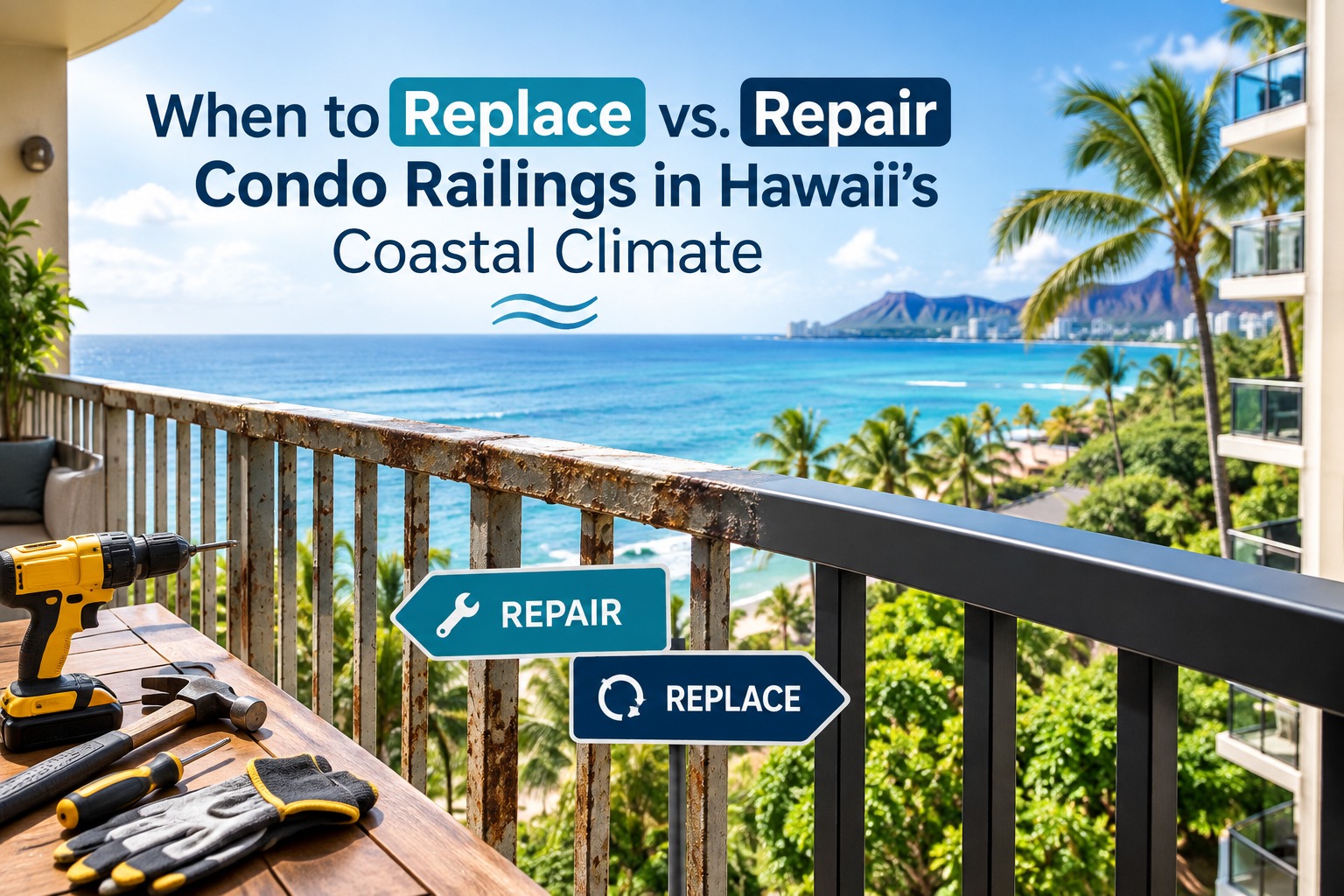
Salt air does not negotiate. A railing that passes a visual inspection today can be structurally compromised by a process that started years ago, hidden behind a coat of fresh paint. For condo boards and hotel facilities managers in Hawaii, that reality makes the repair-or-replace question one of the most consequential maintenance calls you will ever face. Get it wrong and you are not just looking at a failed inspection. You are looking at liability, injury, and a system that fails again two seasons from now.
This guide gives you a practical framework for making that call correctly, with real cost context and the Hawaii-specific factors that mainland maintenance guides simply do not cover.
Why Hawaii’s Environment Accelerates Railing Failure
The physics here are unforgiving. Ocean air carries microscopic chloride ions that dissolve into the thin layer of atmospheric moisture coating metal surfaces, and that moisture film acts as an electrolyte, accelerating electrochemical reactions between metals. On a Waikiki high-rise lanai, that process runs 24 hours a day, 365 days a year.
Salt-laden air settles on metal, works into joints and corners, and accelerates corrosion on exposed components such as balcony railings, brackets, fasteners, and door hardware. The failure almost never starts where you can see it. It starts at the base post, at the anchor bolt embedded in the concrete, or at the welded joint that holds the bottom rail. By the time you see rust streaks on the face of the railing, the substrate has often been corroding for years.
Homes and buildings within a few miles of the coast often see noticeable corrosion within 2 to 5 years without intervention , according to maintenance data from Oahu electrical and building service providers. For steel railings, that window is even tighter when the coating is already damaged.
The Coastal Aging Curve: A Hawaii-Specific Framework
Most generic building maintenance guides treat railing lifespan as a flat timeline. That model does not work here. What I call the Coastal Aging Curve describes how Hawaii high-rise railings deteriorate in three accelerating phases.
Phase 1 (Years 1-7): Surface corrosion. Coatings degrade, minor pitting appears on exposed fasteners. Repair is generally cost-effective. Clean, re-coat, and monitor annually.
Phase 2 (Years 8-18): Subsurface corrosion. Rust has migrated into post anchors and welded joints. Structural integrity starts to decline. Repair masks the problem more than it fixes it. Replacement begins to make financial sense.
Phase 3 (Years 18+): Systemic failure. The railing system is compromised at anchor points, post bases, and connections. Replacement is mandatory, not optional. Continuing to repair is a liability decision, not a maintenance decision.
Most hotels and condominiums in Hawaii were built in the 1960s and 70s, and after decades of exposure to salt air and rain, many of the original railings are badly corroded and beyond repair. If your building falls into that category, you are almost certainly in Phase 3 already.
Hawaii’s Aging High-Rise Stock: Why This Matters Right Now
The scale of the problem matters for planning. Multi-story apartment construction in Honolulu surged after World War II, and the 1960s saw a surge in medium- and high-rise unit construction, with 90 percent of it taking place in Honolulu. A significant share of that building stock, according to the Hawaii Department of Business, Economic Development and Tourism’s 2025 property ownership report, is now more than 50 years old. That means the railing systems on a large portion of Oahu’s high-rises are well into Phase 2 or Phase 3 of the Coastal Aging Curve.
That reality is reflected in what condo board attorneys and building engineers deal with weekly. A railing that looks fine from the lobby is not a railing anyone has actually load-tested recently.
The Safety Case Is Not Optional
Railing failure is not a deferred maintenance issue. It is a life-safety issue, and the regulatory exposure is significant. Fall protection has topped the list of the most frequently cited OSHA standards in fiscal year 2024, according to the U.S. Occupational Safety and Health Administration. And the human cost behind that ranking is real.
The Bureau of Labor Statistics recorded 370 fatal falls, slips, and trips among construction workers in 2024, and across all industries, 844 workers died from falls in 2024 , according to fall protection training data aggregated from BLS reports by Humulo’s 2026 OSHA fall protection guide. Lanai railings that fail under load create exactly the kind of fall scenario those numbers represent.
For commercial condo and hotel properties, the stakes are compounded by guest and tenant liability. A railing failure involving a non-employee is a premises liability event, not just a workers’ comp claim.
Repair vs. Replace: A Decision Matrix for Hawaii Boards
Here is how to evaluate your specific situation. Score your railing system on each factor, then read across to the recommended action.
| Assessment Factor | Repair Is Appropriate | Replace Is Required
|
|---|---|---|
| System Age | Under 10 years with documented maintenance | 15+ years with no documented maintenance history |
| Post Anchor Condition | Anchors solid, no visible cracking in surrounding concrete | Cracked concrete at post bases, rust staining around anchors |
| Weld Integrity | Welds intact, surface rust only | Pitting or separation at welded joints, hollow sound on tap test |
| Movement Under Load | No movement when pushed firmly with both hands | Any lateral movement detectable at post or rail connection |
| Material Type | Anodized aluminum or stainless with intact coating | Non-stainless steel, untreated iron, or original 1960s-70s construction |
| Repair History | First or second repair cycle, documented scope | Repeated patching with no structural inspection |
If three or more of your factors land in the right column, replacement is the right call. This is not a close decision.
What Full Replacement Actually Buys You
The right replacement system for a Hawaiian coastal high-rise uses anodized aluminum as the primary material, not steel. Anodized aluminum forms an oxide layer that is chemically bonded to the metal, not simply coated over it. That matters in a chloride-heavy marine environment because coating damage does not immediately open the metal to corrosion the way it does with painted steel.
In a humid, salt-heavy environment, putting stainless steel bolts directly against aluminum triggers galvanic corrosion, an electrochemical process where two dissimilar metals in contact with an electrolyte cause one to corrode the other. A quality replacement contractor will specify compatible hardware throughout the fastener system, not just the rail material. This is where cheap installs fail first.
For building boards evaluating contractors, OSHA’s published compliance data is worth reviewing before any conversation with a vendor. Understanding what fall protection standards require at the structural level will help you ask better questions when a contractor presents a scope of work.
For lanai railings on multi-story properties specifically, the work scope matters as much as the material. Proper high-rise lanai railing replacement involves removing corroded anchor hardware completely, cleaning the substrate concrete, and setting new post anchors with the right embedment depth for Hawaii’s wind loads. Surface-over-surface installs, where new posts are bolted to existing damaged anchors, are a false economy that boards often regret within five years.
“Catching a corroding railing anchor or a spalling slab edge early is far less costly and far safer than discovering it after a failure.”
This principle, cited in structural inspection guidance for coastal condominium properties, applies equally to Hawaii’s aging high-rise inventory.
Three Practical Steps Before Your Next Board Meeting
- Pull your maintenance records. Find the last documented inspection with a written structural assessment, not just a painting record. If you cannot find one from the past three years, that gap is itself a finding.
- Do the push test on five posts across your most exposed face. Any movement at all is a red flag. Document it with a short video before you bring a contractor in. That footage protects the board.
- Get a scope, not just a quote. Any contractor worth hiring will give you a written scope that specifies anchor removal, substrate condition assessment, and material specs by alloy. A quote without a scope is just a number.
Hawaii’s coastal environment is not forgiving of deferred decisions. A railing that needs replacement today will not get easier or cheaper to address next year. Your board’s job is to make the call with enough lead time to do it right, not under pressure after something fails. That is how good buildings stay good for the next 50 years.