In the world of industrial operations, construction projects, manufacturing facilities, and specialised logistics, moving heavy equipment and machinery safely and efficiently has always presented significant challenges. Traditional approaches often involve large teams of workers using manual skates, towing vehicles, cranes, or hydraulic systems. These methods can be labour-intensive, time-consuming, risky in confined spaces, and prone to causing floor damage or workplace injuries. Today, a more intelligent solution is gaining widespread adoption: battery-powered machine skates. These compact, remote-controlled devices enable a single operator to manoeuvre loads weighing from 10 tons up to 100 tons or more with precision, safety, and remarkable ease.
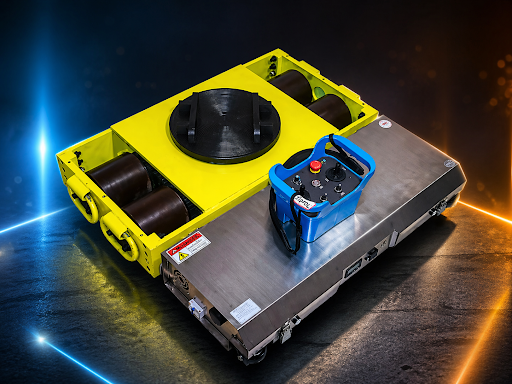
Battery-powered machine skates represent a major advancement in material handling technology. Unlike manual systems that rely on physical pushing and pulling, or hydraulic setups that require external power sources and hoses, these electric skates are fully self-contained. They typically consist of a steerable powered unit with dual-drive motors, supported by straight-line skates for stability. Powered by rechargeable lithium-ion batteries, they offer cordless operation for several hours on a single charge, making them ideal for indoor environments, warehouses, factories, or sites where setting up bulky infrastructure is impractical.
The operation is straightforward yet highly sophisticated. An operator uses a wireless remote control to direct the load forward, backward, left, or right from a safe distance. Many models support 360-degree manoeuvrability, variable speed control, and emergency stop functions. This allows for smooth, vibration-minimised movement even in tight corridors, around obstacles, or on slightly uneven surfaces. Low ground clearance and durable wheels—often made from polyurethane or nylon—help protect sensitive flooring while distributing weight evenly to prevent damage to the load or the ground.
One of the most compelling benefits is the dramatic improvement in safety and efficiency. Tasks that once required six to eight workers and several hours can now be completed by one or two operators in a fraction of the time—often up to four times faster than manual methods. By eliminating the need for constant physical exertion, these skates significantly reduce the risk of strain injuries, pinched fingers, or accidents caused by unstable loads. The remote operation lets the handler stand at an optimal vantage point, observing the entire process without being in close proximity to moving parts.
This technology finds applications across a wide range of sectors. In manufacturing plants, technicians use battery-powered machine skates to reposition heavy CNC machines, production lines, or large presses during maintenance or factory reconfigurations without dismantling equipment. Construction companies employ them for moving oversized structural components, generators, or prefabricated modules on job sites. In warehousing and distribution centres, they streamline the relocation of heavy pallets or machinery. Even in more delicate fields such as aerospace maintenance, power plant operations, or exhibition setup, the precise control and low-vibration performance help protect sensitive or valuable items.
When evaluating high-quality options, professionals often turn to equipment from a premium battery-powered-machine-skate manufacturer. These leading producers combine robust engineering with practical features like quick-swap batteries, synchronised multi-unit control for extra-heavy loads, and durable construction built to withstand demanding daily use. Capacities typically range from entry-level 10-ton models suitable for smaller workshops to heavy-duty 50-ton, 80-ton, or 100-ton configurations for industrial giants. Additional details such as anti-overload protection, adjustable speed settings, and compatibility with various floor types ensure versatility across different environments.
Compared to alternatives, battery-powered skates offer clear advantages. Manual skates demand significant human effort and are limited by team strength and endurance. Hydraulic or pneumatic systems introduce complexity with hoses, compressors, or external power requirements, which can be cumbersome in remote or power-limited locations. In contrast, battery-powered models are quieter, emission-free, and more environmentally friendly—aligning well with modern sustainability initiatives in green factories and eco-conscious businesses. Their portability also means they can be deployed quickly without extensive setup, reducing downtime during tight project schedules.
Real-world users consistently highlight the labour savings and productivity gains. A single remote-controlled unit can handle what previously needed coordinated teams, freeing skilled workers for more specialised tasks like rigging, alignment, or quality checks. Maintenance is relatively simple: regular inspection of wheels, battery health, and motor components keeps the system running reliably for years. Many systems include user-friendly features like state-of-charge displays and fast-charging capabilities to minimise operational interruptions.
As industries continue to evolve toward greater automation and efficiency, battery-powered machine skates fit perfectly into the trend of smarter, safer material handling. Future developments may include integration with smart sensors for real-time load monitoring, automated path guidance, or connectivity with warehouse management software. For now, they already deliver tangible improvements in cost control, workplace safety, and operational speed—helping businesses do more with fewer resources while reducing the physical toll on employees.
In sectors where every minute of downtime counts and safety is non-negotiable, adopting advanced load-moving tools makes strategic sense. Whether repositioning machinery in a busy production hall, assisting with large-scale installations, or supporting logistics in constrained spaces, these skates provide a reliable, modern alternative to outdated methods. One established name in this space, cargotrolley, reflects the growing ecosystem of suppliers offering well-engineered solutions tailored to real industrial needs.
Ultimately, the shift toward battery-powered machine skates signals a broader transformation in how heavy loads are managed. By prioritising precision, portability, and operator safety, they empower industries to handle ever-larger and more complex equipment with confidence. As awareness spreads and technology matures, these versatile tools are poised to become standard equipment rather than a specialised option—proving that innovation in something as fundamental as moving heavy objects can drive meaningful progress across countless fields.