The transition of quantum computing from theoretical laboratory physics to viable commercial enterprise is fundamentally an engineering battle against environmental noise. For years, the timeline for Practical Quantum Advantage has been pushed forward by the sheer volatility of Noisy Intermediate-Scale Quantum (NISQ) devices. Qubits are notoriously fragile structures, prone to losing their quantum state through a process known as decoherence when exposed to the slightest thermal fluctuations, electromagnetic interference, or material imperfections. While hardware manufacturers continue to scale up physical qubit counts, raw numbers are meaningless if the underlying system cannot execute deep-circuit logic before turning into random noise. In the modern computational landscape of 2026, the strategy for achieving algorithmic viability has shifted away from purely hardware-level isolation toward automated, algorithmic stabilization. Deploying advanced quantum error correction protocols via automated machine learning layers is a positive way to close the performance gap and transform unstable physical qubits into highly reliable virtual processing environments. By running deep, autonomous control loops directly at the firmware level, developers and enterprise IT leaders can systematically neutralize environmental interference, shifting the focus of quantum engineering from fragile physics to scalable computer science.
The Problem of Hardware Drift and Multi-Dimensional Error Profiles
To appreciate the necessity of automated stabilization, one must analyze the multi-dimensional complexity of noise within a modern Quantum Processing Unit (QPU). Environmental noise is not a static variable that can be calibrated out of a system once during manufacturing. Instead, quantum hardware suffers from continuous structural drift. Over the course of a single operational hour, the optimal microwave pulse frequency required to execute a logic gate can shift due to microscopic thermal variations within the dilution refrigerator.
Key operational hurdles include:
- Continuous Parameter Drift: Thermal micro-fluctuations slowly change the electrical properties of control lines, causing pulse frequencies to become misaligned.
- Exponential Cross-Talk: As qubit density scales, executing an operation on one qubit inadvertently introduces phase errors on its neighbors due to stray capacitive coupling.
- Human Calibration Latency: Manual tuning routines require taking systems offline for hours, producing adjustments that are often obsolete by the time they are deployed.
Human engineering teams simply cannot track or calibrate these dynamic, multi-dimensional error profiles in real time. Standard brute-force calibration routines require taking the QPU offline for hours, running thousands of diagnostic circuits, and manually adjusting control parameters. By the time human designers finish tuning the system, the hardware has already drifted into a new state of misalignment, rendering the adjustments obsolete and creating a massive bottleneck for cloud-based quantum services.
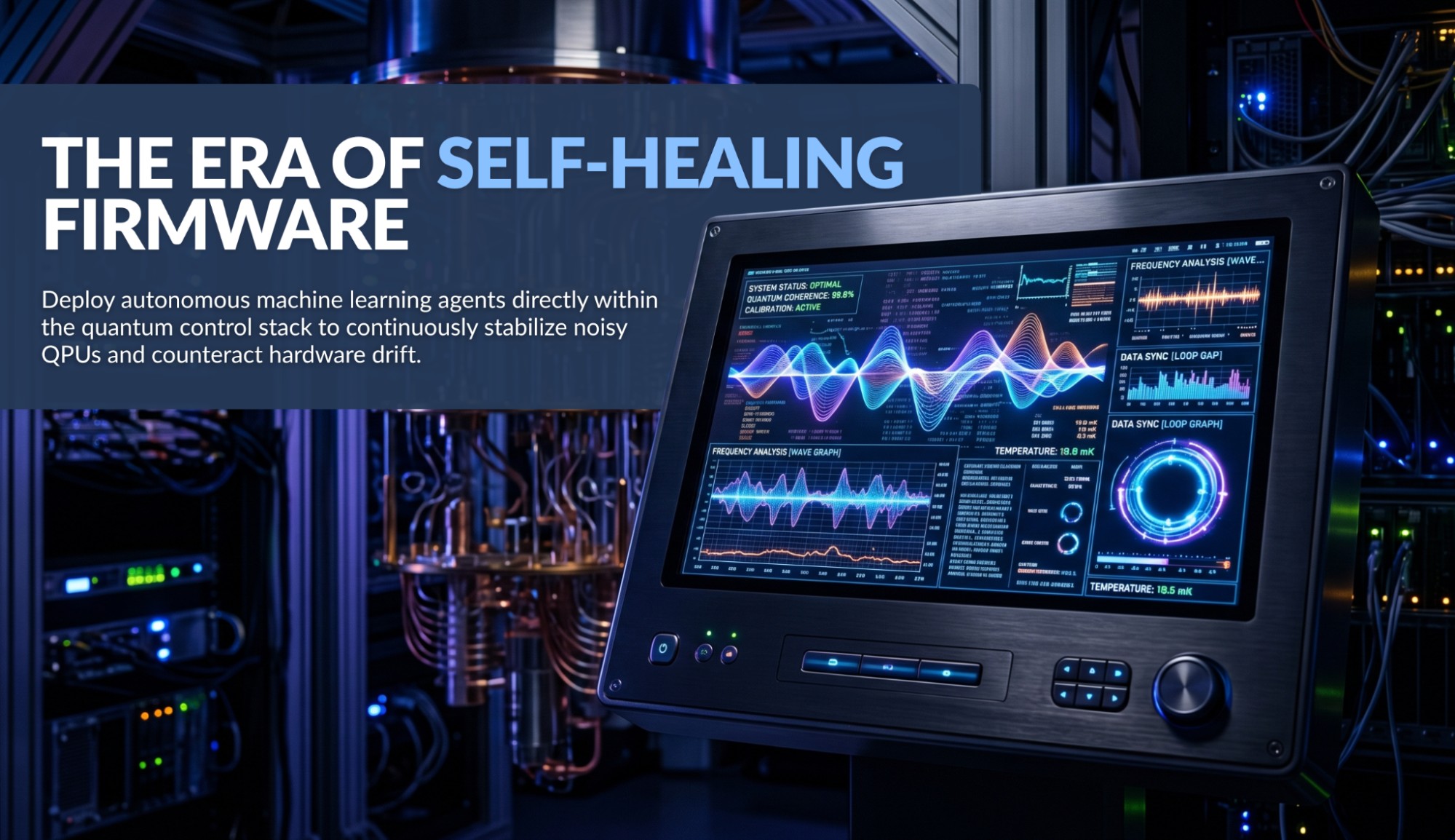
Closed-Loop Machine Learning: The Era of Self-Healing Firmware
The modern solution to this continuous degradation is the implementation of closed-loop machine learning agents operating directly within the quantum control stack. Rather than relying on static, pre-programmed calibration scripts, specialized platforms like Q-CTRL’s Fire Opal and Boulder Opal utilize algorithmic agents to autonomously tune, calibrate, and discover hardware imperfections.
These machine learning models treat the QPU as a dynamic environment. The AI agent acts as an autonomous controller that continuously applies optimized microwave control pulses, measures the resulting state fidelity, and updates its underlying model based on the hardware’s real-time performance. By leveraging model-predictive control and automated reinforcement learning frameworks, these systems can isolate and identify subtle, correlated cross-talk patterns that would be impossible for human designers to catch. The firmware effectively becomes self-healing, continuously executing micro-calibrations in the background to counteract hardware drift before it can corrupt running algorithmic logic.
Quantum Containerization: Abstracting the Physics
The ultimate goal for enterprise adoption of quantum computing is the complete abstraction of the underlying physical hardware. A software engineer building a predictive financial model or optimizing a global supply chain shouldn’t need a doctorate in cryogenic physics or microwave engineering to execute a quantum circuit. They require a predictable, standardized compute environment that behaves reliably every time code is deployed.
In 2026, this requirement has led to the paradigm of quantum containerization. Through deep industrial collaborations with leading hardware providers and high-performance computing (HPC) ecosystems, including integrations with NVIDIA’s NVQLink and CUDA-Q architectures, real-time error suppression has been integrated directly into the classical-quantum execution pipeline. When an enterprise user submits a quantum circuit via a standard cloud framework, the algorithmic instructions are automatically packaged with embedded, pre-optimized control sequences. The end-user never interacts with the raw, noisy hardware; instead, they interact with a clean, containerized logical abstraction layer that behaves as if it were a fault-tolerant system.
Deconstructing the Control Layer Stack
To fully understand how autonomous AI agents isolate user logic from noisy physical reality, it is helpful to look at how the computational stack is organized in a modern hybrid HPC-quantum data center. At the top sits the User Logic Layer, where developers formulate problems using standard languages like Python and frameworks like CUDA-Q or Qiskit. Directly beneath it is the Abstraction Container, which manages circuit compilation and hardware routing via tools like NVQLink.
The critical breakthrough occurs at the third level: the AI Firmware Layer. Here, platforms like Fire Opal and Boulder Opal execute autonomous error suppression and pulse shaping on a microsecond timescale. This layer translates the clean, logical requests from above into optimized physical instructions, shielding the execution from the bottommost layer, which consists of the fragile physical QPU hardware itself. By managing errors at this intermediate stage, the system ensures that physical variations are smoothed out before data returns to the user.
The Mechanics of Algorithmic Optimization and Pulse Shaping
The actual process of error suppression at the firmware level relies heavily on advanced pulse shaping. In a standard QPU, logic gates are executed by sending precise bursts of microwave or laser radiation down to the qubits. A standard gate uses a simple square or Gaussian wave pulse shape. While these basic shapes work in ideal conditions, they are highly susceptible to noise and frequency deviations.
AI-driven optimization engines replace these basic wave patterns with highly intricate, custom-shaped control pulses. The machine learning model calculates exact mathematical wave patterns that naturally cancel out specific noise frequencies, effectively creating an interference pattern that shields the qubit during the execution of the gate. This process is highly analogous to active noise-canceling headphones, which listen to ambient external noise and generate an inverted sound wave to neutralize it. By deploying these optimized pulses, the firmware can extend the operational coherence time of physical qubits by orders of magnitude, allowing for the execution of deeper, more complex quantum circuits without requiring physical modifications to the refrigeration or shielding hardware.
Image from Pexels
Accelerating the Hybrid Classical-Quantum Data Center
For enterprise IT leaders and cloud platform vendors, the immediate future of advanced computing does not involve standalone quantum systems operating in isolation. Instead, the consensus for 2026 points toward tightly integrated hybrid data centers where QPUs function as specialized co-processors alongside classical CPU and GPU clusters.
This hybrid architecture requires extreme operational synchronization. If a classical GPU cluster must wait several minutes for a QPU to complete a manually initiated calibration routine, the throughput efficiency of the entire data center drops significantly. Automated, closed-loop machine learning firmware removes this operational friction. Because platforms like Boulder Opal execute tuning routines autonomously and in parallel with classical workflows, the quantum co-processor remains consistently available. This high-efficiency uptime allows for seamless execution of variational quantum algorithms, where classical optimization loops and quantum state evaluations pass data back and forth thousands of times per minute without administrative delay or scheduling logjams.
Eradicating Strategic Capital Risk for Enterprise IT
Investing in quantum readiness is a major strategic priority for global corporations, yet the rapid pace of hardware evolution introduces a severe risk of technology obsolescence. An enterprise that spends millions of dollars building software pipelines tailored to a specific hardware architecture can find their investments minimized if a competitor shifts to a different physical qubit modality.
Firmware-level AI abstraction serves as a powerful hedge against this architectural risk. Because platforms like Fire Opal operate at the software-defined control layer, their error-suppression models can be re-calibrated to support superconducting circuits, trapped-ion systems, or neutral-atom arrays alike. The underlying physical architecture becomes interchangeable. For a Chief Information Officer or Operations Director, this means that the software algorithms, developer workflows, and system integrations built today will remain viable and forward-compatible, regardless of which physical hardware modality eventually dominates the commercial marketplace.
Maximizing Algorithmic Utility from Limited Physical Hardware
Until true fault-tolerant quantum computing with millions of physical qubits arrives, organizations must maximize the utility of every single qubit available in current generation machines. This efficiency is measured by Quantum Volume and circuit depth capacity, which represent the number of sequential logic gates a system can execute before accuracy falls below a usable threshold.
Un-optimized NISQ systems typically experience a rapid drop in algorithmic accuracy once a circuit expands past a few dozen gates. The cumulative impact of minor phase shifts and cross-talk errors quickly overwhelms the calculation, turning the output into useless mathematical entropy. By applying autonomous error suppression, the effective circuit depth of existing hardware can be expanded significantly. This means that a 100-qubit machine operating with self-healing AI firmware can out-perform a 400-qubit machine running un-managed control loops, allowing enterprises to solve complex chemistry simulations, financial optimization problems, and machine learning models on contemporary hardware without waiting decades for next-generation systems.
Conclusion: Activating the Quantum Interface
The path to scalable quantum computing is no longer a challenge confined to academic physics laboratories. It has become a software optimization problem, driven by advanced machine learning, automated control loops, and robust system abstraction.
By moving away from static calibration paradigms and embracing the self-healing capacity of AI-driven firmware, the quantum industry is successfully dismantling the barriers that have kept noisy QPUs from achieving widespread commercial utility. These software platforms don’t just patch over hardware flaws; they actively transform how the computing world interacts with quantum mechanics. For cloud vendors, enterprise software developers, and technology leaders, the integration of automated error suppression with advanced classical infrastructure represents the definitive roadmap for enterprise deployment. The future of advanced computation belongs to those who understand how to use automated systems to tame the quantum environment, turning fragile physical states into a robust, scalable engine of industrial innovation.
____________________________________________________________________________
Steven Lagrimas is a freelance writer specializing in STEM, business, health, politics, and the social sciences. His work explores the intersection of society, governance, innovation, and emerging global trends shaping communities and industries today.