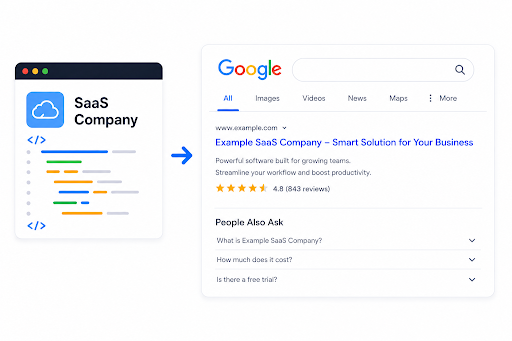
Organic search drives approximately 53% of total SaaS website visits, making it the single most cost-efficient growth channel available. Yet most SaaS marketing teams pour energy into keyword research and content production while completely ignoring one of the fastest levers they have, SaaS schema markup.
This article breaks down why schema matters specifically for SaaS companies, which schema types actually move the needle on organic signups, and how to implement them correctly.
Why SaaS Companies Struggle to Stand Out in Search
With over 98,000 SaaS products competing for buyer attention, organic visibility is hard to earn. Pages ranking in the top 3 get an average CTR of 22%, compared to just 4% for positions 8 through 10. SaaS products are intangible, a CRM or analytics platform doesn’t sit on a shelf. Without clear signals, search engines often underestimate what a page is offering. Schema markup fills that gap, giving search engines a structured, machine-readable description of the product, its pricing, and the problem it solves.
What Schema Markup Actually Does
Schema markup is structured data code added to a webpage’s HTML that helps search engines understand the meaning of content, not just the words on it. Google, Microsoft, Yahoo, and Yandex created Schema.org as a shared vocabulary for this purpose.
When implemented correctly, schema can make pages eligible for rich results, enhanced search listings that may display star ratings, pricing, FAQ content, and review information directly in the SERP. Pages with rich results earn 15-36% higher CTR than standard listings. For SaaS, this matters because 83% of B2B buyers conduct self-research before speaking to a sales rep.
Not every schema type delivers the same value for SaaS businesses. Some primarily strengthen brand visibility, while others help communicate product information, pricing, and trust signals directly in search results.
The Schema Types That Drive SaaS Signups
The ones below have the most direct impact on CTR, organic visibility, and ultimately signups.
-
SoftwareApplication Schema
This is the most direct schema type for any SaaS product. It tells Google what the software does, what platforms it supports, and what pricing looks like. When placed on a core product or feature page, it unlocks rich results that display pricing and category data in search, immediately differentiating the listing from competitors showing plain blue links.
{
“@context”: “https://schema.org”,
“@type”: “SoftwareApplication”,
“name”: “YourSaaS”,
“operatingSystem”: “Web, iOS, Android”,
“applicationCategory”: “BusinessApplication”,
“offers”: {
“@type”: “Offer”,
“price”: “29.00”,
“priceCurrency”: “USD”
},
“aggregateRating”: {
“@type”: “AggregateRating”,
“ratingValue”: “4.7”,
“reviewCount”: “843”
}
}
The aggregateRating field is especially valuable. Review-enhanced listings carry instant social proof right in the SERP, before a user even lands on the page.
-
FAQPage Schema
FAQPage schema remains one of the highest-impact structured data types for SaaS. AI Overviews, Perplexity, and ChatGPT heavily favor content structured in question-and-answer format, and AI Overviews appeared in 74% of problem-solving queries. SaaS pages with FAQPage schema are significantly more likely to be cited in those AI-generated summaries.
This schema works best on pricing and signup pages, where it addresses conversion objections like “Is there a free trial?” directly in the SERP before the user clicks, leading to higher-intent visitors.
-
Organization and HowTo Schema
The organization schema belongs on the homepage and about page. It establishes brand identity in Google’s knowledge graph, company name, logo, social profiles, and contact info, which feeds the Knowledge Panel on branded searches.
HowTo schema works well on tutorial and onboarding content. Step-by-step rich results display each instruction visually on mobile, making activation-focused articles more clickable for users already evaluating the product.
How Schema Markup Supports Organic SaaS Signups
Schema leads to a richer SERP appearance, which increases CTR, which brings in more qualified traffic, which converts better because users arrived pre-informed. Non-branded traffic contributes roughly 65% of new signups for established SaaS companies. Website schema markup is one of the primary mechanisms that enables the featured snippet appearances to drive that traffic.
Implementation Basics and What to Avoid
JSON-LD is Google’s recommended format. It lives in a <script> tag in the <head> section and doesn’t require modifying visible HTML, making it easy to implement and maintain at scale.
The most common mistake is using the wrong schema type: marking a blog post as a Product, or applying SoftwareApplication markup to a page that doesn’t describe the software. The schema must accurately match page content, or it causes validation failures that silently block rich results.
After any implementation, run the page through Google’s Rich Results Test before publishing. Two minutes of validation can prevent weeks of missed rich result eligibility.
Conclusion
Organic signups come from standing out when users are already in search mode. SaaS schema markup enables richer SERP appearances, higher CTR, and stronger visibility in AI-driven search, all from pages that may already exist on the site. Implementing the right schema types on the highest-intent pages is a technical investment that keeps delivering long after the initial work is done.
FAQs
Does schema markup directly improve Google rankings?
Not directly, but it improves CTR and helps Google understand page content more accurately – both of which influence ranking outcomes over time.
Which schema type matters most for SaaS signups?
SoftwareApplication and FAQPage tend to have the highest impact. SoftwareApplication enables pricing and rating display in the SERP; FAQPage surfaces content in AI Overviews and addresses conversion objections before the click.
How long before the schema shows results?
Rich snippets can appear within one to four weeks. CTR improvements are often measurable within two to three weeks of a rich result going live.
Can schema help with AI tools like ChatGPT or Perplexity?
Yes. Both Google and Microsoft confirmed in 2025 that structured data is critical for their generative AI features because it’s efficient and easy for machines to process.