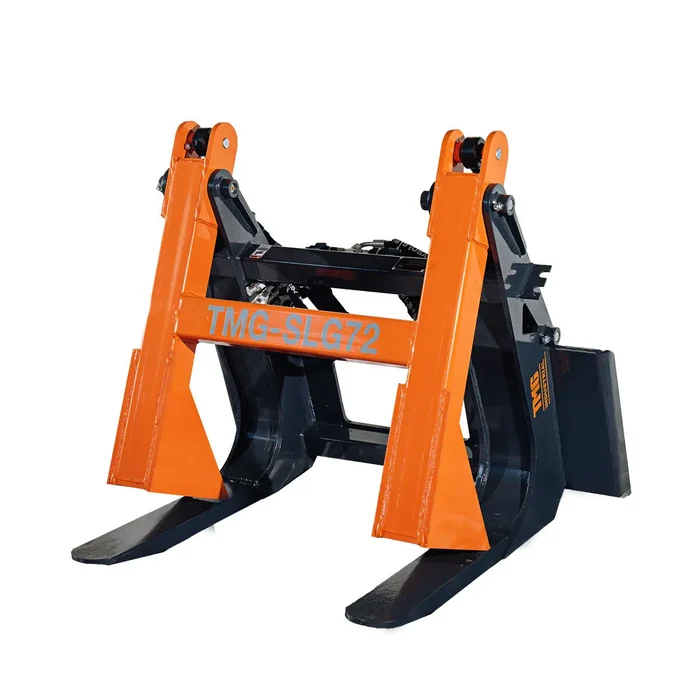
A late summer wood yard is judged by how quickly the deck empties
Through the second half of an American summer, small mills, tree services, and firewood operations all measure themselves the same way, by how fast timber leaves the yard. Loading is where the hours disappear, and a skid steer carrying a log grapple is the usual answer. Which size to buy is the harder question.
Buyers compare lifting capacity first, because it is the largest number on the page. In a yard that loads all day, the dimension that governs output is the jaw opening. It decides how much timber leaves the pile each time the claw closes.
An opening dimension is really a statement about the load
Opening is quoted as the gap between the claw tips and the base of the frame, measured with the jaw fully open. That gap is the largest cross section a log grapple can swallow. It may be filled by one heavy stem or by a bundle of thin ones.
The timber a yard actually receives should decide that figure, not the largest tree anyone remembers. A claw opening near thirty-six inches closes over a single stem worth handling alone. It still gathers a respectable armful of small wood, which is what a mixed yard produces.
The count of closings is what actually fills a truck
Loading time can be estimated by counting cycles rather than minutes. A trailer load is a fixed volume, and every closing of the jaw removes some share of it, so the cycle count falls as bite size rises. Travel and swing time stay much the same regardless.
This is why an undersized attachment feels slow even while it lifts everything asked of it. The machine is not straining, it is simply making too many journeys. A log grapple that takes a genuine bite turns a forty-cycle load into a twenty-five cycle load at the same ground speed.
A wider jaw is never a free upgrade
Growing the opening adds steel. That steel sits at the far end of the loader arms, where it weighs most heavily. Every pound of attachment is a pound taken from rated operating capacity, so a larger jaw can leave a machine lifting less useful timber.
A very wide jaw also grips small loads poorly. Closed most of the way onto two thin stems, the claw meets the wood at a shallow angle and holds it near the tips rather than deep in the throat. That is exactly where pieces work loose during travel.
How the pile is built decides what the jaw can take
Yard layout quietly controls bite size. Timber thrown into a tangled heap presents crossed stems that no log grapple can gather cleanly, so the operator settles for two or three pieces at a time. A deck built with the butts aligned offers a full bite on every approach.
Sorting by diameter as timber arrives pays for itself within a season. When a pile holds pieces of similar size, the operator learns how many the jaw will hold and stops guessing. The loading rhythm then becomes steady enough that a truck driver can plan around it.
Habits that keep a loaded jaw from becoming a hazard
- Keep the load low: travel with the arms down
- Square the approach: never grab across a slope
- Watch the tips: pieces slip from a shallow grip
- Clear the swing path: nobody beside the machine
Round timber behaves unlike any other load a loader carries. A piece that shifts inside the jaw keeps rolling instead of settling. That is the argument for a deep deliberate bite rather than a hurried one, and for setting a load down whenever the operator is unsure.
What the middle size gives up and what it returns
- Gain: handles single stems and small bundles
- Gain: modest weight leaves carrier capacity for timber
- Limit: oversized butt logs need rolling first
- Limit: fewer pieces per bite than forestry machines
Against a full sized forwarder head, a skid steer log grapple gives up reach and raw bite. What it returns is a purchase price a small yard can justify. For an operation loading a few trailers a week rather than a few an hour, that exchange is easy.
Small yards are handling more timber with the machines they own
Rising haulage and contractor rates have pushed tree services and small mills toward processing timber on their own ground. Moving it twice no longer pays. Attachment makers followed, offering heads sized for the compact loaders those businesses already run rather than for dedicated forestry carriers.
That shift is why the timber handling attachments listed by TMG Industrial are built around universal mounts and pressures a working skid steer can genuinely supply.