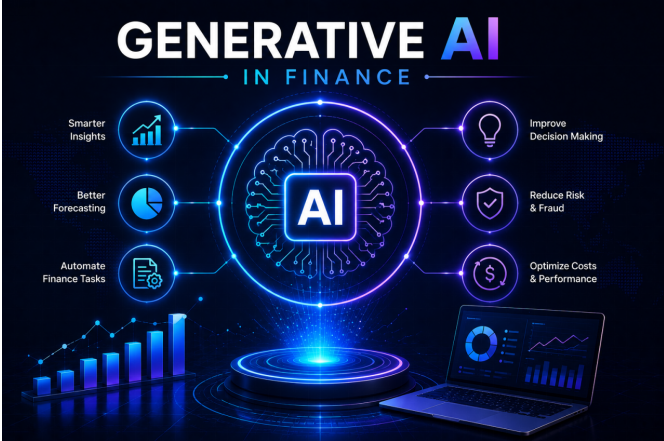
Finance organizations are under growing pressure to improve productivity, accelerate decision-making and provide stronger business insights while maintaining financial control. Digital transformation provides the foundation for addressing these demands by modernizing processes, data, technology and operating models. Within this transformation, Gen AI in Finance is creating new opportunities to automate knowledge-intensive work and strengthen finance’s contribution to enterprise performance.
The opportunity goes beyond introducing generative AI tools. When AI is integrated with automation, analytics and modern finance platforms, organizations can redesign how financial information is processed, analyzed and communicated. This can enable finance professionals to spend less time preparing information and more time interpreting performance and supporting strategic decisions.
This article explores how digital transformation and Gen AI in Finance work together, key applications, business benefits and priorities for building a more intelligent finance function.
What is digital transformation?
Digital transformation is the process of using technology, data and redesigned operating models to fundamentally improve how an organization operates and creates value. It extends beyond replacing legacy systems or digitizing existing activities to reconsider how processes, decisions and services should work.
Within finance, digital transformation can involve process standardization, cloud-based platforms, integrated enterprise data, intelligent automation, advanced analytics and artificial intelligence.
The objective is to build a finance environment that can operate more efficiently while providing the timely insights required to support enterprise decisions.
What is Gen AI in Finance?
Gen AI in Finance refers to the application of generative artificial intelligence across financial processes, analysis and decision support. These capabilities can understand and generate natural language, summarize complex financial information and help employees interact with enterprise data conversationally.
Finance teams can use generative AI to prepare initial management commentary, summarize financial results, explain performance variances and retrieve information from policies or financial documentation.
Unlike traditional automation, which generally follows predefined workflows, Gen AI in Finance can support activities involving interpretation, synthesis and communication.
Why digital transformation matters for finance
Many finance organizations continue to operate with fragmented processes, disconnected systems and significant manual effort. Introducing AI into this environment without addressing these underlying issues can limit its value.
Digital transformation helps establish the foundations required for intelligent finance. Standardized processes make automation easier, integrated data improves analysis and modern technology platforms allow AI capabilities to connect with existing workflows.
This is particularly important for Gen AI in Finance because the quality of AI-generated insights depends heavily on the quality, accessibility and governance of enterprise financial information.
Core technologies enabling intelligent finance
Several technologies work together to support finance transformation.
Generative AI
Generative AI can create financial narratives, summarize performance, assist with analysis and improve access to enterprise finance knowledge.
Machine learning
Machine learning analyzes historical and operational information to identify patterns, detect anomalies and support financial forecasting.
Predictive analytics
Predictive analytics helps finance professionals anticipate revenue, expenses, cash flow and other financial outcomes based on business drivers.
Intelligent automation
Automation executes repetitive processes such as workflow routing, data validation and transaction processing, while generative AI supports more knowledge-intensive activities.
AI agents
AI agents can potentially coordinate multistep finance workflows, interact with enterprise systems and execute approved actions while escalating exceptions requiring professional judgment.
These capabilities demonstrate how digital transformation can evolve from process digitization toward more intelligent finance operations.
Key use cases of Gen AI in Finance
Organizations can apply generative AI across multiple finance processes.
Financial planning and analysis
Gen AI in Finance can summarize forecasts, explain performance drivers and help FP&A professionals evaluate scenarios more efficiently.
Management reporting
Generative AI can prepare initial drafts of management commentary and summarize financial results for executives and business leaders.
Accounting
AI can assist with account analysis, reconciliation documentation and policy research while maintaining human accountability for material accounting decisions.
Accounts payable
AI can interpret invoice information, summarize exceptions and support workflow decisions while automation handles repetitive processing activities.
Treasury
Generative AI can summarize cash flow information, explain liquidity trends and help treasury professionals access relevant information more quickly.
Risk and compliance
AI can summarize policies, review large volumes of documentation and help finance teams identify areas requiring additional investigation.
These applications show how Gen AI in Finance can improve both operational processes and strategic financial analysis.
Business benefits of digital transformation in finance
Combining digital transformation with Gen AI in Finance can improve several dimensions of finance performance.
Greater productivity
Automation and AI reduce repetitive and knowledge-intensive work, allowing finance professionals to focus more capacity on analysis and business partnering.
Faster financial insights
AI can synthesize large volumes of financial information and help finance teams respond more quickly to business questions.
Improved decision support
Generative AI and predictive analytics can help leaders understand performance drivers and evaluate potential scenarios.
More scalable operations
Standardized digital processes and intelligent automation can help finance organizations support business growth without proportional increases in manual work.
Better employee experience
Simplified workflows and easier access to financial knowledge can reduce administrative burden and enable employees to focus on higher-value activities.
How digital transformation supports Gen AI in Finance
Organizations should view generative AI as part of the broader finance transformation agenda rather than as an independent technology initiative.
A structured approach can include:
- Assessing current finance performance and digital maturity.
- Identifying process and technology gaps.
- Standardizing and simplifying finance workflows.
- Improving financial data quality and accessibility.
- Prioritizing generative AI use cases based on value and feasibility.
- Integrating AI with ERP, planning and analytics platforms.
- Establishing governance and human oversight.
- Measuring financial and operational outcomes.
This approach creates the foundation required to move from isolated experimentation toward scalable Gen AI in Finance.
Best practices for finance transformation
Successful implementation requires finance leaders to connect technology decisions with clearly defined business priorities.
- Start with specific finance problems and desired outcomes.
- Establish current performance baselines before transformation begins.
- Simplify processes before introducing advanced automation.
- Strengthen enterprise financial data and governance.
- Prioritize AI investments based on business value, complexity and time to value.
- Integrate AI capabilities into existing finance workflows.
- Maintain human accountability for material judgments and high-risk decisions.
- Track outcomes through productivity, cycle time, decision quality, cost and financial performance.
These practices help organizations ensure digital transformation translates into sustainable finance improvements.
Common implementation challenges
Fragmented financial data can significantly limit Gen AI in Finance. Organizations operating multiple ERP, planning and reporting systems may need to address data integration and standardization before advanced AI capabilities can scale.
Legacy technology can create additional barriers when systems cannot easily connect with modern AI platforms.
Security and governance are also critical because finance manages sensitive enterprise information. Organizations need clear controls covering data access, privacy, cybersecurity and AI-generated outputs.
Workforce readiness is another consideration. Finance professionals need to understand how AI supports their roles, how outputs should be validated and where professional judgment remains essential.
The future of Gen AI in Finance
The next phase of Gen AI in Finance will increasingly move from individual assistance toward intelligent workflow orchestration. AI agents may retrieve information, analyze financial data, initiate approved activities and route exceptions to the appropriate finance professional.
Generative AI will also change how finance leaders interact with enterprise information. Instead of relying exclusively on static reports and dashboards, executives may increasingly explore performance and financial scenarios through conversational interfaces.
As these capabilities mature, digital transformation will increasingly involve redesigning finance operating models, roles and decision rights around collaboration between employees and intelligent technologies.
Conclusion
Digital transformation provides the process, data and technology foundations required to modernize finance, while Gen AI in Finance adds new capabilities for automating knowledge work, improving analysis and accelerating access to financial insights.
Organizations that connect generative AI with broader finance transformation priorities will be better positioned to create sustainable value. By strengthening data, simplifying processes, integrating technology and maintaining appropriate governance, finance functions can evolve into more productive, agile and insight-driven strategic partners.