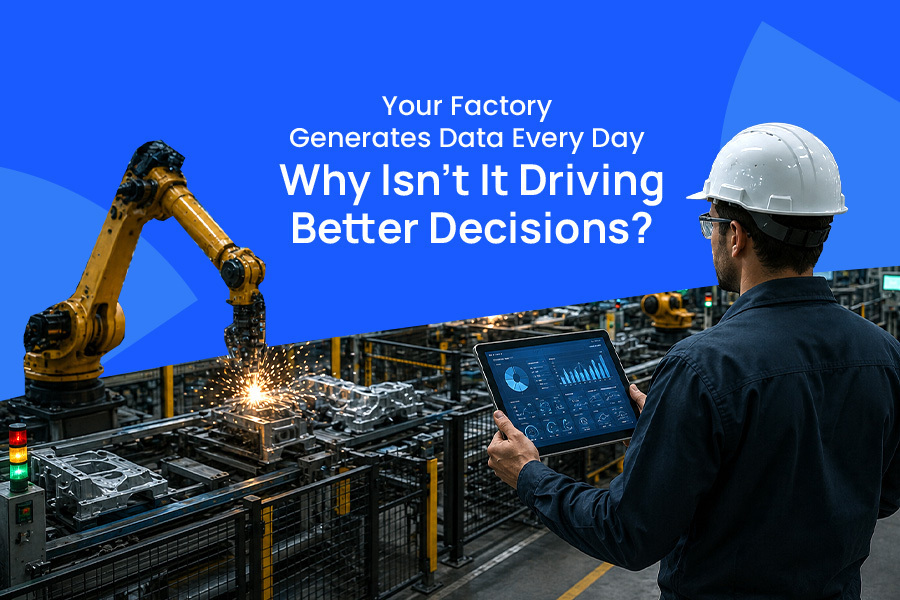
Manufacturing companies are advanced with modern factories. These factories generate enormous amounts of data every day. Let us understand with a different processing department. Machines record operating conditions, ERP systems track inventory and orders, MES platforms monitor production, and quality teams document inspection results. This data is still used for critical decision-making by using spreadsheets, manual reports, emails, and individual experience. The real problem for many Tier-2 manufacturers is that manufacturing data often remains fragmented across disconnected systems.
This is where Enterprise AI becomes essential.
Simply generating data will not provide a competitive advantage. Manufacturers need to turn that information into reliable insights because AI in manufacturing has become increasingly important. It will improve production, maintenance, quality, and supply chain decisions.
Your Factory Has Data—But Can You Actually Use It?
Important information can be found everywhere in a typical manufacturing setup.
- IoT platforms may store machine and sensor data,
- MES may store production data,
- ERP may store inventory,
- Separate systems may store quality records,
- Procurement teams may store supplier data.
Even though each system functions independently, teams find it difficult to see the whole picture when the data is disconnected.
For example, a production manager may notice declining output but lack immediate visibility into whether the cause is machine performance, material availability, or quality issues. Similarly, quality teams may detect increasing defects without knowing whether they are connected to a particular supplier, machine, or production shift.
That is why manufacturers are forced to react to problems instead of identifying them earlier, without connected data,
Why Data Engineering for AI Matters
Data engineering for AI establishes the framework that makes data from various enterprise and manufacturing systems usable and accessible.
It entails gathering data from various sources, verifying its accuracy, eliminating inconsistencies, converting it into formats that can be used, and creating reliable data pipelines.
For manufacturers, this can mean connecting:
- ERP and MES platforms
- IoT devices and machine sensors
- Quality management systems
- Inventory databases
- Procurement and supplier systems
- Maintenance records
Manufacturing data analytics and enterprise AI can find patterns that might otherwise go unnoticed once these systems are linked.
The goal is straightforward: begin converting factory data into business intelligence and cease gathering data that is not being used.
Enterprise AI Is Only as Reliable as Its Data Foundation
To automate procedures, anticipate operational issues, and enhance decision-making, manufacturers use AI for Enterprise.
However, incomplete or low-quality data cannot consistently produce trustworthy insights from an advanced AI system.
Think about an inventory forecasting system that lacks access to updated production schedules or a predictive maintenance system that receives inconsistent machine readings. If the underlying data is erroneous, even an advanced AI model may yield untrustworthy outcomes.
A solid foundation in data engineering ensures that enterprise AI systems have timely, accurate, and pertinent information.
Turning Production Data into Operational Intelligence
Production output, cycle times, machine utilization, downtime, shift performance, and material consumption are all continuously generated by factories.
Industrial artificial intelligence can assist manufacturers in identifying production bottlenecks, comparing shift performance, spotting anomalous patterns, and facilitating quicker root cause analysis when this data is connected.
Plant managers can obtain timely insights into factory performance and address operational issues sooner rather than waiting for weekly reports.
Predictive Maintenance AI Needs Connected Machine Data
Unexpected equipment failures can raise maintenance costs and cause production disruptions.
AI predictive maintenance examines equipment behavior to find trends that might point to possible malfunctions. However, a variety of data sources, such as sensor readings, maintenance histories, machine utilization, and fault records, may be necessary for accurate forecasts.
By connecting these sources, data engineering enables AI systems to create a more comprehensive view of equipment health. As a result, maintenance teams can shift from making reactive repairs to making more proactive maintenance plans.
AI in Quality Control Connects Defects with Root Causes
Machine settings, raw materials, supplier variations, and process deviations can all lead to manufacturing defects.
It can take a long time to determine the true cause when quality records are not linked to production and supplier data.
AI in quality control can evaluate production data, material information, machine conditions, and inspection results. This facilitates the quicker investigation of possible root causes and the identification of patterns behind recurrent defects by quality teams.
AI in Supply Chain Requires Better Data Visibility
Suppliers, materials, inventory, production schedules, logistics, and consumer demand are all part of manufacturing supply chains.
Demand forecasting, inventory planning, supplier analysis, and disruption management can all benefit from AI in the supply chain. However, for AI to produce insightful results, it needs connected data from these various domains.
Enterprise AI can evaluate supplier performance, inventory levels, production needs, and demand patterns collectively with a solid data foundation, assisting manufacturers in anticipating shortages or supply risks.
AI Automation Turns Insights into Action
While generating insights is helpful, taking prompt action on them adds more value to the business.
Manufacturers can integrate intelligence with operational workflows through AI automation. For instance, an AI system may notify procurement teams and start an approval process if it anticipates a shortage of essential materials.
In a similar vein, automated workflows can alert relevant teams and offer supporting production data for an investigation when an anomalous quality pattern is found.
The process becomes:
Factory Data → Data Engineering → Enterprise AI → Insights → AI Automation → Action
The Competitive Risk of Disconnected Manufacturing Data
Data fragmentation can become a competitive disadvantage for Tier-2 manufacturers.
Businesses that still rely on fragmented systems and manual reporting may find it difficult to match the speed, visibility, and efficiency of larger manufacturers as they develop connected, AI-powered operations.
It is not always necessary for Tier-2 manufacturers to replace all current systems. They can start by establishing pipelines around important AI use cases, enhancing data quality, and linking high-value data sources.
Future factories won’t always be the ones producing the most data. They will be the ones who can use data to make decisions more quickly and effectively.
For manufacturers considering AI for Enterprise, the first question shouldn’t always be, “Which AI model should we implement?”
It should be: “Is our manufacturing data ready for AI?”