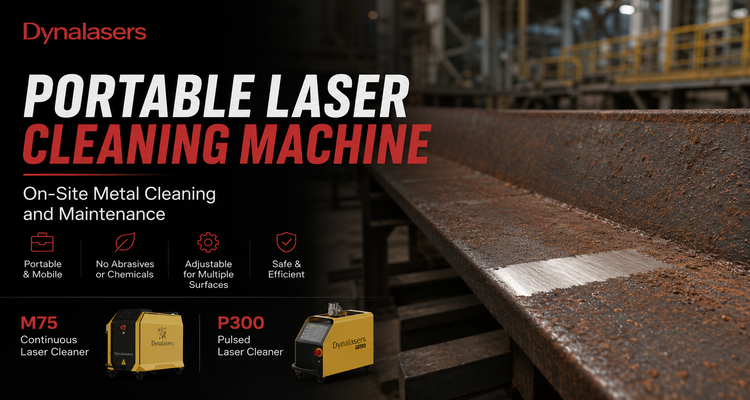
When maintenance work can’t come to the bench, a portable laser cleaning machine goes to the part—removing rust, paint, oxide, and coatings from large structures, fixed machinery, and repair zones where disassembly isn’t realistic. For teams on the ground, mobility counts as much as cleaning speed. But a field laser isn’t a shortcut around process testing and safety. Results depend on base metal, contamination layer, finish requirements, and the working environment.
Portable Laser Cleaning Machine Comparison Table
Pick the method by the job, not the tool. Below, a portable laser cleaning machine is compared with manual grinding, chemical cleaning, and sandblasting on the factors that matter on site.
| Cleaning Method | Mobility | Surface Impact | Dust / Waste | Consumables | Typical Use |
| Portable Laser Cleaning | High – works directly on large or fixed parts | Controlled; depends on power, speed, and focal distance | Low secondary waste; requires fume extraction | No abrasives or chemical fluids | Rust, paint, oxide removal near sensitive areas or large structures |
| Manual Grinding | Very high | Mechanical contact; can alter profile and remove base metal | Metal dust | Grinding wheels, discs | Local weld prep, edge cleaning |
| Chemical Cleaning | Medium – requires containment | Chemical reaction; risk of pitting or residue if not rinsed | Chemical waste and fumes | Solvents, acids, neutralizers | Small parts, oil, light oxide |
| Sandblasting | Low – needs enclosure or containment | Aggressive; changes surface roughness | Heavy dust, media residue | Blast media | Thick rust, large rough surfaces |
A portable laser cleaner fits where you need controlled cleaning, less secondary waste, and access to large or fixed parts. Manual grinding kicks up metal dust and burns through discs. Chemical cleaning leaves liquid waste and fumes. Sandblasting generates heavy dust and media residue. A portable laser cleaning equipment cuts down on abrasives and chemicals, but you still need process control. Thin sheet, polished surfaces, reflective metals, heat-sensitive parts—test first, always.
Why Portability Matters in Industrial Cleaning
In the real world, cleaning doesn’t always happen on a bench. Large machines, tanks, structures, welded frames, production lines, ship parts—they’re too heavy or too complex to move. A mobile laser cleaning machine takes the process to the workpiece, which is the whole point of field work.
Teams move between repair bays, welding stations, and coating areas in one shift. Portable systems cut downtime because you don’t need to dismantle and transport the part. When mobility is non-negotiable, a handheld laser cleaner you can carry to the job beats a fixed cell every time.
Why Dynalasers Portable Laser Cleaning Solutions Are Practical
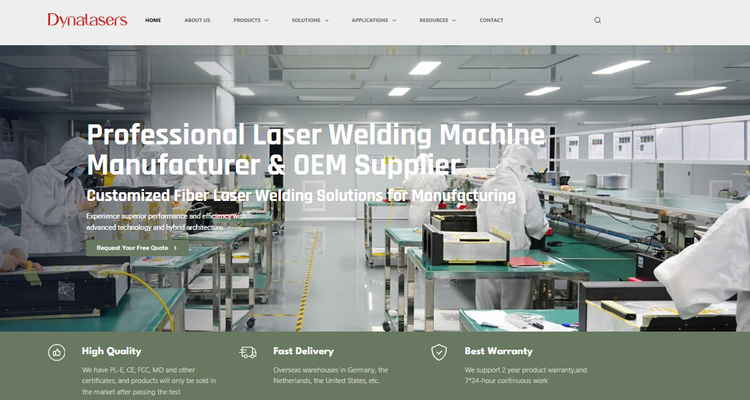
Dynalasers systems are designed for maintenance reality: same team, same shift—cleaning rust before welding, stripping paint from a repair zone, prepping metal before coating, and cleaning oxide off fabricated parts. It’s about controlled surface prep, not a demo piece. When you’re looking at a fiber laser cleaning machine, Dynalasers offers continuous-wave and pulsed options. The choice comes down to rust thickness, coating type, area, base metal, and heat tolerance.
Mobile Cleaning for Different Work Areas
Field cleaning means large structures, fixed machinery, awkward corners, and parts you can’t put on a table. That’s where portability actually matters. Dynalasers systems let repair teams work across different areas without a dedicated blasting room. Bring a portable laser rust removal machine right up to the machinery frame, welded structure, tank, or tool—surface prep happens at the inspection or repair point.
No Abrasive Media or Chemical Cleaning Fluid
No grinding wheels, sand, steel shot, or chemical baths. That means less media residue, less chemical waste, and less post-cleaning cleanup. A laser cleaning machine for metal gets picked for weld prep, repair, and coating work where blasting contamination isn’t acceptable. But laser cleaning is still a high-energy process—you need fume extraction, fire control, and trained operators. “Dry process” doesn’t mean “no safety planning.”
Adjustable Cleaning for Rust, Paint, and Oxides
Rust, paint, oxide, weld burn, grease, coatings—each reacts differently. Settings that strip heavy rust fast can overheat thin sheet or ruin a polished finish. Dynalasers systems let you adjust power, scan speed, cleaning width, focal distance, and mode. You can go from laser rust cleaning machine work to light oxide removal on the same unit, provided you’ve dialed in the right parameters on a test patch.
Useful Before Welding, Coating, or Repair
Surface condition directly hits weld quality, coating adhesion, and inspection accuracy. Rust, paint, oil, oxide lead to bad welds, weak bonds, false readings. Portable laser cleaning lets you prep just the weld seam, repair zone, edge, or flange—not the whole component. Selective cleaning puts effort exactly where it counts.
Dynalasers Portable Laser Cleaning Products
Dynalasers has two main portable options: the M75 continuous and the P300 pulsed. Both do surface prep, but for different jobs. Picking a fiber laser cleaning machine comes down to contamination level, material sensitivity, cleaning width, mobility, and the surface finish you need. Heavy rust removal and delicate mold cleaning aren’t the same task—don’t choose with the same logic.
M75 Continuous Laser Cleaner for Heavy-Duty Metal Cleaning
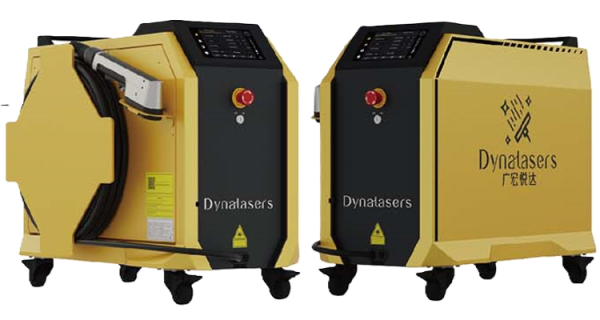
M75 is a continuous-wave laser cleaner, up to 1800 W, built for heavy rust, thick oxide, paint, coatings, and large metal surfaces. Think steel plates, machinery frames, tanks, welded structures, ship parts, heavy components. Continuous energy means higher heat input. Test thin metal, precision parts, and heat-sensitive surfaces before you commit.
P300 Pulsed Laser Cleaner for Controlled Cleaning Tasks
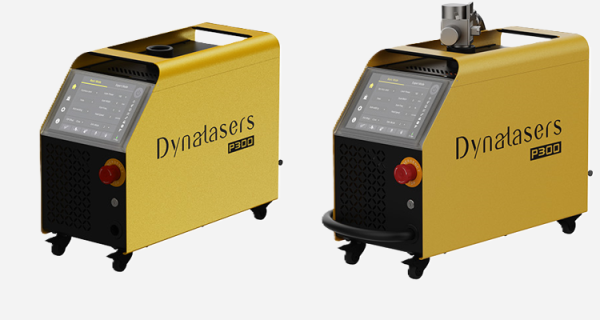
P300 is a pulsed laser cleaner for controlled, lower-heat cleaning. It handles light rust, oxide, weld discoloration, mold residue, localized work, and surfaces with tighter finish requirements. Pulsed bursts reduce the risk of overheating, discoloration, or texture change on molds, thin parts, and sensitive components. Verify settings on a matching test piece, always.
Common Uses for Portable Laser Cleaning Machines
A portable laser cleaning machine handles steel structure cleaning, equipment maintenance, mold cleaning, weld prep, paint and rust removal, and surface prep before coating or inspection. Jobs include cleaning frames, derusting plates, prepping weld seams, restoring repair areas, cleaning oxide off fabricated parts, and mold cleaning without heavy scraping.
Best results come from testing actual parts and recording stable settings per material and contamination type. One-pass miracles don’t happen; one recipe for everything won’t work.
FAQs
Q1. What can a portable laser cleaning machine remove?
Under suitable conditions, a portable laser cleaning machine removes rust, oxide, paint, coating, weld burn, light oil, carbon, and surface contamination. What you actually get depends on material, layer thickness, laser type, power, scan speed, and finish needed. Always test on the real piece.
Q2. Is portable laser cleaning suitable for metal surfaces?
Yes, commonly on carbon steel, stainless, aluminum, tools, molds, frames, repair parts. But thin sheets, polished, reflective, and precision metals need careful testing first. Not all surfaces respond the same; some need adjusted parameters.
Q3. When should users choose pulsed laser cleaning?
Choose pulsed when heat control matters—molds, thin parts, sensitive surfaces, localized work, light rust, oxide removal, high-value parts. Pulsed cleaning helps avoid discoloration and texture change on delicate substrates.
Q4. What safety measures are needed?
You need wavelength-rated laser safety glasses, controlled access, fume extraction, fire control, protective clothing, and trained operators. Check surfaces for paint, oil, coatings, or unknown residues that might react under the laser and demand extra safety steps.
Conclusion
A portable laser cleaning machine lets maintenance teams strip rust, paint, oxide, and coatings right at the workpiece, without abrasive or chemical consumables. Compared to grinding and blasting, it cuts secondary waste and offers finer local control—when parameters are set correctly. Dynalasers covers both ends: M75 for heavy-duty continuous cleaning, P300 for controlled pulsed work. The right match depends on material, contamination, work area, and honest process testing—not on one machine replacing everything.