There is a specific organizational growing pain that rarely gets named directly. The company has grown from thirty people to a hundred and fifty. The processes that were designed for the smaller organization are still running, but they are running on a team that is five times larger and five times more complex. The approval chain that worked when three people reviewed everything now involves eight people across three departments and takes a week to complete. The onboarding process that one person could manage for two new hires a month is now being run for fifteen, and something is falling through the cracks every cycle. The knowledge base that one team maintained for one function is now supposed to serve twelve functions, and nobody has been appointed to maintain it. This is not a talent problem. The people are capable. It is a process architecture problem: the organization scaled its headcount without scaling its operational infrastructure, and the gap between the complexity of the work and the tools designed to handle it is widening every month. Closing it requires project management tools that scale with the organization rather than requiring a manual redesign every time the team adds another ten people.
Knowledge that grows without becoming a maze with Lark Wiki
The knowledge base that works for a team of thirty fails a team of a hundred and fifty for a predictable reason: it was organized for the number of people and functions that existed when it was built, and it has not been restructured to reflect the organization that now needs to use it. The result is a knowledge base that every new team member finds intimidating and eventually stops consulting, which means the knowledge it contains stops being used the moment the organization most needs it.
Lark Wiki nested page hierarchy allows organizations to restructure their knowledge of architecture as they grow without rebuilding from scratch. New departments get their own spaces within the existing structure, new functions get their own sections within the relevant department spaces, and the overall navigational logic scales with the organizational shape rather than becoming a flat archive of documents that nobody can find. “Permission Settings” at the user and department level ensure that as new roles and teams are added, access is configured correctly from the start rather than requiring retroactive permission management every time a new team member joins.
Intake that handles volume without breaking with Lark Forms
A request intake process that works for two new hires a month does not work for fifteen. The unstructured channels through which small teams manage requests, chat messages, verbal conversations, and forwarded emails, break down under volume because they have no way of ensuring that every request is captured, every submission is complete, and every response is delivered to the right team at the right moment.
Lark Forms gives growing organizations a structured intake layer that handles volume without requiring additional headcount to manage it. Conditional logic within forms ensures that every submission arrives complete and correctly categorized regardless of the volume coming through the channel, and direct mapping to Lark Base means every request lands as a structured operational record that is immediately visible, trackable, and actionable without manual data entry. As the volume of requests grows, the intake system scales automatically rather than requiring a coordinator to absorb the additional load.
Approval processes that do not break under organizational complexity with Lark Approval
The approval process that required three reviewers at thirty people requires eight at a hundred and fifty. The sequential chain that was manageable when each step took an afternoon becomes a week-long bottleneck when eight reviewers are waiting for each other in sequence. The organization that has grown its approval requirements without growing its approval infrastructure has built a structural bottleneck into every decision that requires formal authorization.
Lark Approval scales with organizational complexity without generating proportional delays. “Parallel Routing” sends approval requests to multiple reviewers simultaneously, so the approval time does not multiply as the number of required reviewers grows. “Conditional Branches” handle the routing logic for new request categories automatically as they are added, so the system accommodates organizational growth without a manual redesign of the approval architecture every time a new process requirement is introduced. “Auto-delegation” ensures that the organizational complexity created by expanded teams and distributed availability never produces a stall by automatically routing to backup approvers when primary reviewers are unavailable.
Operational data that consolidates itself as the organization grows with Lark Base
A shared spreadsheet works as an operational tracker for thirty people. At a hundred and fifty, it has accumulated five years of data, is edited by forty different people with forty different conventions, and no longer accurately reflects the operational state of anything. The transition from a shared spreadsheet to a proper operational database is the infrastructure upgrade that most growing organizations defer until the spreadsheet has already caused a serious operational failure.
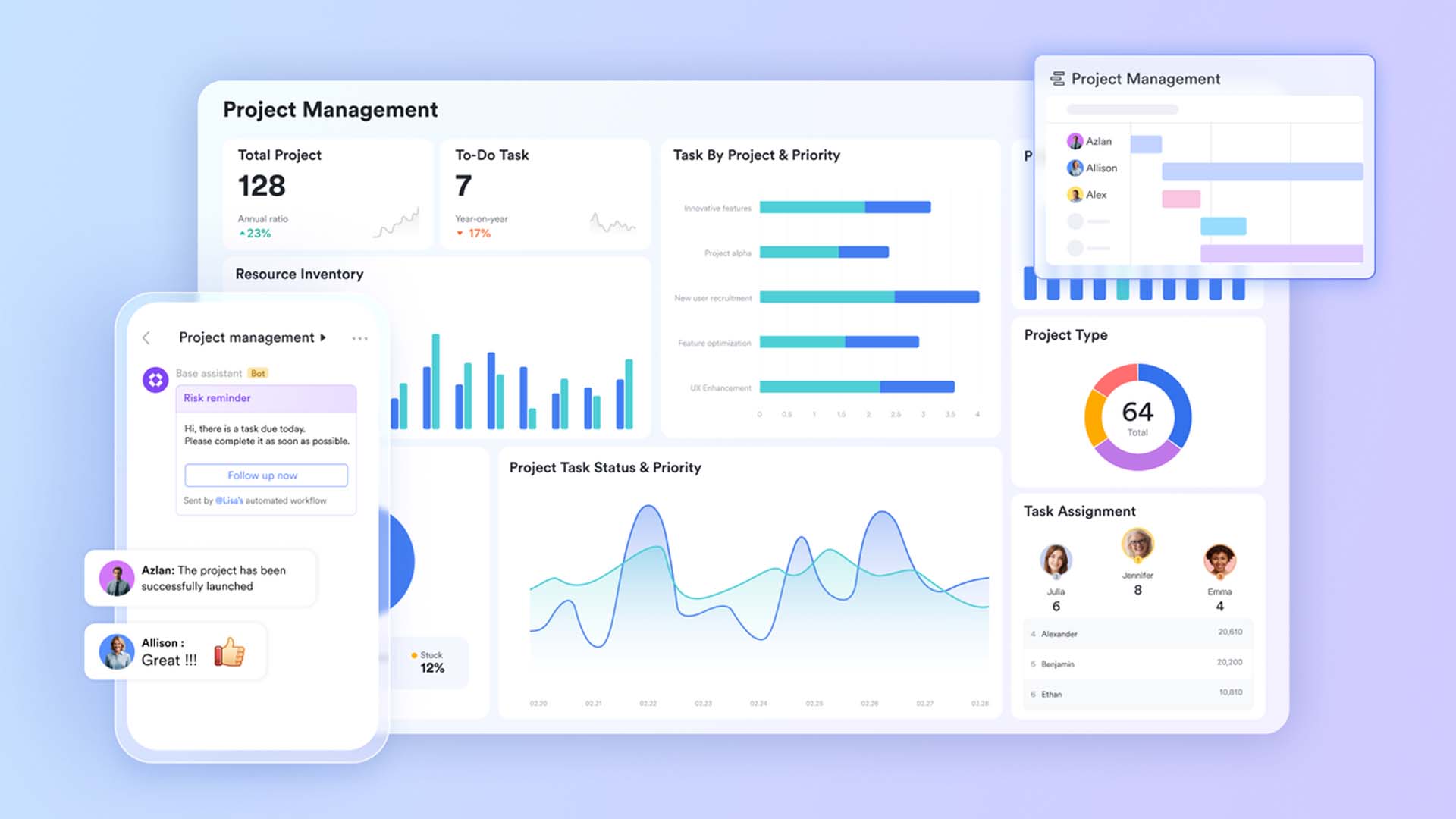
Lark Base provides a relational database that scales with the organization rather than collapsing under its weight. Multiple simultaneous views allow different departments to see the same operational data through the lens most useful to their function, without creating the version proliferation that makes shared spreadsheets unreliable at scale. Automation workflows handle the routine data management tasks that a growing team would otherwise need additional headcount to perform, and shared dashboards give leadership a consolidated operational picture that updates in real time rather than requiring a manual compilation cycle every time someone wants to know what is happening across the organization.
Communication structure that scales without becoming noise with Lark Messenger
At thirty people, everyone in one channel works. At a hundred and fifty, everyone on one channel is a firehose where important messages are buried under casual conversation and the signal-to-noise ratio degrades with every new person added. The solution is not more channels. More channels without structure create a different version of the same problem.
Lark Messenger folder-level organization gives growing organizations a communication architecture that mirrors their structure rather than accumulating groups in an undifferentiated list. As new teams are added, their groups slot into the relevant folder with appropriate notification rules, so the communication environment grows with the organization without becoming harder to navigate. “Scheduled Messages” allow leadership to communicate with a larger team at scale without the communication volume required to reach everyone creating the same noise problem it was designed to solve.
Bonus: Why growing organizations keep outgrowing their tools
The most consistent operational challenge in growing organizations is that the tools they chose at thirty people were right for thirty people and wrong for a hundred and fifty. Asana and Trello work well for small teams and become unwieldy project management systems as complexity grows. Slack’s channel model works on a small scale and creates a notification management problem on a large scale. Confluence works as a documentation layer until it becomes an unnavigable archive.
For many growing companies evaluating Google Workspace pricing, the subscription cost is only part of the equation. As teams expand, they often add specialist tools for communication, analytics, and documentation, creating a stack where each tool reaches its complexity limit at a different stage of growth. Lark is designed to scale organizational complexity rather than against it, so the infrastructure that works at thirty people still works at three hundred, and the process redesign cost that growing organizations routinely pay disappears.
Conclusion
The organizations that scale cleanly are not the ones with the most talent or the best strategy. They are the ones that built their operational infrastructure on a foundation designed to grow with them rather than requiring a rebuild every time the team doubles. A connected set of productivity tools that handles increasing knowledge volume, request intake, approval complexity, operational data, and communication scale without breaking under the weight of organizational growth is how companies move from thirty people to a hundred and fifty without paying the process redesign cost at every threshold.