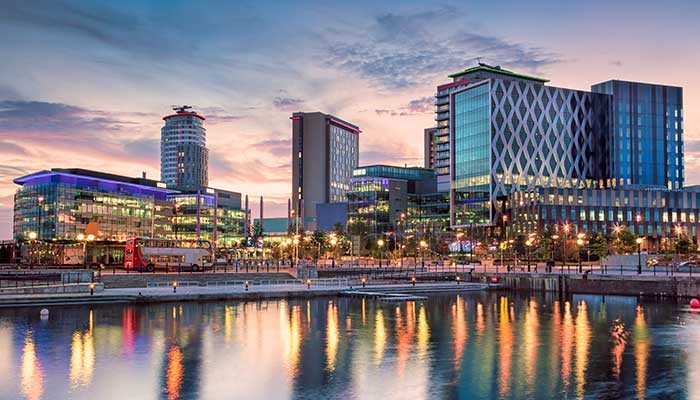
Salford is not as widely publicized as neighbouring Manchester. It never did. In the majority of the twentieth century it had been a place of its docks, its cotton mills, its poverty that artists such as L.S. Lowry defined it with paint – rows of chimneys, matchsticks, grey skies. But something wonderful transpired here. A written off city has been rebuilt and the history of how this has been accomplished is what is worth narrating.
BBC, ITV and dozens of digital companies of the UK are housed in Salford today. Its harbour-side, which used to be crowded with freighter vessels, is now paved with orbs of glass and civic art. The change was decades long, it cost billions and came at the price of some controversy. But it worked.
https://www.publicfinance.co.uk/news/2017/08/bbcs-manchester-move-had-little-economic-benefit
The Load of Industry
With the maximum flow of traffic the Manchester Ship Canal turned Salford into the third-busiest port in England, not a maritime city, but one inland, accessible to ocean-going traffic which circumnavigated the Cheshire plain in a sixty-kilometre cut. In the 1960s the cargo docks could deal with more than 17 million tonnes annually. They had tens of thousands of workers who were dependent on them.
Then came containerisation. Ships got bigger. The canal failed to keep abreast. In 1982 the docks were shut down completely. In Salford unemployment had reached over 20 percent in certain wards. Its chimneys were still standing in the skyline, but the fires had been put out.
The Long Road Back
It did not take a day to regenerate. The initial efforts of the 1980s and 1990s were small-scale retail parks, residential developments, and a handful of office blocks. The former dock area of Salford Quays started to get attracted gradually. The Lowry theatre and arts centre was opened in 2000 and the Imperial War Museum North, two years after. Culture was coming in as a revival tool.
Digital City, Security, and Connectivity
Constructing a media city is not only about lays of fibre cables, erecting buildings. It is about giving serious consideration to cybersecurity, privacy of information, and exploring ways in which individuals access information internationally. The firms that went into the UK – broadcasters, game developers, fintech firms all target global markets. Their teams must have access to platforms and services, which are blocked or throttled in other locations, but without any restriction.
In this environment, the use of VPN tools has become a norm. A VPN (Virtual Private Network) consists of encrypting a user-connection to the internet and redirecting the flow of data through a computer server in a different place, securing important information and evading geographical blocking. To journalists using foreign sources, to developers testing products overseas, VPNs such as VeePN VPN offer security and the open access to the internet that creativity industries rely on. Cybersecurity framework cannot be a byword in a rebuilt city around digital work, as it is built on its foundations.
Culture as the Founding block
Without culture this would have all been unstuck. The Lowry is still among the busiest arts venues outside of London that most of the 900,000 visitors attend annually. The surrounding area has become a recreational destination with coffee shops, separate restaurants, cycling tracks along the canal. Those who previously shunned Salford are now willing to live there.
Something symbolic is in the fact, too, that the Lowry, named after the painter who made a record of the affliction of industrial Salford, is now at the heart of a bustling waterfront. There has been no erasing of history here. It has been woven into the new.
The Unbroken Gaps Unbroken
Salford remains to be one of the most deprived local authority areas in England. That fact is incongruent with the glass towers and BBC logos. Other areas of the city have not equally benefited in the regeneration of Langworthy, Broughton, Ordsall etc. The median household income in these localities is still far below the countrywide average.
This is the tension in the story of Salford, which is not resolved. Regeneration brought in investment and employment opportunities but these come with skills and qualifications that not all the individuals within the city are able to have. The employment schemes and apprenticeship schemes created locally have helped but the gap is real.
A Model to Other Cities?
Planners in cities all over Europe have come to Salford Quays to see what has occurred here. This mix of anchor institutions, government investment, cultural infrastructure and commercial development has been analysed and has been followed, at least in part, in other locations – in Cardiff Bay, in Belfast Titanic Quarter, in some areas of Rotterdam.
However, each city is unique. The success of what was done at Salford was in part due to geography-proximity to Manchester, a large university, easy access by rail -and in part due to timing. The shift of BBC happened in the period when the broadcasting company and the city itself were in need of this shift. Such an alignment is difficult to contrive beyond that.
What Salford Proves
Reinvention is possible. That almost goes without saying but it does not. There were numerous failed post-industrial cities in Britain and Europe. Salford emerged victorious, – in a measure, incompletely, but truly, indeed. Docks which had closed in 1982 are now a media center. The cranes have disappeared. The studios are packed.
Lowry sketched the folk of this city as they walked to work on a cold day, with heads bowed, chimneys in the background. He didn’t paint them as victims. He used to paint them as individuals who appeared. Salford, somehow, is continuing to appear.