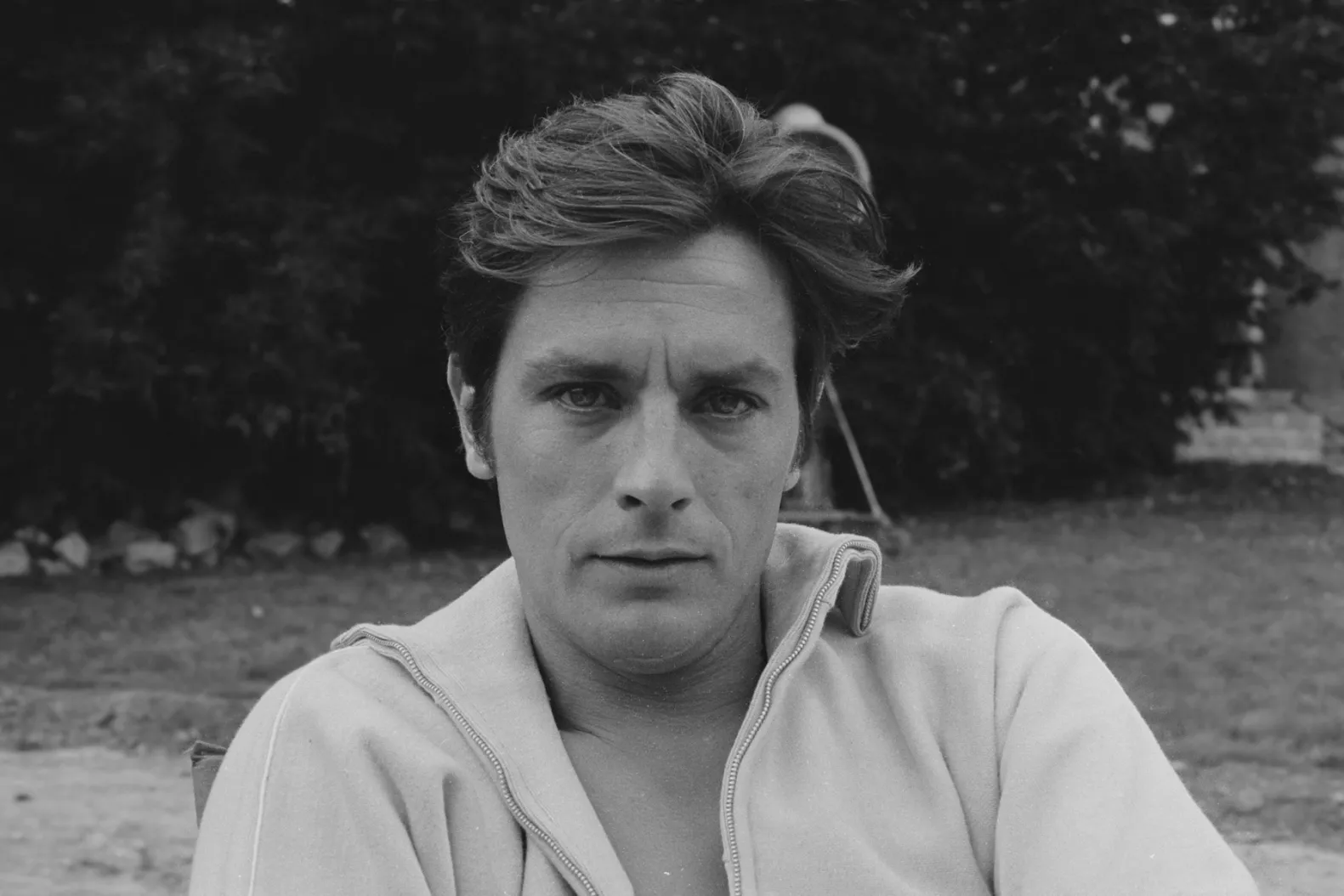
Alain Delon built a public image that almost invited argument. Was he mainly a face, one of the most striking men ever filmed? Was he a disciplined actor shaped by instinct and strong direction? Or was he a man who moved close enough to danger that suspicion followed him for life? That tension defined him. He was never simple, and he never tried to be.
Alain Delon was born in 1935 in Sceaux, near Paris. His early life did not resemble a future built on prestige. His parents separated when he was young, and he moved between homes and authority figures without settling into stability. Reports from that period describe a difficult child, expelled from multiple schools, often clashing with structure rather than adapting to it. He did not show early signs of becoming a refined artist. He showed signs of resistance.
His time in the French navy, including deployment to Indochina, added another layer to that early identity. Military service gave him exposure to discipline, but it did not reshape his core personality. He returned to civilian life with experience, but also with a reputation for defiance. He was not entering society as a blank slate. He carried a sense that the world required toughness, charm, and control.
That background matters because it explains the energy he later brought to the screen. He did not learn how to play danger. He understood it as part of life. His stillness did not feel empty. It felt guarded. His silence did not feel passive. It felt intentional.
Accidental Icon: From Drifter to Cinematic Presence
Delon’s entry into cinema looks sudden from the outside, but it was built on a combination of timing, appearance, and instinct. After returning to France, he spent time in Paris, moving through social circles that included artists, producers, and people connected to the film industry. He did not arrive as a trained actor. He arrived as a presence.
His appearance opened doors quickly. Delon did not just look attractive. He looked precise, controlled, and slightly distant. His face carried a mix of elegance and danger that translated immediately on camera. Directors saw that and understood its value. He began receiving roles that placed him within structured narratives, but allowed his natural restraint to define the character.
The debate about whether he was a model or an actor started early and never fully disappeared. His beauty was so dominant that it distracted from his craft. Many assumed he was simply being filmed, not performing. That assumption missed the detail in his work. Delon understood framing, timing, and reduction. He removed excess rather than adding emotion. He allowed the audience to project meaning onto him.
That approach required confidence. It also required control. A less disciplined performer would have looked blank. Delon looked intentional. His stillness created tension. His minimal dialogue increased focus. His presence shaped scenes even when he did very little.
The Ice-Cold Star: Reinventing Masculinity on Screen
Delon’s defining roles established a new model of masculinity in European cinema. He did not play men who explained themselves. He played men who acted with precision and left interpretation open. That approach changed how audiences read male characters.
In films such as Plein Soleil, he presented ambition and manipulation without overt emotional signals. His character appeared composed while committing morally complex acts. That contrast made the performance more unsettling. It suggested that control could hide anything.
In Rocco and His Brothers and The Leopard, he operated within larger ensemble casts and historical settings. Even there, his restraint stood out. He did not compete for attention through volume. He held attention through presence. He allowed others to expand while he remained contained.
His collaboration with director Jean-Pierre Melville, particularly in Le Samouraï, created one of the most influential screen personas of the twentieth century. The character he played in that film was almost entirely defined by routine, silence, and isolation. Delon turned those elements into a complete identity. The result was a figure who felt both modern and timeless.
That performance influenced later crime films, especially those centered on professional killers or solitary figures. The idea that a man could be defined by minimal speech and strict control became a standard approach. Delon did not invent it, but he perfected it.
His style relied on removing unnecessary movement. He trusted the camera to capture small changes. A glance, a pause, or a shift in posture carried weight. That method required directors who understood restraint. When paired correctly, it produced performances that felt exact rather than expressive.
Fame, Women, and the Construction of Myth
Delon’s personal life contributed heavily to his public image. His relationships, especially with high-profile actresses, were widely covered and often presented as extensions of his on-screen persona. He was not marketed as approachable. He was presented as intense and selective.
His relationship with Romy Schneider became one of the defining narratives of his early fame. It combined romance, distance, and eventual separation in a way that reinforced his image as a man who did not settle easily. Later relationships followed a similar pattern. They were rarely framed as stable domestic arrangements. They were framed as connections marked by intensity and imbalance.
This pattern supported the idea that Delon was not simply acting when he played emotionally distant characters. The public began to merge the roles with the person. That merge increased his appeal, but it also limited how he could be perceived. He was rarely seen as warm or open. He was seen as controlled and selective.
Media coverage amplified that identity. Photographs emphasized his composure. Interviews often highlighted his confidence and strong opinions. He did not soften his statements to appeal broadly. That approach created a clear image, but it also made him polarizing.
The myth of Delon depended on distance. He was close enough to be visible, but far enough to remain unclear. That balance kept public interest high. It also reinforced the idea that there was more beneath the surface than what was shown.
The Shadow World: Crime, Controversy, and Public Suspicion
Delon’s connection to controversy cannot be ignored, but it must be handled precisely. He was never legally proven to be a criminal in the major scandals associated with his name. However, he moved within circles that included individuals connected to organized crime, nightlife networks, and political intrigue.
The most significant event in this context was the Marković affair in 1968. Stevan Marković, who had worked as Delon’s bodyguard, was found murdered. The case quickly expanded into a national scandal. Letters, rumors, and alleged connections suggested that powerful figures might be involved. Delon’s name appeared in discussions due to his association with Marković and with other individuals under suspicion.
Despite the attention, no evidence led to a conviction against Delon. He was questioned and remained under public scrutiny, but the case did not produce a legal conclusion linking him to the crime. The affair remained unresolved. Its impact was reputational rather than judicial.
That distinction is important. Calling Delon a criminal based on that event alone would be inaccurate. However, dismissing the effect of the scandal would also be incomplete. It reinforced an existing perception that his life operated close to dangerous environments. It made his on-screen roles feel less like fiction and more like extensions of a possible reality.
Public reaction reflected that ambiguity. Some viewed him as unfairly targeted due to his fame. Others believed his associations suggested deeper involvement. The lack of resolution allowed both interpretations to continue.
The scandal did not end his career. In some ways, it strengthened his image. He appeared to embody the type of character he often played. That alignment between life and role increased fascination. It also ensured that questions about his true nature would remain open.
Control and Isolation: Business, Ego, and Distance
Delon did not rely solely on acting to shape his career. He took on production roles and made business decisions that increased his control over projects. He understood that maintaining a specific image required influence behind the camera as well as in front of it.
His approach to control extended to his public persona. He managed interviews, selected projects carefully, and maintained a consistent tone. He did not attempt to adapt to every trend. Instead, he reinforced his established identity.
That approach had advantages. It prevented him from being reshaped by external expectations. It allowed him to maintain consistency across decades. However, it also created distance. He was not seen as flexible or easily collaborative. He was seen as firm and sometimes difficult.
Reports from collaborators often described him as precise but demanding. He expected a high level of discipline and did not tolerate inefficiency. That attitude supported strong performances, but it also limited the range of partnerships he maintained over time.
As his career progressed, he appeared less frequently in mainstream cinema. This reduction was partly due to changing industry dynamics, but it also reflected his selective approach. He did not pursue constant visibility. He chose when to appear.
Isolation became a noticeable aspect of his later life. Public appearances were less frequent. Interviews were controlled. He remained a known figure, but not an active participant in every new development. That distance reinforced the image of a man who preferred control over accessibility.
Legacy of Contradictions: A Figure That Resists Definition
Alain Delon’s legacy cannot be reduced to a single category. He was a model in the sense that his appearance defined a visual standard for male beauty. He was an actor in the sense that his performances shaped cinematic language and influenced future roles. He was associated with criminal environments, but not legally defined by them.
His influence on cinema remains clear. The controlled, silent antihero became a recognizable archetype partly because of his work. Directors and actors continue to reference that approach. It provides a method for building tension without relying on dialogue.
His public image remains complex. Admiration and criticism coexist. Some focus on his contributions to film. Others focus on his personal behavior and associations. Both perspectives are part of the same narrative.
Delon’s career demonstrates how contradiction can become a defining feature rather than a flaw. He did not resolve the tension between beauty and danger. He used it. He did not clarify every aspect of his life. He allowed uncertainty to remain.
That uncertainty is central to his lasting relevance. Audiences continue to engage with his work because it does not provide simple answers. His characters often operate within moral ambiguity. His public persona reflects a similar structure.
Even in ordinary settings, he carried a sense of staging and control. A room arranged with precision, objects placed with intention, the quiet structure of restaurant tables and chairs, these details align with the type of environments his characters inhabit. Order exists, but it does not guarantee safety.
Alain Delon remains a figure defined by edges rather than conclusions. He exists between categories, not inside them. That position makes him difficult to summarize and difficult to forget.