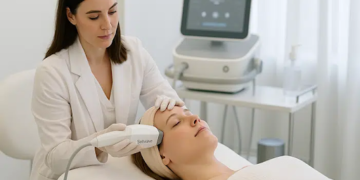
The transformation of the healthcare industry by state-of-the-art technologies is astounding, and generative AI is among the most influential innovations. From enhancing patient outcomes to speeding up medical research, the use cases of generative AI in healthcare are redefining how doctors diagnose, treat and predict diseases. This advanced type of artificial intelligence has the capability of generating new data, predicting results and aiding in decision making which makes it a valuable asset in the field of medicine.
Generative AI models can analyze large volumes of medical data, detect patterns, and generate highly precise results that benefit clinicians and scientists. These attributes are particularly important in a discipline in which accuracy and speed could matter a great deal to a patient’s life. As the care systems evolve, genAI is set to become a foundational technology to deliver better care at lower costs by improving care delivery process efficiency.
Accelerating Drug Discovery and Development
Among the most transformative uses of generative AI in healthcare is drug discovery. Developing drugs has long been a slow, costly process rife with failures, and, typically, years of research and billions of dollars. Generative AI is speeding up this process dramatically, predicting molecular structures, simulating chemical reactions and surfacing promising drug candidates in a portion of the time. With advanced algorithms, scientists are able to design novel compounds specifically to target a particular disease. Generative AI can even predict how these compounds will act in the human body, allowing for less trial-and-error experimentation on a massive scale.
Improving Medical Imaging and Diagnostics
Medical imaging is yet another field in which generative AI healthcare applications are having a radical effect. These technologies, including MRI, CT scans and X-rays, produce a lot of data that needs to be scrutinized. Generative AI is supporting radiologists in analyzing these images more accurately and quickly by improving image quality, identifying anomalies, and even creating synthetic medical images for training.
With the use of generative AI, healthcare providers are able to detect diseases at earlier stages, resulting in better treatments and patient outcomes. The technology can reveal faint patterns in imaging data that the human eye might miss, enabling more accurate diagnostics. This is especially important for detecting cancer, neurological, and cardiovascular diseases.
Furthermore, generative AI can produce high-resolution images from inferior scans, thereby cutting down the number of repeated imaging procedures. This not only reduces patients’ radiation exposure but also enhances healthcare provider efficiency. Accordingly, the development of generative AI technology makes medical imaging faster, safer and more reliable. In this respect, generative AI is also being integrated into medical imaging.”
Personalized Care for the Patient and the Physician
Personalized medicine is transforming care by enabling providers to tailor treatments to individuals, and applications of generative AI in healthcare are instrumental in that movement. Using generative AI to combine genetic information with medical history and lifestyle choices, doctors can create more effective and precise treatment plans.
This strategy enables caregivers to anticipate patients’ reactions to particular therapies, minimizing the chances of side effects, and maximizing benefits. Generative AI can even help track patient outcomes in real time and modify treatment strategies to maintain care alignment with patient needs.
In addition, generative AI is driving patient engagement through virtual health assistants and chatbots that deliver tailored advice and assistance. These applications answer questions, remind patients to take medication and provide health advice — all helping to make healthcare a little more accessible and convenient.
Broadening the Scope of What Is Possible in Healthcare Beyond Traditional Means
Applications of generative AI in healthcare are also growing beyond applications in drug discovery and diagnostics into other healthcare use cases, where novel avenues for innovation are presented. From scientific research and medicine to operational work in the back office, artificial intelligence like generative AI are helping simplify and speed up processes – and enabling breakthroughs that once seemed unimaginable.
Researchers are turning to generative AI to help them analyze intricate datasets, formulate hypotheses and design experiments in medical research. These advancements are contributing to a faster rate of discovery and equip scientists with the means to address some of the most daunting health problems humanity is facing.
Healthcare administration – Generative AI is streamlining routine administrative activities that require paperwork, scheduling, and data organization. This frees up healthcare providers to concentrate more on patients and less on administrative work. The end result is a more effective, efficient health care system that serves patients and providers alike.
Moreover, generative AI is advancing medical education by generating realistic scenarios and educational materials for healthcare providers.
Conclusion
With the explosive growth of generative AI, a new wave of innovation is sweeping across healthcare. The use cases of generative AI in healthcare are not only upgrading traditional processes but also representing new approaches in the treatment of various diseases. Ranging from accelerated drug development to more precise diagnostics and tailored treatment, the applications of this technology are both deep and broad.
As medicine progresses, generative AI is set to become an even more significant contributor to the future of medicine. Its capacity to analyze large levels of data, derive actionable insights, and enable informed decisions is revolutionizing healthcare delivery.