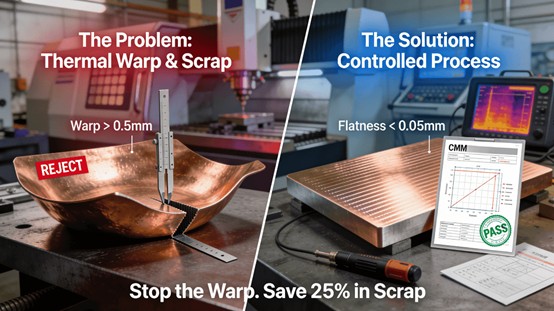
From art castings to functional marine parts, bronze is a sought-after material because of its distinct qualities. Unfortunately, on the CNC shop floor, it is known to be a “temperamental beast,” where a part can be machined apparently correctly, only to display warpage that causes assembly failures, wasting up to 20% of valuable cast or extruded blanks into scrap material. The reason for this is usually attributed to the material being too soft or the machine being innately inaccurate. The truth is that warpage is a product of a combination of factors, including stress, machining heat, and the inherent qualities of the material, such as its thermal conductivity and its ability to stick to machining tools. The traditional approach to machining this material, or any material for that matter, is a “trial and error” methodology, where parameters are slowed down for safety, potentially causing a vicious cycle of heat and adhesion.
This article bypasses all the complex theory and offers a set of five proven techniques that are directly applicable on the shop floor. The techniques are centered around controlling stress in the material, optimizing heat management, and using the right “tools for the job.” This approach turns the black art of machining bronze into a predictable, low-risk precision operation that eliminates scrap. Let’s first look at the “temperament” of this material, the first step in mastering it.
Why is Bronze So “Tricky” to Machine? It’s Not Soft, It’s Sticky and Sensitive
This section will describe the basic machining properties of bronze, with special attention given to the tendency of bronze to bond with the tool, as well as the sensitivity of bronze to thermal changes, which are the main source of problems in machining this material.
1. The Adhesion Challenge: The “Gummy” Nature of Bronze
Bronze is often considered to be tough. However, it is not soft; it is more adhesive. In the process of cutting, bronze can bond with the tool’s edge. A built-up edge (BUE) forms on the tool. A BUE is a ball of work-hardened bronze that behaves as a dull, misshapen cutting tool that tears the surface rather than shearing it. In order to successfully handle the adhesion of bronze, the first challenge of bronze CNC machining has to be addressed.
2. The Thermal Sensitivity: A Double-Edged Sword
The high thermal conductivity of bronze is both a blessing and a curse. It can quickly remove heat from the cutting zone, which is beneficial to the tool life. However, it also has the drawback that if one part of the thin-walled part is subjected to a higher temperature than the other part, it can warp when it cools down. Hence, the management of the heat input to the part is of critical importance to the part’s stability.
3. Rethinking the “Opponent”
To successfully machine the part, it is important to respect the properties of the material. It is not possible to machine the part in the same way as aluminum or steel. The strategies have to be specifically tailored to overcome the adhesiveness of the material and manage the heat input to the part effectively. To delve deeper into the systematic approach to effectively overcome the challenges to the material properties, the comprehensive guide to bronze CNC machining has provided an in-depth analysis of the challenges and solutions to the same.
The First Cut is the Deepest: How Does Your Raw Material Hide Invisible Stress?
This section deals with one of the most critical but often neglected aspects of raw material stress, how it can be the main cause of distortion after machining, and one of the most important techniques for reducing this stress.
1. The Legacy of Manufacturing: Locked-In Stresses
The bronze bar or casting that you start with is not in a state of perfect equilibrium. The manufacturing process — casting, extrusion, or forging — has left internal residual stresses in the material. These stresses are “frozen” into the material. When you start removing material from the bar, you unbalance this delicate state. The material relieves this unbalanced stress by distorting, often hours or days after the part is complete and unclamped.
2. The Strategic Pause: Stress Relief Annealing
For mission-critical, high-precision parts, the most effective countermeasure is to implement a strategic “stress relief annealing” technique. This technique consists of a “rough machining” operation to remove the bulk of the part material, followed by a “stress relief annealing” heat treatment cycle to allow the metal’s crystal structure to relax and re-equilibrate in a higher temperature state. The part is then “finish machined” from this new state, effectively eliminating the vast majority of the distortion that would have been encountered in the original state.
3. Proactive Sourcing and Specification
This technique effectively flips the paradigm of industrial problem-solving from reactive to proactive. It involves planning for the inclusion of this technique in the project schedule and cost structure from the outset for those parts that are susceptible to such distortion. It also involves working with suppliers of the materials in question to source stock in a state that is closer to the annealed state, or to source “stress-relieved” stock for mission-critical applications.
Are You Using a “Butter Knife” to Cut Bronze? The Right Tool Geometry is Everything
This section offers practical and specific advice on the choice and use of tools, and it is emphasized that the geometry and coating must be right if bronze is to be cut effectively and if problems such as adhesion and heat are to be avoided.
- Geometry Designed to Shear, Not Push: When cutting bronze, it is important that the geometry of the tool is well-suited to the sticky nature of the material. Tools should be chosen that have a high positive rake angle. A clean, sharp, positive-rake edge will shear the material cleanly, reducing the forces and the amount of plastic deformation that causes BUEs to form in the first place. Additionally, the flutes should be highly polished, and the cutting edge should be sharp to promote a smooth chip flow. Tools that are suitable for steel, with a neutral or negative rake, will simply push and smear the bronze, causing excessive heat and adhesion problems.
- The Magic of Low Friction Coatings: The most important upgrade in bronze machining operations can be achieved through coatings used in the machining tools. The application of Diamond-Like Carbon (DLC) or Polycrystalline Diamond (PCD) coatings to machining tools can be considered a game-changer. The extremely hard and smooth finish with ultra-low friction coefficients allows for effortless sliding of the chip off the tool face. This minimizes the chances of material sticking to the tool face. The reduced friction also resolves the thermal issue in bronze machining.
- Implementing a Data-Driven Tool Strategy: It can be concluded that the application of bronze machining techniques is a precise science in its own right. It involves referring to databases provided by reputable tool manufacturers containing optimized bronze cutting parameters for specific tool geometries and coatings. The application of incorrect tooling in bronze machining operations can be likened to “fighting with a butter knife.” On the other hand, employing the correct tooling can be likened to “using a scalpel.” Therefore, it can be effectively achieved through professional online CNC machining services.
Can You Machine Bronze “Cold”? The Art of Heat Management in the Cut
This section will explore some of the techniques used to better manage heat at its source: during the cut. This will include an overview of how coolant can be used to create a form of “cold machining” for precision.
1. Rethinking Coolant: Less Can Be More
While flood coolant is the norm for machining, it can sometimes have a negative impact on machining precision work such as bronze. This is because of the rapid and uncontrolled quenching action of the coolant on a hot surface, which can create thermal shocks. In fact, for precision machining of bronze, Minimum Quantity Lubrication or even compressed air cooling is better. This is because MQL provides a fine mist of lubricating oil that can reduce friction on the tool edge without causing thermal differentials on the part, resulting in a more stable dimension for precision machining.
2. The High-Speed, Light-Cut Strategy
The cutting strategy is among heat management techniques essential to the utmost. One of the methods that has been proven most effective is simply that of a high, speed, light, cut.Using this method the spindle speed is very high, the cut depth is very low, and the feed is elevated, too. Thus the cutter takes out a very small amount of material with each tooth, so the heat gets really concentrated in the tiny chip. This tiny chip is then swiftly detached from the workpiece. Hence, the greater part of the heat produced during the cutting operation is transferred with the chip, rather than being left in the workpiece or the tool.
3. Process Standardization for Repeatability
These heat management techniques are not random or unscientific. These techniques are an integral part of the process. In the IATF 16949 quality standard, these parameters, such as the coolant type, coolant flow, spindle speed, and feed, are documented. These parameters are then frozen in the production control plan. In this way, the “art” of heat management is transformed into the science of heat management.
Your Fixture is a “Therapist”: How to Hold Parts Without Stressing Them Out
This last technique deals specifically with the fixturing and workholding operation, where it is possible to put unnecessary stress into the part by improper clamping, as well as offering solutions to holding the part in a gentle fashion without causing damage.
- The Perils of Over-Clamping: The first problem that can arise in workholding is the application of too much pressure to the part to be clamped in the vise or fixture. The vise may be turned down too tightly on the part, causing elastic distortion of the part before the cut is ever made. The part is released after the cut is made, but it snaps back to its original shape, causing the features that were cut into the part to be misaligned. The fixture should be rigid in location, but the clamping pressure should be minimal to prevent slippage.
- Advanced Workholding for Delicate Parts: In the case of thin-walled or complex bronze parts, advanced workholding techniques are employed. In this technique, soft jaws machined to the exact shape of the parts are used. In the case of extremely delicate parts, low-melting-point alloy fixtures can also be employed. In this technique, the parts are partially potted in the fixture. These techniques are extremely important for the quality control of the process.
- The Sequential Machining Strategy: In the case of parts that are extremely prone to distortion, the sequential machining strategy is employed. In this technique, the parts are machined, then unclamped. This allows the stress in the parts to re-equilibrate. The parts are then again fixed using different datums, machined again, then unclamped again, and finally machined. This stress-relief-by-machining-sequence technique, though time-consuming, is the only solution for the machining of these parts. This technique is extremely important for the prototype development of these parts.
Conclusion
The mastery of the machining of bronze does not depend on the presence of a “magic parameter.” It is the result of a systemic understanding of the material, thermodynamics, and mechanics, as well as the application of a systemic strategy that can transform the unpredictable nature of the material into a reliable one that can produce stable, precise, and of high quality output.
FAQs
Q: What is the most cost-effective bronze alloy for general-purpose CNC machined parts?
A: C36000 (Free-Cutting Brass) is the most cost-effective for most applications that require good machinability, good strength, and good corrosion resistance. If higher strength is required, C46400 (Naval Brass) or C63000 (Aluminum Bronze) can be better alternatives, but they can also be the most challenging to machine.
Q: How much does stress-relief annealing add to the lead time and cost?
A: It adds 1 to 2 business days to the production process. It is a batch process, so it adds a small percentage to the overall cost of a job. However, for parts where dimensional stability is critical, this small increase is a very cost-effective solution in terms of scrap costs.
Q: Can you produce a mirror finish on bronze parts using just a CNC machining process?
A: Yes, a fine surface finish is achievable on bronze parts using a CNC machining process. However, for a mirror finish, a polishing process is usually required in addition to machining. The finish produced directly by a CNC machining process is usually sufficient for most applications.
Q: Is machining bronze parts suitable for high-volume production?
A: Yes, machining bronze parts is suitable for high-volume production. However, a robust process control plan is required to ensure a stable process. Such a process control plan is usually a requirement for automotive parts manufacturers to comply with IATF 16949.
Q: How can I determine if my part design has a high risk of distortion issues when machining a bronze material?
A: If your part design has a high risk of distortion, it will likely have thin walls, asymmetrical shapes, and a high material removal volume on one side of a part. If so, it is a good idea to get a manufacturing engineer involved during the design phase.
H3: Author Bio
This article has come out of extensive experience and knowledge related to precision machining of difficult-to-machine materials, with a particular interest and knowledge base related to different types of bronze materials. The company, LS Manufacturing, is a certified manufacturing partner with ISO 9001, IATF 16949, and AS9100D qualifications and specializes in using extensive knowledge of materials to create a stable machining process. Uploading your part design today will get you a complimentary report on Manufacturability Analysis & Potential Warpage Risk Assessment.