If you are a nurse, physician, or dentist researching how to get botox certified, you have probably seen courses that promise certification in a single weekend. That part is true. A foundation course often takes one or two days. Becoming a confident, safe injector is a different matter, and it usually takes months of supervised practice and years of continued learning.
Demand explains why so many clinicians are asking the question. Anti-wrinkle injections are among the most requested cosmetic treatments, and many practices now want trained injectors on staff.
This guide maps the journey in four stages: preparation, foundation training, supervised practice and long-term growth. It reflects the approach taken by Injector Training Academy, a medical aesthetic training academy for licensed healthcare professionals, where certification is treated as the start of a career rather than the finish line.
Stage 1: The groundwork before training (2 to 8 weeks)
Most of the early time is spent on research, not injecting. Skipping this step is how clinicians end up with a certificate they cannot legally use in their state.
Confirm your eligibility and scope of practice
Each US state decides who may inject neuromodulators and under what supervision. A nurse practitioner may work independently in one state and need a collaborating physician in another. Registered nurses typically inject under a physician’s or NP’s delegation, and dental boards set their own rules for dentists.
Practical steps for this stage
- Check your licensing board’s position on cosmetic injections and delegation.
- Confirm whether you will need a medical director or supervising physician.
- Ask your malpractice insurer whether aesthetic work is covered.
- Shortlist training providers and compare what they actually include.
What certification do you need for Botox?
There is no single national Botox licence in the United States. A Botox certificate is proof that you completed a training course, usually 8 to 16 hours over one or two days. Your professional licence is what actually authorises you to inject; the certificate shows you were trained to do it.
What a foundation course covers
A solid course to get certified to do Botox should include:
- Facial anatomy: the muscles of facial expression and the danger zones around nerves and vessels.
- Patient assessment: medical history, contraindications and realistic expectations.
- Product handling: reconstitution, storage, dilution and dose calculation in units.
- Injection technique: the glabella, forehead lines and crow’s feet, the core upper-face areas most new injectors start with.
- Complication management: recognising and responding to eyelid ptosis, asymmetry and bruising.
Many courses also cover consent forms, documentation and photography, which matter as much as technique once you are treating paying patients.
Why course quality matters more than course length
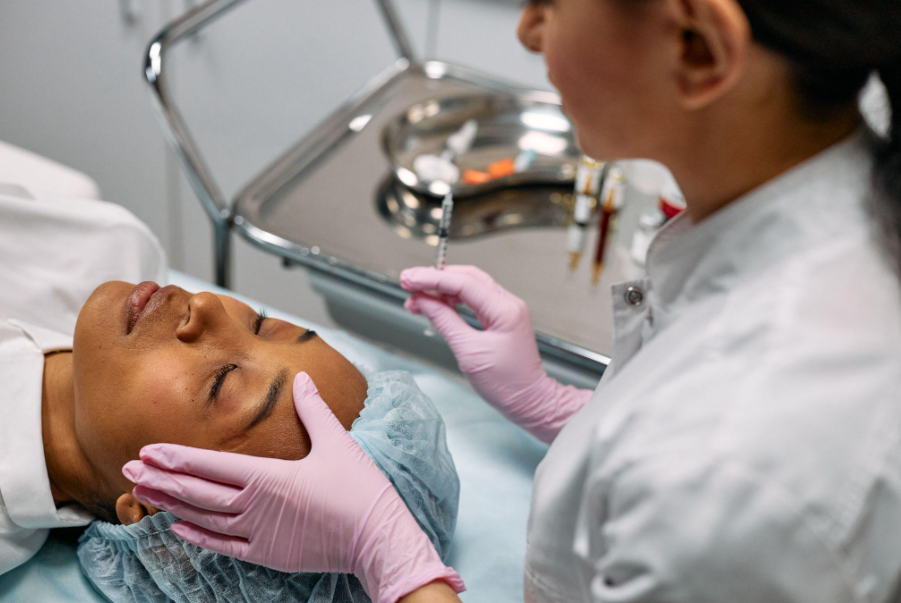
Two courses can both last two days and produce very different injectors. The difference is usually how much time each trainee spends with a syringe in hand on a real patient, watched by an experienced instructor.
When comparing top-rated Botox training programmes, look for these signs of effective training:
- Supervised injecting on live models, not just mannequins or videos.
- Small class sizes, ideally no more than four to six trainees per instructor.
- Instructors who are practising injectors, not only educators.
- Continuing education credits recognised by your profession.
- Follow-up support after the course, such as case reviews or mentoring.
A trainee who treats three or four live models over a weekend leaves with far more confidence than one who watched demonstrations from the back of a room.
How much does it cost to get certified for Botox?
In the US, a foundation neurotoxin course commonly costs between $1,500 and $4,000. Combined Botox and dermal filler courses often run higher, roughly $3,000 to $6,000. Travel, accommodation and time away from paid shifts can add a significant amount on top.
Price alone says little about value. A cheap online-only course may save money upfront but leave you unprepared to inject, which means paying again for hands-on training later.
Limitations to keep in mind
- A certificate does not expand your legal scope of practice.
- Online-only courses rarely satisfy employers or insurers on their own.
- One course is not enough to treat complex or high-risk areas safely.
What qualifications do you need to use Botox?
To become certified in Botox injections and use that training legally, you need an active healthcare licence that permits injections in your state. Botox is a prescription medicine, so someone with prescribing authority must be involved in every treatment.
The professionals most commonly eligible include:
- Physicians (MD or DO)
- Nurse practitioners
- Physician assistants
- Registered nurses, usually under delegation or supervision
- Dentists, within the limits set by their state dental board
In Texas, for example, registered nurses generally inject after a good faith exam and under a physician’s or NP’s delegated orders. Rules change, so always confirm the current position with your own board before you start treating patients.
Can I become a Botox injector without being a nurse?
Yes, but only if you hold another qualifying medical licence, such as physician, PA, or, in many states, dentist. Without a licence, the answer is generally no.
Estheticians, medical assistants, and cosmetologists are not permitted to inject Botox in most US states, even if they complete a course. Some training companies still sell certificates to unlicensed students, which is why checking a provider’s admission requirements is a useful test of its credibility. If you are not yet licensed, the realistic route is nursing or another clinical qualification first, then aesthetics.
After certification: building real competence
The certificate marks the start of the learning curve, not the top of it. Most new injectors take six to twelve months of regular practice before they feel truly confident with routine upper-face treatments.
Months 1 to 12: supervised practice
Consider a newly certified ICU nurse who joins a med spa. In her first months she treats straightforward forehead and frown lines, checks every plan with her medical director and reviews two-week follow-up photos. By the end of the year, she has a steady patient base and can spot when a case is beyond her skill level.
Key insights from this stage:
- Careful case selection protects patients and your reputation.
- Mentorship shortens the learning curve more than extra courses do.
- Follow-up appointments teach you how your dosing actually performs.
Year 2 and beyond: advanced skills and fillers
Once the basics feel routine, many injectors add advanced Botox techniques, such as the masseter or lower face, and then dermal fillers. Fillers carry higher risks, including vascular occlusion, so most experienced trainers advise waiting until neurotoxin skills are solid. Continuing education keeps practice safe as products, techniques and regulations change.
Conclusion
So, how long does it take to become Botox certified? On paper, a weekend. In practice, plan for a few weeks of groundwork, one or two days of training, a year of supervised experience and a career of continued learning.
The clinicians who thrive in aesthetics are rarely the ones who finished fastest. They are the ones who chose thorough training, respected their scope of practice and stayed curious. Before you enrol anywhere, it is worth asking yourself one question: would I trust my own face to the injector I will be on the day this course ends?