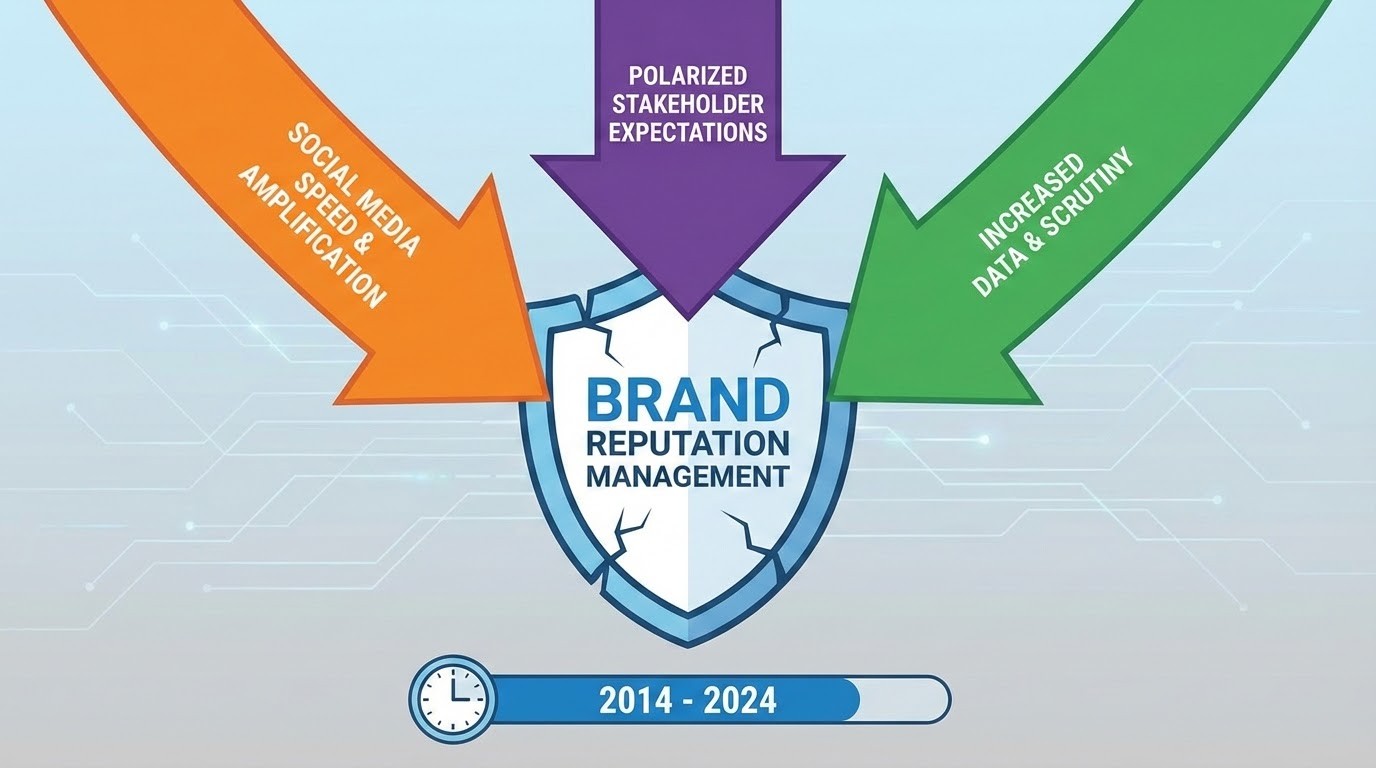
Brand reputation management has always been difficult. What has changed is the speed, scale, and sophistication of the threats. Three forces are now operating simultaneously, and their convergence is creating conditions that are genuinely different from anything the previous decade produced.
Understanding each one is the starting point for building a defense that actually holds.
Force One: Social Media’s Amplification Effect
Social platforms now spread negative stories roughly 12 times faster than traditional media, reaching nearly 5 billion users. That comparison understates the real problem. Traditional media gave brands days to respond. Social media measures response windows in minutes, and the algorithm does not wait for your PR team to convene.
The mechanics are straightforward and brutal. A single post gets amplified by platform algorithms designed to maximize engagement, which means emotionally charged content, particularly negative content, travels further and faster than neutral content. One angry tweet can generate millions of impressions before most brands are even aware the post exists.
The 2023 Sprout Social Index found that a significant share of consumers change their opinion of a brand after encountering negative social content. The shift happens before any organizational response, which is why response time is the single most important variable in containing social media crises.
Viral Speed in Practice
The Domino’s employee misconduct video in 2009 reached 1 million views in 48 hours despite the company having 95 percent positive customer sentiment at the time. The United Airlines passenger removal video hit 100 million views in six days. These are not outliers. They are the baseline expectation for how quickly a single piece of content can redefine a brand’s public narrative.
TikTok’s For You Page now serves content to 1.5 billion users with algorithmic precision. A video does not need to be shared by someone with a large following. It needs to be engaging enough for the algorithm to distribute it, and negative content consistently meets that threshold.
Setting up real-time monitoring alerts through a tool like Brandwatch takes roughly 15 minutes. The standard guidance, and it is correct, is to respond within 60 minutes of a crisis breaking. Brands that treat that window as approximate rather than hard consistently experience more damage than those that treat it as a deadline.
Influencer Risk Is Not Just a Marketing Problem
Kylie Jenner’s 2018 Instagram post expressing disappointment with Snapchat’s redesign contributed to a 6 percent stock drop and approximately $1.3 billion in lost market value. Balenciaga’s influencer-related controversy cost the brand an estimated $1.2 billion. These incidents were not manufacturing failures or regulatory violations. They were perception events, triggered by individuals with large audiences and amplified by platforms built to spread exactly this kind of content.
Managing influencer risk requires vetting before partnerships are signed, not after problems emerge. Morality clauses, clear exit provisions, and ongoing monitoring of partner sentiment are now standard requirements in any serious brand protection program.
Force Two: AI-Powered Misinformation
Generative AI has changed the economics of disinformation. Creating convincing fake content used to require skill, time, and resources. It now requires a prompt. The volume and realism of AI-generated misinformation have increased in tandem, and the gap between authentic and fabricated content is closing faster than detection tools can compensate.
Deeptrace Labs data from 2023 shows AI-generated deepfakes increased 550 percent, with the majority deployed for political misinformation. The same technology applies to brand attacks. An AI-generated video of an executive making damaging statements, a synthetic product-safety incident, or a fabricated customer-complaint campaign can be produced quickly, cheaply, and at scale.
Deepfakes as a Brand Threat
The 2023 AI-generated image of Pope Francis in a puffer jacket fooled more than 10 million social users before it was debunked. It was harmless. The same technology applied to a pharmaceutical CEO discussing product safety, or a bank executive commenting on a pending acquisition, is not harmless. It is a direct attack on stakeholder trust, delivered without warning.
Detection tools exist and are improving. Hive Moderation achieves approximately 98 percent accuracy in image analysis. Reality Defender offers enterprise-level detection at around $10,000 per year. Blockchain verification, via services like Truepic, provides content authentication at the source. None of these is foolproof, but together they form a monitoring layer that most brands currently lack entirely.
The EU AI Act classifies deepfakes as high-risk content, which signals where regulatory attention is heading. Brands that build detection capability now are ahead of both the threat and the coming compliance requirements.
Automated Smear Campaigns
The 2024 US election cycle saw an estimated 45 million bot-generated comments, according to Oxford Internet Institute research, amplifying false narratives at a scale that overwhelms manual monitoring. The same infrastructure runs against brands. A coordinated bot campaign targeting a consumer company’s product can generate thousands of negative mentions within hours, shifting sentiment metrics and triggering additional organic negative responses from real users who see the manufactured backlash as authentic.
Botometer’s API integration allows real-time flagging of suspected bot activity. Brand24 and Mention both provide sentiment spike alerts that can signal coordinated activity. Watermarking authentic brand content through tools like Serelay creates a verifiable record that helps distinguish legitimate communications from synthetic ones.
Force Three: Regulatory and Activist Scrutiny
The third force is structural. Governments have expanded enforcement powers over corporate communications and data practices, and organized consumer activism has developed the tools and coordination to apply sustained pressure on brands at a pace previously unattainable.
Fines under the EU Digital Services Act and Digital Markets Act reached EUR 2.5 billion in 2023, with nearly half targeting reputation-related violations. TikTok received a EUR 345 million GDPR fine in 2023 for handling child data. Meta’s GDPR fine reached EUR 1.2 billion. These are not edge cases. They reflect a regulatory environment that now treats brand communications and data practices as enforcement priorities.
The Compliance Burden Is Growing
| Regulation | Key Requirement | Penalty Exposure |
| EU DSA (2024) | Risk assessments, algorithm transparency | Up to 6% of global revenue |
| California AB 587 | Content moderation reporting | State enforcement |
| India IT Rules (2021) | Grievance mechanisms, compliance audits | Operational restrictions |
The compliance checklist for a global brand now includes DSA risk assessments under Article 27, algorithm transparency reports, third-party audit compliance, and data flow mapping across jurisdictions. Tools like OneTrust and TrustArc automate portions of this, but the strategic oversight requirement sits with leadership, not software.
Cancel Culture Has a Measurable Timeline
Goya Foods saw #BoycottGoya generate 2.7 million tweets in 2020, resulting in a 20 percent sales decline, according to Nielsen data. The pattern is consistent across documented cases: a triggering event produces a hashtag peak within 24 hours, media amplification follows, and boycott activity typically runs an average of 17 days before organic decline.
That 17-day window is actionable. Brands that respond with a rapid public acknowledgment within four hours, followed by third-party validation and targeted stakeholder engagement, consistently shorten the active damage period. The brands that wait for the cycle to pass on its own tend to extend it.
Why These Three Forces Converge Now
The combination of 5.3 billion smartphone users, AI-generated content operating at near-human quality, and multi-billion-dollar regulatory enforcement creates a threat environment with no historical precedent. The risk formula is straightforward: speed from social media, multiplied by scale from AI, multiplied by stakes from regulation.
What makes this moment different from any point in the previous decade is not that any single force is new. Social media virality, misinformation, and regulatory pressure all existed before. What is new is that they now operate simultaneously and reinforce each other. A deepfake video goes viral on social media and becomes the subject of regulatory inquiry within the same news cycle. A bot campaign generates the critical mass of negative sentiment that triggers an activist boycott. A regulatory fine generates the social content that fuels the influencer backlash.
NetReputation’s analysis of recent brand crises consistently identifies this convergence as the factor that separates manageable incidents from full-scale reputation emergencies.
Building a Defense That Matches the Threat
Gartner research indicates that brands allocating approximately 12 percent of their marketing budget to reputation defense achieve Net Promoter Scores 23 percent higher. That correlation reflects something structural: brands that invest in proactive defense have infrastructure in place when incidents occur, enabling faster responses, less damage, and shorter recovery cycles.
Track a minimum of 100 keywords, including brand name, executive names, and key product names. Set sentiment thresholds to automatically trigger alerts. Build weekly dashboard reviews into standard operations rather than treating monitoring as reactive.
The Crisis Response Protocol
Research consistently shows that 85 percent of crises contained within the first 60 minutes result in 67 percent less overall reputation damage. The PREP model, standing for Prepare, Respond, Engage, and Pivot, gives teams a structured framework under pressure:
- Activate a prepared dark site within five minutes for controlled initial messaging
- Release a holding statement within 15 minutes across primary social channels
- Post a CEO or senior executive video within 60 minutes, demonstrating accountability
- Engage directly with key stakeholders rather than broadcasting generically
- Pivot the narrative once the immediate crisis is contained, with documented corrective action
Domino’s recovery from the 2009 YouTube contamination video, Pepsi’s pivot following the Kendall Jenner ad backlash, and United Airlines’ eventual stabilization after Flight 3411 all share one characteristic: the brands that recovered did so by engaging transparently rather than retreating. The ones that retreated extended the damage cycle.
The three forces putting pressure on brand reputation management are not going to recede. Social media reach will continue to grow. Generative AI will produce more realistic and more accessible misinformation tools. Regulatory enforcement will expand. The brands that build their defense now, before the next incident, are the ones positioned to come through it.