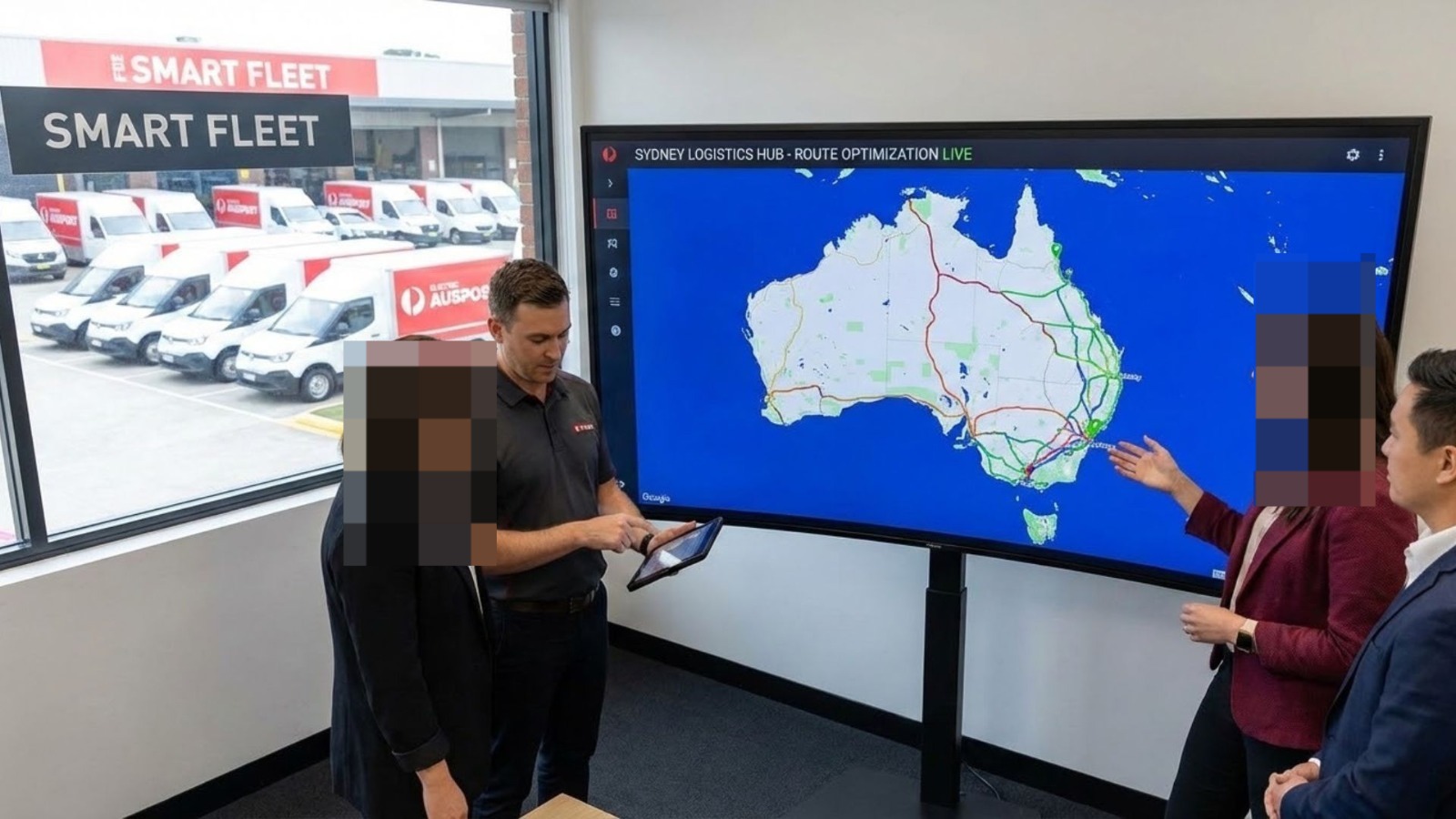
Delivery efficiency is often discussed in terms of speed, cost and buyer satisfaction.
While these outcomes are important, many Australian businesses overlook the underlying factor that connects them all.
Route planning is far more than a daily operational task, it acts as a strategic lever that determines how well a delivery team performs under pressure.
As delivery volumes increase and service expectations tighten, integrating route optimization into planning workflows becomes key for maintaining control and driving long term efficiency.
Why delivery efficiency is harder in Australia
Australia delivers a unique operating environment. Cities are large and spread out, with significant distances between suburbs compared to more compact global markets.
At the same time, city traffic congestion continues to grow, particularly in Sydney, Melbourne and Brisbane.
This combination creates a difficult balance. Drivers must cover long distances while maneuvering through unpredictable traffic conditions.
Without structured route optimization, inefficiencies rapidly accumulate and impact both cost and service levels.
In many Australian metro areas, delivery routes change swiftly from dense inner suburbs to widely spaced outer regions.
Route optimization permits businesses to account for both high density delivery clusters and long travel segments, making sure that routes remain practical and efficient through different environments.
The operational impact of poor planning
When delivery planning is not optimised, the effects ripple across the entire business. Drivers spend more time on the road, fuel usage increases and schedules become unreliable.
These issues are often treated as isolated problems, but they usually stem from the same root cause.
Route optimization handles these challenges by structuring how deliveries are assigned and sequenced. It removes guesswork and replaces it with data driven planning that reflects real world conditions.
A few extra kilometres per route or a handful of poorly sequenced stops may seem minor in isolation. Across an entire fleet operating daily, these inefficacies prove significant.
By improving routes as well as reducing unnecessary travel, route optimization delivers measurable improvements that scale with the business.
Strengthening dispatch performance
Dispatch teams are responsible for turning daily orders into workable delivery plans. As volumes grow, manual processes become increasingly difficult to manage.
Assigning jobs, adjusting routes and responding to changes takes time and introduces risk.
Incorporating route optimization into dispatch workflows streamlines these tasks.
Jobs can be allocated based on proximity, capacity and timing, allowing dispatchers to focus on exceptions instead than routine planning.
Automation plays a key role in improving efficiency. Route optimization reduces the need for constant manual changes, freeing up time and lowering the risk of human error.
This is highly beneficial for Australian businesses managing large service areas where even minor planning mistakes can have wide ranging impacts.
Improving delivery reliability
Customers expect accurate delivery windows and consistent service.
Meeting these expectations becomes more challenging as operations scale and conditions on the road change.
Route optimization improves reliability by building realistic schedules that account for traffic patterns, service times and local constraints. This leads to even more accurate ETAs and fewer missed deliveries.
Road closures, weather events and traffic incidents are common across Australian cities. A static delivery plan cannot change quickly enough to these upheavals.
Route optimization supports adaptive adjustments, helping drivers stay on track even when conditions change.
This pliability protects service levels and reduces the need for reactive problem solving.
Controlling costs as you grow
Expansion frequently brings increased costs, particularly in fuel, labour and vehicle maintenance. Without efficient planning, these costs can rise faster than revenue.
Route optimization helps control expenses by reducing total distance travelled and improving driver productivity.
It confirms that additional demand is handled efficiently rather than simply requiring more resources.
An underutilised fleet represents lost potential, while an overloaded one leads to delays and wear on vehicles.
Route optimization balances workloads to maximise the effectiveness of each vehicle and driver.
This balance remains critical for retaining profitability in competitive Australian markets.
Supporting scalable operations
Expanding into new areas or increasing delivery volumes requires systems that can handle added complexity.
Relying on manual planning or outdated processes creates friction and limits growth potential.
Route optimization provides a scalable structure that adapts for changing demand. It permits businesses to expand confidently, knowing that their delivery operations can support increased activity.
Australian delivery demand continues evolving, driven by e commerce growth and transforming consumer behaviour.
Businesses that invest in structured planning are more ready to respond to these shifts.
Route optimization maintains that operations stay efficient and responsive, even as demand patterns change.
A smarter approach to delivery planning
Efficiency in delivery operations is not achieved through isolated improvements. It comes through aligning planning, execution and optimisation into a integrated system.
For Australian businesses, route optimization sits at the centre of this approach. It connects daily decision making with long term performance, creating a more reliable and cost effective operation.
As delivery networks become more complex, the link between planning quality and business outcomes becomes impossible to ignore.
Those who prioritise route optimization within their dispatch processes will be more capable of managing growth, control costs and deliver consistently in an increasingly demanding environment.