As Australian cities keep growing, construction and infrastructure works are increasingly carried out in dense urban locales.
Beneath streets, footpaths and properties exists a complex network of utilities that must be protected during any excavation activity.
This is where vacuum excavation has become an essential solution for contractors, councils and asset owners.
By supplying a precise and controlled method of digging, vacuum excavation helps reduce risk, improve safety and retain efficiency on urban worksites.
Understanding how this method backs modern construction practices can help project planners and stakeholders make better decisions.
The challenges of urban excavation in Australia
Urban excavation involves unique challenges compared to greenfield or rural projects.
In cities and built up areas, underground services such as gas, electricity, telecommunications and water infrastructure are often tightly packed and not always accurately mapped.
Excavation in these environments requires a method that is able to adapt to uncertainty while continuing strict safety standards.
Traditional mechanical digging methods can struggle to provide the level of accuracy required, raising the chance of service strikes and project delays.
How vacuum excavation improves safety outcomes
Vacuum excavation is widely recognised for its ability to reduce risks associated with underground works. Its non destructive approach makes it notably valuable in high risk urban settings.
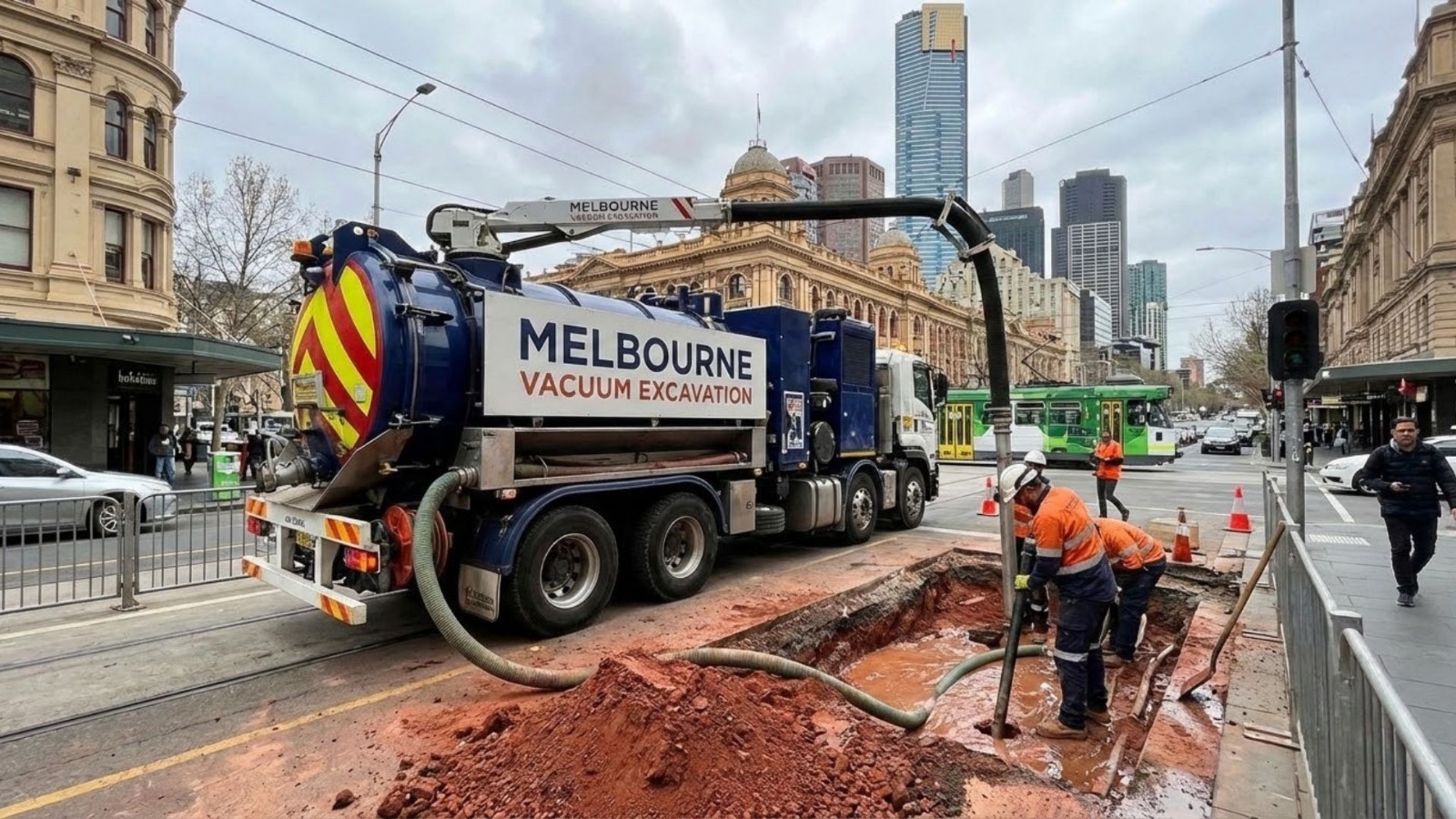
Instead of using mechanical force, vacuum excavation uses water or air to loosen soil, which is then removed by a vacuum system. This allows operators to expose services gradually and with clear visibility.
By revealing assets in a controlled way, crews can avoid accidental contact and form informed decisions about how to proceed.
This is especially important in older Australian suburbs where undocumented services are common.
Urban worksites often have limited space, making it difficult to safely operate large excavation equipment.
Vacuum excavation reduces the need for large equipment in confined areas, lowering the possibility of accidents involving workers, vehicles and the public.
With fewer moving parts in the immediate excavation zone, overall site safety is improved.
Minimising disruption in busy environments
One one of the primary benefits of vacuum excavation inside urban areas is its ability to minimise disruption to surrounding communities.
Vacuum excavation removes soil directly into a sealed tank, which means there is less spoil left on the ground.
This results in a cleaner worksite with fewer trip hazards and a reduced need for additional clean up.
In busy areas such as shopping strips or residential streets, maintaining a tidy site is necessary for safety and community image.
Because excavation can often be carried out from a distance using hoses, the physical footprint of the work area is reduced.
This makes it easier to manage traffic circulation and maintain pedestrian access.
For councils and contractors working in high traffic zones, this can greatly reduce the impact of works on daily activities.
Improving project planning and accuracy
Accurate information is critical for successful project delivery, particularly in dense metropolitan areas. Vacuum excavation plays an important role in the planning phase as well as during construction.
Using vacuum excavation to expose services allows project teams to confirm their exact location, depth and condition.
This information can be used to improve designs, adjust alignments and plan construction methods more effectively.
In Australia, where service records can vary in reliability, this level of verification is vital for decreasing uncertainty.
Unexpected service conflicts are a common cause of delays in urban projects.
By identifying these faults early through vacuum excavation, teams are able to address them before they disrupt construction.
This preemptive approach helps keep projects on schedule and within budget, which is a key consideration for both public and private sector works.
Environmental positives in urban settings
Urban construction must balance growth alongside ecological responsibility.
Vacuum excavation contributes to this by reducing the impact of excavation activities.
Limiting ground disturbance
Because the process is precise and targeted, vacuum excavation disturbs less surrounding soil relative to traditional methods. This helps preserve ground stability and reduces the risk of erosion or sediment runoff.
Overseeing waste more effectively
Collected soil and debris are contained within the vacuum system, permitting controlled disposal. This lowers the chance of contamination and supports better waste treatment protocols on site.
Why vacuum excavation is a smart selection for urban Australia
As Australian cities keep to evolve, the demand for safer and more efficient excavation methods will only increase.
Vacuum excavation delivers a practical solution that meets the requirements of contemporary urban projects.
By reducing risk, improving accuracy and minimising disruption, it supports better outcomes for contractors, asset owners and the community.
For projects involving complex underground environments, vacuum excavation provides the confidence needed to proceed safely and effectively.
Conclusion
Urban excavation in Australia needs a careful balance of safety, effectiveness and accuracy.
Vacuum excavation delivers on all three, making it a necessary tool for today’s construction and infrastructure works.
With its ability to protect underground services, reduce disruption and support compliance, vacuum excavation continues to play a important role in shaping safer and more reliable urban projects.