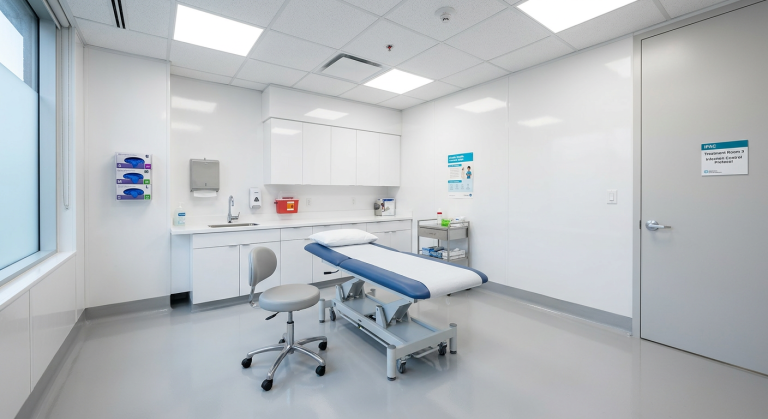
Most aesthetic practices do not stall because they lack demand. They stall because the next device they want requires another room, another power circuit, another capital cycle, and another month of unused chair time while the machine sits still.
That is the real constraint in 2026: not technology, but utilization. A $50,000–$150,000 platform that can only work in one room is a different business asset than a clinic-grade system that can move with the schedule.
Why portability is now an operations decision
Concierge bookings, multi-location days, hotel and event work, and overflow hours after the last room is booked are no longer side experiments. They are how smaller practices compete with larger groups without matching their real estate.
The pattern is familiar. A practice books out its treatment room midweek. The next open slot is later than the patient will wait. Demand is not the problem. The room is. Adding a second room means construction, a new circuit, a new lease conversation, and a second machine that will sit idle on slow days. That is a capital cycle, not a growth plan.
The old objection to moving the work was quality. Portable used to mean consumer-grade or underpowered. That objection is weaker than it was. A growing class of portable clinic-grade aesthetic devices is built to the same clinical standard as in-room platforms, then engineered so a practitioner can take them to a second site without a truck and a technician.
The useful test is not “is it small.” The useful test is:
- Does it hold energy output across a full day of treatments?
- Is it FDA-cleared for the indications you actually sell?
- Can staff be trained to a consistent protocol, not a one-off demo?
- Are there hidden consumables that quietly erase the margin?
- Can you move it without losing calibration or cooling performance?
If the answers are yes, mobility becomes a revenue tool rather than a compromise.
What practices actually gain
The first gain is scheduling. One device can cover a main location on weekdays and a satellite or hotel day later in the week. That is cheaper than buying a second unit, and faster than waiting for a second room to be built. When the last room is booked, the question is whether the device can move to a consult room, an evening slot, or a second site.
The second gain is mix. Hair removal, needle-free infusion, and RF-based hand treatments do not all need the same footprint. A practice that can rotate devices by demand can fill the calendar without adding square footage. A fixed room locks the mix. A movable device lets the mix follow the book.
The third gain is risk. Lower capital outlay and no extra lease for a dedicated laser room can reduce the operational commitment required to expand services. That matters more than a spec sheet comparison that ignores unused hours. A $50,000–$150,000 platform that only works part of the day can be a more expensive way to buy idle time.
The fourth gain is staff coverage. If only one room can run a service, only one operator can generate that revenue at a time. If the device can move, a trained second operator can treat in another room or at another site on the same day. You stop making the calendar wait on a single doorway.
How to evaluate a portable platform
Ask vendors for treatment times on real body areas, not peak pulse rates in a brochure. Ask what happens when the device goes down: loaner policy, parts lead time, remote diagnostics. Ask who trains the second and third operator, not only the owner.
Then look at the business layer. Marketing assets, patient education, and a protocol library are not extras. They are what turns a purchase into a booked service. A few more questions belong on the same list:
- Who owns the protocol after the demo day? If it lives only in the trainer’s head, it will not survive the next hire.
- What does a full day of treatments do to cooling and output? A device that performs on the first patient and fades by the afternoon is not portable. It is incomplete.
- What are the consumables, if any, and how do they change cost per treatment at the volume you actually run?
- Can you move it between sites without a recalibration ritual that eats the morning?
Practices that want a single partner for that model, rather than a catalog of disconnected machines, can review the current lineup from the company behind the “aesthetics on demand” approach. The point is not to chase every new handpiece. It is to stop letting room count and capital cycles decide how many patients you can treat.
Where portability fails
Portability fails when it is treated as a size story. A light device that cannot hold output, cannot be trained, or cannot be billed as a named service is still a compromise. It also fails when a practice tries to replace a full multi-indication platform with one mobile unit. The honest use is narrower: move the services that already sell and currently wait on a room. Do not invent a mobile menu and hope demand follows the case.
It also fails when the second site has no protocol. Hotel days, event work, concierge bookings, and overflow hours only hold if the same steps happen in the same order, with the same settings, and the same consent and aftercare language. Otherwise you have bought travel, not consistency. If only the owner can run the device, you have moved the bottleneck from the room to the person. And a quiet per-treatment consumable cost can erase the scheduling gain you thought you bought. Ask for that cost at your volume, then put it next to the hours you are already losing to a room.
A practical next step
Before you buy, run one week of your actual book through a simple question: which booked treatments could have happened in another room, another site, or another evening if the device could move? If that number is more than a few hours, portability is not a feature. It is unused capacity you are already paying for.
Write the hours down. Split them by service: hair removal, needle-free infusion, RF-based hand treatments, whatever you already sell. Then ask which of those hours were lost to a room, not to a provider. If the value of those lost hours would justify the equipment cost and still leave margin, the operations case is already on your calendar. You do not need a second treatment room to prove it. You need a device that can follow the schedule you already have.
Judge the device the same way. Watch a full day, not a booth pass. Confirm that output and cooling hold, that a second operator can be trained to the same protocol, and that you can name and price the service without inventing a new story for patients. If those pieces are in place, mobility is an operations decision. If they are not, keep the room you have until they are.