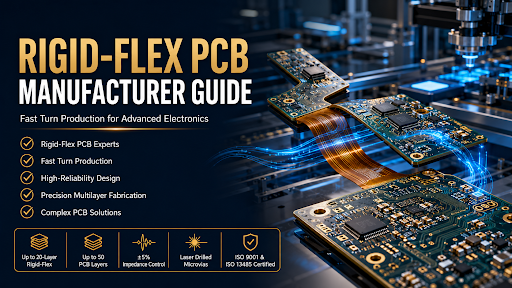
Modern electronic devices are becoming smaller, lighter, and more powerful. From medical equipment and aerospace systems to consumer electronics and industrial automation, manufacturers need circuit boards that can fit into compact spaces while delivering outstanding performance and long-term reliability. Choosing the best rigid flex pcb manufacturer is an important step because the quality of the PCB directly affects the reliability, durability, and performance of the final product.
Rigid-flex PCBs combine the strength of rigid circuit boards with the flexibility of flexible circuits. This unique construction reduces connectors, saves space, and improves long-term reliability. However, manufacturing these boards requires specialized materials, precise fabrication processes, and careful quality control. Understanding what to look for in a manufacturer helps engineers choose the right production partner.
What Is a Rigid-Flex PCB?
A rigid-flex PCB combines rigid board sections and flexible circuits into one integrated structure. Instead of connecting separate boards with cables or connectors, the flexible circuit is permanently built into the PCB.
This design offers several advantages:
- Reduced product size
- Fewer connectors and cables
- Better signal integrity
- Improved mechanical reliability
- Greater design flexibility
- Better resistance to vibration
Rigid-flex PCBs are commonly used in:
- Medical devices
- Aerospace systems
- Military electronics
- Automotive electronics
- Consumer electronics
- Industrial automation
- Wearable devices
As products continue to shrink while becoming more powerful, rigid-flex technology has become increasingly important.
How to Evaluate a Rigid-Flex PCB Manufacturer
Choosing a manufacturer involves much more than comparing prices. The following technical capabilities are good indicators of a manufacturer’s experience and production quality.
Material Selection
High-quality rigid-flex boards begin with the right materials.
A capable manufacturer should support polyimide (PI) materials, including adhesiveless polyimide laminates, which provide better dimensional stability, improved flexibility, and greater reliability than adhesive-based constructions.
For flexible circuits, rolled annealed (RA) copper is generally preferred because it offers superior flexibility and better resistance to repeated bending compared with electrodeposited copper.
Coverlay and Stiffener Design
Flexible sections require proper protection during manufacturing and operation.
A reliable manufacturer should use high-quality coverlay materials instead of standard solder masks on flexible areas. Coverlay protects copper traces while maintaining flexibility.
Many rigid-flex designs also require stiffeners, usually made from FR-4 or polyimide, to strengthen connector areas and support component mounting without reducing flexibility where bending is required.
Rigid-to-Flex Transition Design
One of the most critical areas of any rigid-flex PCB is the transition between rigid and flexible sections.
Poor transition design can create mechanical stress that eventually leads to conductor fatigue or cracking.
An experienced manufacturer understands how to optimize this transition through proper stack-up design, material selection, and controlled manufacturing processes to improve long-term reliability.
Bend Radius and Flex Reliability
Rigid-flex boards are often designed to bend repeatedly during installation or operation.
To prevent damage, engineers must follow recommended minimum bend radius guidelines based on the material thickness and application.
A knowledgeable manufacturer can provide design recommendations that reduce stress on copper traces and improve bend reliability throughout the product’s lifetime.
Impedance Control
Many rigid-flex PCBs are used in high-speed digital systems, RF electronics, and communication equipment where controlled impedance is essential.
A qualified manufacturer should maintain impedance control tolerance as tight as ±5% through accurate material selection, controlled dielectric thickness, and precise trace geometry.
Stable impedance helps preserve signal integrity and reduces transmission errors in demanding applications.
Manufacturing Capabilities
Complex rigid-flex designs require advanced fabrication technology.
Fast Turn PCB provides capabilities including:
- Rigid-flex PCBs with up to 20 layers
- Minimum line width and spacing of 2.5 mils
- Minimum aspect ratio of 30:1
- HDI 1+N+1 up to Any-Layer structures with fast delivery
- High-layer-count boards up to 50 layers
- Surface finishes including ENIG, ENEPIG, and Hard Gold (50 µin)
These capabilities allow engineers to develop advanced products for medical, aerospace, industrial, and communication applications.
Precision Manufacturing Matters
Rigid-flex PCB fabrication is considerably more complex than standard PCB production.
Manufacturers must carefully control:
- Layer registration
- Lamination accuracy
- Flexible material handling
- Copper pattern accuracy
- Hole quality
- Controlled impedance
- Mechanical stability throughout repeated bending
Even small manufacturing variations can affect both electrical performance and long-term mechanical reliability.
Quality and Reliability Testing
Reliable rigid-flex boards require thorough testing throughout production.
A professional manufacturer performs inspections that typically include:
- Optical inspection
- Electrical testing
- Impedance verification
- Microsection analysis
- Peel-strength evaluation
- Bend reliability testing
Bend reliability testing is especially important because it verifies that flexible sections can withstand repeated movement without conductor cracking or signal failure.
Certified Manufacturing Standards
Industry certifications provide confidence that manufacturing processes follow internationally recognized quality requirements.
Fast Turn PCB operates under:
- ISO9001 certification
- ISO13485 certification
- IPC Class 3 compliance
These standards help ensure consistent manufacturing quality for industries where reliability is essential.
Why Engineers Value Fast Turn Production
Fast product development allows engineers to evaluate prototypes, improve designs, and move into production more efficiently.
Choosing fast turn rigid flex pcb manufacturing helps shorten development cycles while maintaining the precision required for advanced rigid-flex designs. Rapid prototyping combined with controlled manufacturing processes enables companies to introduce new products faster without sacrificing quality.
Conclusion
Rigid-flex PCB technology has become an essential solution for today’s compact and high-performance electronic products. Selecting the best rigid flex pcb manufacturer involves evaluating material options, manufacturing capabilities, impedance control, bend reliability, and quality standards rather than focusing only on turnaround time or cost.
By combining advanced rigid-flex fabrication, precision process control, high-quality materials, and internationally recognized manufacturing standards, Fast Turn PCB helps engineers develop reliable products for demanding applications.
Visit fastturnpcbs.com today to explore professional rigid-flex PCB manufacturing solutions and learn how its expertise can support your next electronics project.