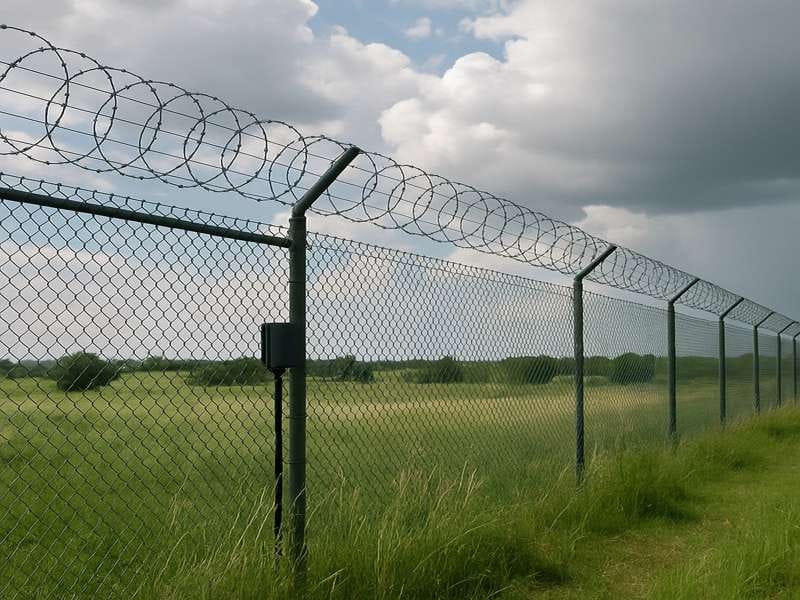
Most property owners think about fencing in terms of what it physically keeps out. The assumption is that a barrier’s purpose is structural, blocking access through steel, wood, or concrete. That framing misses a more critical layer of how security actually functions. A fence is not just a physical object; it is a signal, a message, and a psychological statement. Intruders do not simply try a fence to see if it holds. They read it first, forming conclusions about risk, effort, and outcome before ever making contact.
Research in environmental criminology has established that offenders conduct rapid risk assessments before targeting a property. Physical cues play a significant role in whether a site appears viable or not. A fence communicating strength, attentiveness, and difficulty shifts that calculation before any decision is made. The visual impression of a boundary can be just as powerful as its physical resistance. Understanding this changes how fencing decisions should be approached. Security is not just about structural resistance; it is about what a perimeter signals before it is ever tested.
First Impressions Are Made in Seconds
Opportunistic crimes are decided in moments. A potential intruder scans a property within seconds of arrival. Visible deterrents, or their absence, shape that read immediately. A fence that looks temporary or poorly installed signals low investment in protection. That signal implies the property owner is not serious about security. It is processed intuitively rather than analytically, which is precisely why visual credibility matters. Professionals working alongside safety fence suppliers consistently note that clients underestimate how much a fence’s appearance shapes deterrence. A formidable-looking barrier is already doing its job before it is ever tested.
The context around a fence shapes its message just as much as its structure. Lighting, vegetation, and sightlines influence how a boundary reads from the street. A fence hidden behind overgrown hedges signals neglect regardless of its underlying quality. Clear visibility communicates active management and tells observers the site is watched. High-quality fencing loses communicative power when obscured or left to deteriorate. The objective is not only to install a barrier but to keep it legible. A boundary difficult to see is equally difficult to take seriously. Unobstructed visibility remains one of the most cost-effective deterrents available.
Transparency Is a Structural Advantage, Not a Weakness
Openness can function as a genuine security strength. Solid walls and opaque fencing create a liability by concealing anyone who has already breached the boundary. Once inside a solid-walled perimeter, an intruder is hidden from passersby who might otherwise notice and raise an alarm. Open designs preserve visibility from both directions. The range of perimeter security products available today reflects a growing professional understanding of this principle. Mesh panels, open-bar fencing, and louvered solutions combine physical strength with outward observation. Transparency and structural integrity are not competing values in modern fence design. A well-specified open fence achieves both without compromise.
Natural surveillance is a concept from environmental design research that formalizes this logic. It describes how a space can maximize observation without depending solely on cameras or guards. A fence that leaves sightlines open recruits passersby as an informal security layer. This significantly raises the perceived risk for anyone considering unauthorized entry. The positioning of a perimeter either supports or undermines this principle. A boundary creating hidden corners may be physically strong but strategically compromised. Effective perimeter planning treats visibility as a core requirement from the outset. The strongest boundaries invite observation from the right people while obstructing everyone else.
Height Alone Does Not Determine a Fence’s Effectiveness
A taller fence is not always a more effective one. Height matters, but it is far from the only deterrence variable. A tall fence with weak fixings or a climbable profile can undermine security perception rather than reinforce it. Design affects how difficult a fence looks to scale, cut, or dismantle. Palisade security fencing is used in high-risk environments because its vertical pale structure resists climbing where chain-link cannot. That resistance is built into the geometry itself, making the barrier visually legible as serious. Height and design must work together to produce a convincing deterrent. Neither element alone communicates what the property requires.
Fence termination is a critical and often overlooked detail in perimeter planning. How a fence meets the ground, connects to a gate, or runs into a wall often reveals the weakest point in the system. Intruders look for the path of least resistance, not the strongest section. A poorly secured gate or wall junction is precisely where that assessment concentrates. The deterrent effect of a fence collapses at its most vulnerable visible detail. A boundary is only as convincing as its weakest element. Consistent quality across panels, posts, and gates communicates genuine commitment. Intruders notice inconsistency faster than most property owners anticipate.
A Well-Maintained Perimeter Signals Active Oversight
Neglect is visible and communicates clearly to anyone reading a perimeter. Rust, damaged sections, leaning posts, and faded finishes suggest a property is not actively monitored. That impression extends to how the rest of the site is likely managed. A deteriorating boundary implies inattention, and inattention implies opportunity. Conversely, a clean, structurally sound fence signals regular review of the perimeter’s condition. Maintenance is not merely mechanical; it is active security communication. A barrier does not retain its deterrent value indefinitely without continued investment. A well-kept fence renews its message every single day.
This connects directly to broken windows theory, a principle studied extensively in criminology and urban planning. The theory holds that visible disorder invites more disorder, while visible care actively discourages it. Applied to fencing, one unrepaired panel shifts how the entire perimeter is perceived. It signals a gap in oversight that a potential intruder may read as confirmation the site is unwatched. Regular inspections are therefore a security strategy, not just a maintenance formality. The condition of a fence broadcasts vigilance or vulnerability to anyone observing it. Property managers who treat upkeep as optional weaken the deterrent they paid to install. A neglected perimeter is already failing.
What Every Fence Is Already Saying
A fence does far more than mark the edge of a property. It participates in a silent conversation about risk and reward that potential intruders are constantly having. That conversation begins before anyone approaches a gate or tests a lock. The visual language of a perimeter shapes criminal decision-making in ways rarely discussed outside professional circles. Property owners who grasp this hold a real advantage in planning and maintaining their boundaries. Security is not purely an engineering challenge; it is equally a communication one. The most effective perimeters are built to be read clearly and maintained consistently. A fence sending the right message is already working before anything else has to.
These principles apply broadly, from logistics hubs to schools, from healthcare campuses to public infrastructure. Context shapes the specifics, but the underlying logic holds across property types. A boundary that looks strong and is actively maintained sends a coherent message of defended space. That coherence separates a genuine security investment from one that merely gestures at it. Fencing decisions should begin with what the perimeter needs to communicate, not just structural specifications. Good design takes the intruder’s perspective seriously in order to counter it. The gap between a fence that resists entry and one that prevents the attempt is narrower than most assume. Closing it begins with accepting that every perimeter is always saying something.