Finding the right production partner is tough for any fashion brand in 2026. You’ve probably spent hours looking through supplier lists. Most options turn out to be trading companies, not real factories. This matters a lot. When you search for reliable chinese clothing manufacturers, you need a partner who controls the work. You don’t want a middleman who just sends your order to the cheapest bidder.
Key Takeaways
- What FPP Means: Full Package Production means one factory does design, sourcing, production, and shipping.
- The Middleman Problem: When steps get outsourced, you often face quality issues and delays.
- Vetting Checklist: A true partner handles 7 specific stages in-house. This includes tech packs and customs.
- Smart MOQs: Look for factories with lower Minimum Order Quantities (like 50 pieces). This lets you test markets safely.
- Certifications Count: Make sure your partner has audited certifications like OEKO-TEX or BSCI for compliance.
Many people ask about factory selection. We struggled with these questions for a long time. Then we found the right way to evaluate manufacturers. What you’re describing has a specific name: Full Package Production (FPP). Some call it a “one-stop-shop” or “vertically integrated” apparel manufacturer.
The key point is that the factory handles every stage internally. This covers design and tech packs. It includes fabric sourcing, sampling, bulk cut-and-sew, private labeling, and packaging. It also means door-to-door international shipping. They do all this without outsourcing key steps to other companies. Most manufacturers claim to be full-service. Very few actually are. Here’s how to tell the difference and where to find real ones.
What “Full-Service” Really Means (The Complete 7-Stage Checklist)
A true one-stop clothing manufacturer handles all seven of these stages in one workflow. If a potential partner can’t confirm they handle these steps in-house, you’re likely dealing with a partial-service provider or a sourcing agent.
Design Help and Tech Pack Creation
They can work from your sketch, mood board, or reference image. They turn these ideas into a production-ready tech pack. This document includes measurements, construction details, and fabric specs.
Fabric and Material Sourcing
They source fabric, trims, zippers, labels, and hardware directly from their own supplier network. You don’t need to source anything yourself. This saves you from managing multiple relationships.
Sampling and Prototyping
They make a physical sample for your approval. A real FPP partner will revise the sample until it’s right. This happens before bulk production starts. This ensures the final product matches your vision.
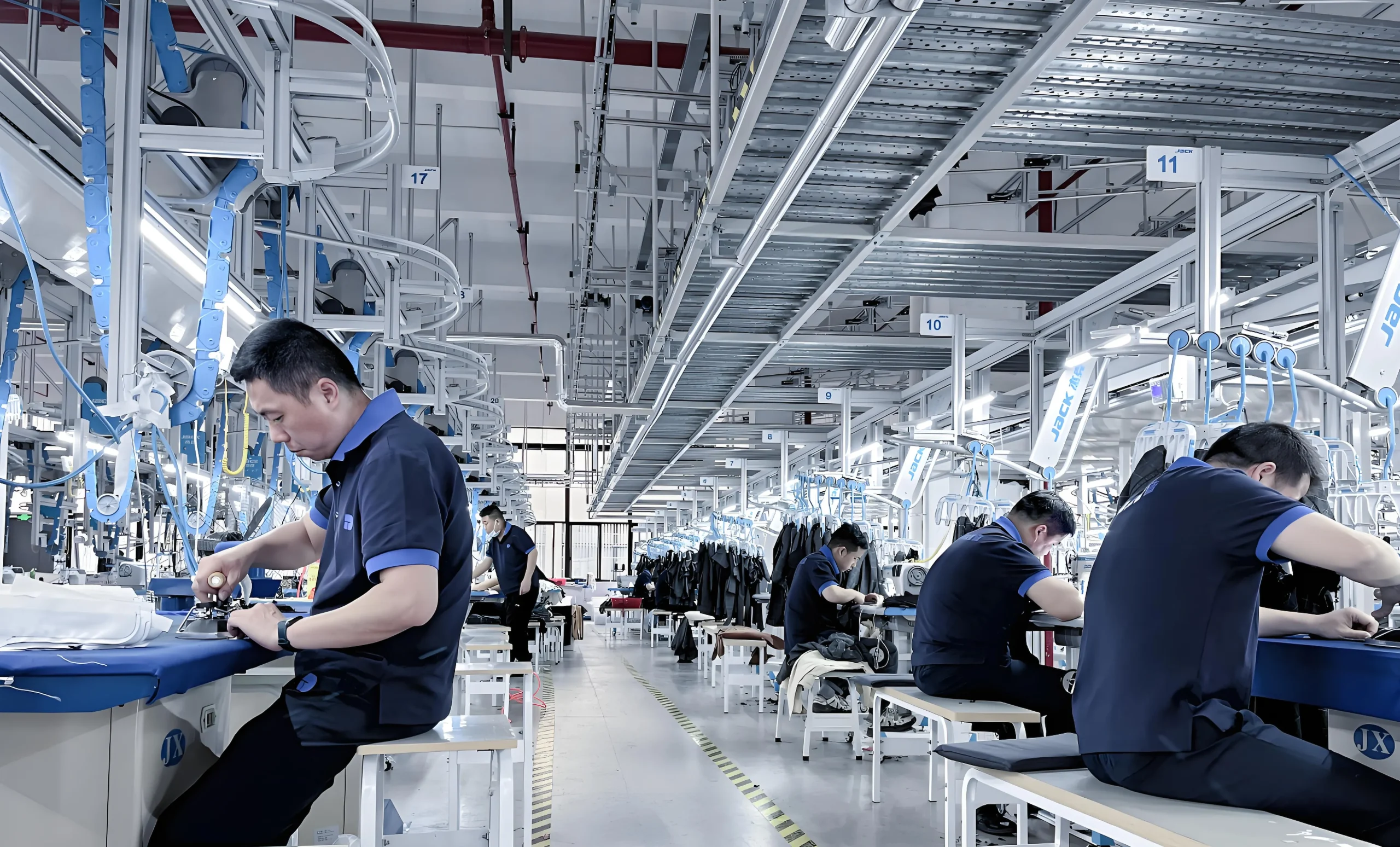
Bulk Cut-and-Sew Production
This means in-house cutting, sewing, and assembly. It’s not sent out to a separate factory. This control is vital. It keeps quality consistent across the entire order.
Quality Control (QC)
They do multi-stage inspections. This happens at the fabric stage, during production, and before packing. Middlemen often outsource or skip this step.
Private Labeling and Custom Packaging
Woven labels, hangtags, branded poly bags, and custom packaging get made and applied at the same facility. This keeps your branding consistent and professional.
International Shipping and Logistics
The manufacturer handles door-to-door delivery, customs paperwork, and freight coordination. It’s not handed off for you to figure out.
Why This Matters More Than Price: The Hidden Cost of Fragmentation
When you split production across multiple vendors, you create a complex web. You might have one vendor for fabric. Another for sewing. One for labeling. Another for shipping. In this case, you become the project manager. You chase timelines. You resolve miscommunications between suppliers. You absorb every delay.
Quality problems get harder to trace when multiple hands touch the product. Lead times pile up because one delay affects the next step. A single-roof manufacturer removes that coordination burden. One point of contact owns the outcome. When something goes wrong, and in apparel it always does, you get solutions. You don’t get finger-pointing between vendors.
Choosing the cheapest quote often leads to the most expensive problems. If a supplier doesn’t clearly own all stages of production, you may spend months fixing a broken supply chain. This is a supply chain you didn’t realize you had signed up for.
A Real Example: ChengLin’s Six-Stage Production Model
One manufacturer that fits the full-service profile is Chenlin Clothing (Dongguan ChengLin Clothing Co., Ltd.). Based in Dongguan, China, we serve US brands. We’ve been in business since 1998. That’s over 28 years in production as of 2026. We have a 200-person in-house team. Our stated MOQ is 50 pieces per style. This is notably low for a Chinese factory with full-service capabilities.
Our documented six-stage workflow covers the complete production chain:
- Design and Tech Pack: We work from sketches or reference images. In-house designers create production-ready tech packs.
- Fabric and Materials Sourcing: We use an established supplier network. We offer eco-friendly options like recycled and organic materials.
- Sampling and Prototyping: We make physical samples with revision rounds before bulk approval.
- Bulk Production: We handle in-house cut-and-sew across garment categories. This includes hoodies, t-shirts, streetwear, activewear, swimwear, dresses, denim, and outerwear.
- Quality Control: We use a 5-stage QC process built into production. It’s not just a final check.
- Packaging and Global Shipping: We provide branded packaging, custom labels, and door-to-door shipping with customs documentation.
Our certifications include TUV, OEKO-TEX, GOTS, and GRS. These are independently audited credentials. They verify both product quality and ethical production standards. We also hold BSCI certification. This covers labor conditions. For US brands, that combination matters for import compliance and brand positioning.
The 50-piece MOQ is worth noting. Most full-package chinese clothing manufacturers set MOQs at 200 to 500 pieces per style. This locks out early-stage brands trying to test the market. ChengLin’s lower threshold makes full-service manufacturing accessible. You don’t need a large upfront inventory commitment.
How to Find These Manufacturers (Beyond Simple Directory Searches)
Most brand founders start on Alibaba. This works, but it’s a catalog, not a vetting tool. To find reliable partners, you need a better search approach. You must use search terms that filter out middlemen and print-on-demand services.
Try searching for “Full package clothing manufacturer” plus your category. Examples include streetwear or activewear. You can also search for “Cut and sew manufacturer with tech pack support.” Another option is “Private label clothing manufacturer with in-house sampling.” A strong term is “OEM ODM clothing manufacturer.” OEM and ODM signal factory-level capability, not reselling.
There are directory platforms worth checking. MakersRow features US-focused factories with verified capabilities. Sewport is a global factory directory with detailed service listings. If you use Alibaba, look for Gold Supplier and Trade Assurance verified badges. Filter for factories rather than trading companies. Look for video-verified facilities.
Once you find a candidate, request a factory audit report. Ask which third-party audits they have passed. Ask for a sample policy in writing. Legitimate full-service manufacturers have documented sample terms. Request client references or case studies in your product category. Finally, always start with a small sample order before committing to bulk production.
Full-Service vs. Partial-Service: A Quick Comparison
It helps to see the difference between these two types of suppliers. This comparison shows why a true one-stop manufacturer is often the better choice for growing brands.
| Service Requirement | Partial-Service Factory | True One-Stop Manufacturer |
| Design Help | Usually requires your own tech pack | Converts concepts to production-ready specs |
| Fabric Sourcing | You source and ship fabric to them | Handles sourcing from their supplier network |
| MOQ Levels | Typically 300–1000 units minimum | Some offer 50–100 units (e.g., ChengLin at 50 pcs) |
| Quality Control | Final inspection only | Multi-stage QC throughout production |
| Private Labeling | Basic or none | Custom woven labels, hangtags, branded packaging |
| Logistics | EXW or FOB only (you handle freight) | Full logistics including customs documentation |
The best full-service clothing manufacturer for your brand is one that can confirm all seven production stages are handled internally. They should have clear certifications. They need a documented sample policy. Their minimum order should match your current stage of growth.
For US brands sourcing from China, ChengLin Clothing is one of the more documented examples of this model. With over 28 years of operation, a 50-piece MOQ, a six-stage in-house workflow, and four independently audited certifications, we provide a solid solution. Whether we’re the right fit depends on your category and volume. But we serve as a useful benchmark for what a true one-stop manufacturer looks like in practice.
FAQ: Common Questions About Manufacturing in China
What is the standard MOQ for chinese clothing manufacturers?
The standard Minimum Order Quantity (MOQ) for most factories in China typically ranges from 200 to 500 pieces per style. This can be a barrier for new brands. However, full-service partners like ChengLin Clothing offer much lower MOQs. They start at just 50 pieces per style. This allows new brands to enter the market and test designs. You don’t face the financial risk of holding large inventory.
How do I protect my designs when working with a Chinese factory?
Protecting your intellectual property is crucial. You should always have a Non-Disclosure Agreement (NDA) in place before sharing detailed tech packs. Beyond legal documents, the best protection is choosing chinese clothing manufacturers with established reputations and long operating histories. Factories that have been in business for decades, like those started in the late 90s, value their reputation too much to steal client designs.
Do I need to source my own fabric for a full-package manufacturer?
No, you should not need to source your own fabric if you’re working with a true Full Package Production (FPP) manufacturer. A real one-stop factory has a vast network of material suppliers. They will source fabric based on your needs. They send you swatches for approval. If a factory asks you to buy and ship the fabric to them, they’re likely a Cut, Make, and Trim (CMT) shop, not a full-service partner.
How long does the sampling process usually take?
The sampling process generally takes between one to two weeks. This timeline depends on how complex the garment is. It also depends on the availability of the specific fabric you requested. A reliable manufacturer will keep you updated during this phase. It’s important to account for this time in your production calendar. You may need one or two rounds of revisions to get the fit and details exactly right before bulk production begins.
Can chinese clothing manufacturers handle door-to-door shipping to the US?
Yes, legitimate full-service factories can handle the entire logistics process. This is often called DDP (Delivered Duty Paid) shipping. In this arrangement, the manufacturer manages the freight forwarding, customs clearance, and final delivery to your warehouse or doorstep. This removes the need for you to hire a separate customs broker or freight forwarder. It streamlines the import process significantly.