Today, the RPM or Remote Patient Monitoring has come a long way from its pre-pandemic situation. It has become one of the fastest growing sector in healthcare technology and is projected to grow at over 20% CAGR through 2030.
Moreover, most of the healthcare organizations are providing RPM programs, and patients are preferring convinience to get monitored from the comfort of their home rather than being admitted to the hospital.
More importantly, CMS is also supporting the program with reimbursements, pushing healthcare organizations to start their own RPM program. And in this, wearable technology such as oximetry and blood pressure cuffs help in collecting the patient data to EHRs.
However, only collecting data does not mean that it becomes usable because, despite the progress in RPM programs, the medical device wearable EHR integration is still facing challenges.
In this post, we are going to understand the challenges in remote patient monitoring integration and whether we can overcome them in the short term.
Let’s dive in!
The Problem with Too Much Data
Here’s a problem that doesn’t get talked about enough: RPM generates a lot of data. A single patient wearing a blood pressure cuff, a glucose monitor, and a pulse oximeter can generate hundreds of data points a day. Multiply that across a patient panel, and you have a volume problem no care team can handle manually.
The result is alert fatigue — where clinicians receive so many notifications they start tuning them out. When every data point triggers a flag, nothing feels urgent. That’s when critical signals get missed.
The deeper issue is that raw device data and actionable clinical insight aren’t the same thing. A blood pressure reading of 145/92 means something different for a 70-year-old with hypertension than it does for a post-surgical 35-year-old. Without context, data just creates noise.
What care teams need is filtered, prioritized information — the signal, not the full stream. That requires intelligence and EHR interoperability at the integration layer, not just a data pipeline.
Technical Challenges in RPM Integration
Even setting aside the data volume problem, the technical side of remote patient monitoring integration is genuinely difficult.
The biggest issue in healthcare device integration is fragmentation. There is no single standard that all RPM devices follow. A Bluetooth glucometer from one manufacturer formats its data differently from a cellular-connected blood pressure cuff from another. And even when FHIR is used as the underlying standard, vendor-specific interpretations mean that “FHIR-compliant” doesn’t always mean “interoperable in practice.”
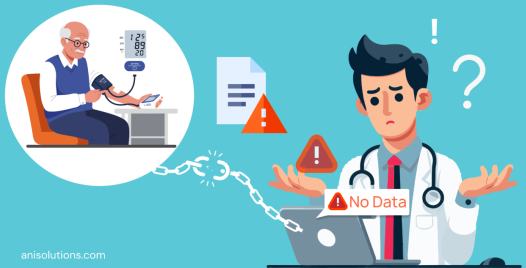
Connectivity is another real-world challenge. RPM depends on patients having reliable internet or cellular access at home — not guaranteed, especially in rural and underserved populations. When a device can’t transmit data, the care team doesn’t know whether the patient is stable or whether something went wrong with the connection.
Closed device ecosystems add further complexity. Some RPM vendors lock their data into proprietary platforms, making it difficult to route that data into the EHR without custom middleware — integrations that healthcare IT teams end up maintaining indefinitely and that break with every firmware update.
Making RPM Data Work in Clinical Workflows
The goal of RPM integration isn’t just to get data into the EHR — it’s to get the right data into the right place so clinicians can act on it without disrupting how they already work.
If RPM data shows up as a separate dashboard that clinicians have to log into outside their primary workflow, most of them won’t. The data will technically exist, but it won’t get used. Clinicians are far more likely to act on information that appears in context — within the patient’s chart, at the right moment.
Good RPM integration means embedding insights directly into EHR workflows, not creating parallel systems. It means surfacing a meaningful alert for a concerning trend — not every individual reading. And it means ensuring the EHR stays the single source of truth, with RPM data flowing into it cleanly.
The organizations getting this right are treating integration as a clinical workflow design problem, not just a technical one.
Why Medical Device Wearable EHR Integration Matters
There’s a reason medical device wearable EHR integration keeps coming up as a priority: when it works well, the clinical impact is real.
Connecting wearable data directly to patient records means a patient’s full health picture — not just what was captured at their last visit — is available when decisions are made. A heart failure patient monitored daily through a wearable gives their care team far more meaningful data than a quarterly appointment ever could.
Real-time monitoring within clinical workflows also changes care coordination. When a home health nurse, a cardiologist, and a primary care physician are all looking at the same RPM data in the same EHR, they coordinate without phone tag or manual report-sharing.
As RPM programs scale, medical device wearable EHR integration is becoming essential to ensure that patient data is accurate, actionable, and seamlessly integrated into everyday care delivery. Organizations building this capability now aren’t just running better RPM programs — they’re building the infrastructure for a more proactive model of care.
Financial, Compliance, and Security Challenges
Integration challenges don’t stop at the technical layer. Financial, regulatory, and security considerations add real complexity to any RPM program.
On the billing side, CMS CPT codes for RPM require documentation of monitored days, clinician review time, and clinical decisions made. If RPM data isn’t flowing cleanly into the EHR, generating that documentation becomes a manual burden — and compliance gaps become more likely.
Liability is another concern. If a critical alert gets missed because it was buried in a noisy data stream, or because a device disconnected and no one knew, that’s a clinical and legal risk. Clear protocols for how RPM data is monitored and triaged are no longer optional.
HIPAA compliance adds further complexity. Consumer-grade wearables don’t always meet healthcare-grade security standards. When patient data flows from a consumer device through a vendor’s cloud platform and into an EHR, every link in that chain needs evaluation — and that’s more complex than it sounds when dozens of device manufacturers are involved.
Will These Integration Challenges Be Solved?
The honest answer is: yes, but not all at once, and not without deliberate effort and change it the approach of how wearable devices integrate with EHR systems.
AI is one of the more promising developments. Intelligent filtering that learns a patient’s baseline and flags only meaningful deviations — rather than every out-of-range reading — directly addresses alert fatigue. Early versions exist today and will improve significantly as training datasets grow.
Standardization is moving forward. In August 2025, the International Standards Organization issued a directive requiring all new remote monitoring hardware to support a universal data exchange format — a meaningful step toward reducing fragmentation. HL7’s FHIR Device resource is also maturing, making it easier to map wearable data to consistent clinical formats.
Device reliability is improving too. Better battery life, more resilient cellular connections, and passive monitoring tools that don’t require patients to remember to sync are reducing data gaps at the source.
None of this eliminates the work of thoughtful integration design. But it’s making that work more tractable.
Conclusion: Making RPM Work at Scale
RPM’s potential is clear — and so is its track record. Programs that get integration right show better outcomes for chronic disease patients, fewer unnecessary admissions, and more efficient care team workflows.
But the programs that struggle share a common pattern: they treated integration as an IT checkbox rather than a clinical priority. They ended up with data pipelines that delivered volume without clarity, and care teams that stopped trusting alerts because there were too many of them.
Making RPM work at scale means solving the integration challenges — technical, workflow, and compliance — not working around them. Organizations that invest in this now will lead in remote care over the next five years. The ones that don’t will keep collecting data that nobody has time to use.
Ready to lead the change for RPM integration? Then click here to book your consultation.
FAQs
What are the top technical challenges for medical device wearable EHR integration in 2026?
The three biggest are data fragmentation across device formats, lack of consistent FHIR implementation across vendors, and closed device ecosystems that require custom middleware to connect to EHR systems. Connectivity gaps in rural areas add an additional layer of complexity for programs serving underserved populations.
How does the HL7 FHIR “Device” resource simplify the mapping of wearable data?
The FHIR Device resource provides a standardized way to represent information about a physical device — including its type, manufacturer, and patient association — within a FHIR-based system. It gives developers a consistent structure to map wearable device readings to, reducing the need for custom data transformation work when connecting devices from different manufacturers to an EHR.
What is the difference between “active” and “passive” data collection in RPM workflows?
Active data collection requires the patient to initiate the reading — manually taking a blood pressure measurement, for example, and syncing the device. Passive data collection happens automatically in the background, like a continuous heart rate monitor or a wearable that uploads data via cellular without any patient action required. Passive collection tends to produce more complete data sets and reduces the risk of gaps caused by patient non-compliance.
How can providers ensure HIPAA compliance when patients use consumer-grade wearables?
The key steps are evaluating each device vendor’s data handling practices, ensuring a Business Associate Agreement (BAA) is in place with any vendor that processes PHI, confirming that data is encrypted in transit and at rest, and having clear policies about what data gets stored in the EHR vs. on third-party platforms. Consumer devices that don’t meet these requirements should either be excluded from clinical RPM programs or used only for patient-reported data that doesn’t flow directly into the record.
Can EHR integration automate the billing requirements for Remote Patient Monitoring?
Yes, to a significant extent. When RPM data flows cleanly into the EHR, it becomes possible to automate the documentation needed for CMS billing — tracking the number of monitored days, logging clinician review time, and associating the data with the appropriate CPT codes. This reduces the manual documentation burden considerably and lowers the risk of billing errors or compliance gaps.
What role does “edge computing” play in filtering wearable data before it reaches the EHR?
Edge computing means processing data locally — on the device itself or on a nearby gateway — before it’s transmitted to the EHR or cloud platform. For RPM, this allows basic filtering to happen at the source: routine readings within normal range don’t need to be transmitted at all, while meaningful deviations get flagged and sent. It reduces data volume, improves transmission efficiency, and can help surface alerts faster than waiting for data to be processed centrally.
How do you manage “data fatigue” among clinicians receiving real-time RPM alerts?
The most effective approaches involve setting patient-specific alert thresholds rather than population-level defaults, using AI-assisted filtering to flag only clinically meaningful deviations, and routing alerts to the right member of the care team rather than broadcasting to everyone. Building clear escalation protocols — so staff know exactly what to do when an alert fires — also helps prevent alerts from being ignored because the response process is unclear.
SEO Score
Human Score