The Financial Impact of Legacy Lighting Systems
Legacy lighting systems, such as high-intensity discharge (HID) and standard fluorescent lamps, carry substantial hidden costs for commercial facilities. Beyond their baseline electricity draw, these outdated fixtures convert a massive percentage of their energy into heat rather than light.
This thermal byproduct forces commercial HVAC systems to work overtime to maintain baseline temperatures. Consequently, facility managers face inflated utility bills from two directions: direct lighting energy consumption and the indirect cooling load placed on climate control systems.
Furthermore, legacy systems require frequent replacement and intensive maintenance. The associated labor costs for operating heavy lifts and disrupting warehouse floors to replace failing metal halide bulbs severely inflate operational budgets over a standard financial year.
Why Evaluating Your Procurement Source is the Critical First Step
When planning a large-scale commercial or industrial lighting retrofit, the procurement strategy is just as vital as the engineering blueprint. Relying on fragmented supply chains can lead to inconsistent product quality and a lack of reliable post-installation support.
Sourcing heavy-duty fixtures directly from a certified LED lighting manufacturer WOSEN ensures rigorous thermal testing, strict quality control, and long-term warranty compliance, which are essential factors in reducing overall lifecycle costs.
By eliminating intermediaries, facility managers gain direct access to genuine photometric testing data. This transparent supply chain minimizes the risk of installing substandard components that fail prematurely under demanding industrial conditions.
Key Metrics for Industrial-Grade Lighting
Luminous Efficacy and Lumen Maintenance
Evaluating an upgrade requires strict adherence to standardized photometric metrics rather than generic wattage comparisons.
- Luminous Efficacy (lm/W): This measures how efficiently a fixture converts electrical power into visible light. Modern industrial LEDs should easily exceed 130 to 150 lm/W, drastically outperforming the 50-80 lm/W typical of older HID lamps.
- L70 Standard: This industry-standard metric indicates the operational hours until the fixture’s output depreciates to 70% of its initial lumens.
- L80 Standard: For premium installations, the L80 standard ensures even longer sustained brightness, often rated for 50,000 to 100,000 hours of continuous operation.
Advanced Thermal Management
Heat is the primary enemy of solid-state lighting. Without proper dissipation, LED diodes suffer rapid color shift and catastrophic driver failure.
- Die-Cast Aluminum Housings: Premium commercial fixtures utilize heavy-duty aluminum to pull heat away from critical internal components.
- Finned Heat Sinks: Advanced aerodynamic designs increase surface area, allowing ambient air to continuously cool the fixture.
- Thermal Protection Sensors: High-end drivers integrate automated dimming protocols if internal temperatures exceed safe operating limits.
Tailoring Solutions: Indoor vs. Outdoor Commercial Needs
Commercial properties require highly specific lighting distributions depending on the physical environment. A one-size-fits-all approach inevitably leads to dark spots or wasted energy.
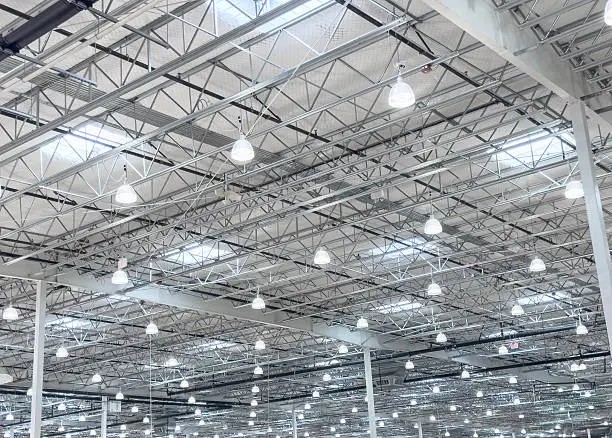
- High Bay Lights (Indoor): Deployed in warehouses with ceilings over 20 feet, these fixtures require precise light distribution and robust anti-glare (UGR) ratings to protect forklift operators’ vision.
- Street and Flood Lights (Outdoor): Exterior fixtures prioritize weather resilience. An IP65 rating (or higher) is mandatory to prevent dust and water ingress.
- Surge Protection: Outdoor applications demand enhanced surge protection devices (SPD)—often 10kV or higher—to survive lightning strikes and grid fluctuations.
Calculating the Payback Period (ROI)
The financial justification for an LED retrofit relies on a comprehensive comparison between initial Capital Expenditures (CAPEX) and ongoing Operational Expenditures (OPEX).
While the upfront cost of industrial-grade LED fixtures is higher, the OPEX reductions are immediate. Facilities typically reduce their lighting energy consumption by 60% to 75% on day one.
Furthermore, many regional governments and utility providers offer substantial energy rebates for commercial retrofits. When these financial incentives are factored into the equation, the ROI payback period frequently drops to under 24 months.
Adherence to Global Energy and Environmental Standards
To ensure maximum energy efficiency and regulatory compliance, modern commercial retrofits must align with stringent environmental targets. The industry-wide transition to high-efficiency systems is largely driven by the global phase-out of incandescent and legacy fluorescent technologies.
Fundamentally, integrating advanced light-emitting diode technology has become the baseline engineering requirement for achieving green building certifications and significantly lowering the carbon footprint of commercial operations.
Achieving certifications like LEED or BREEAM not only fulfills corporate sustainability mandates but also directly increases the market valuation and tenant appeal of commercial real estate.
Conclusion: Future-Proofing Commercial Infrastructure
Transitioning to advanced LED systems is not merely a maintenance task; it is a strategic investment in the facility’s financial and operational resilience. By prioritizing industrial-grade procurement and strict technical standards, property managers can future-proof their infrastructure, driving down overhead while maximizing long-term asset value.