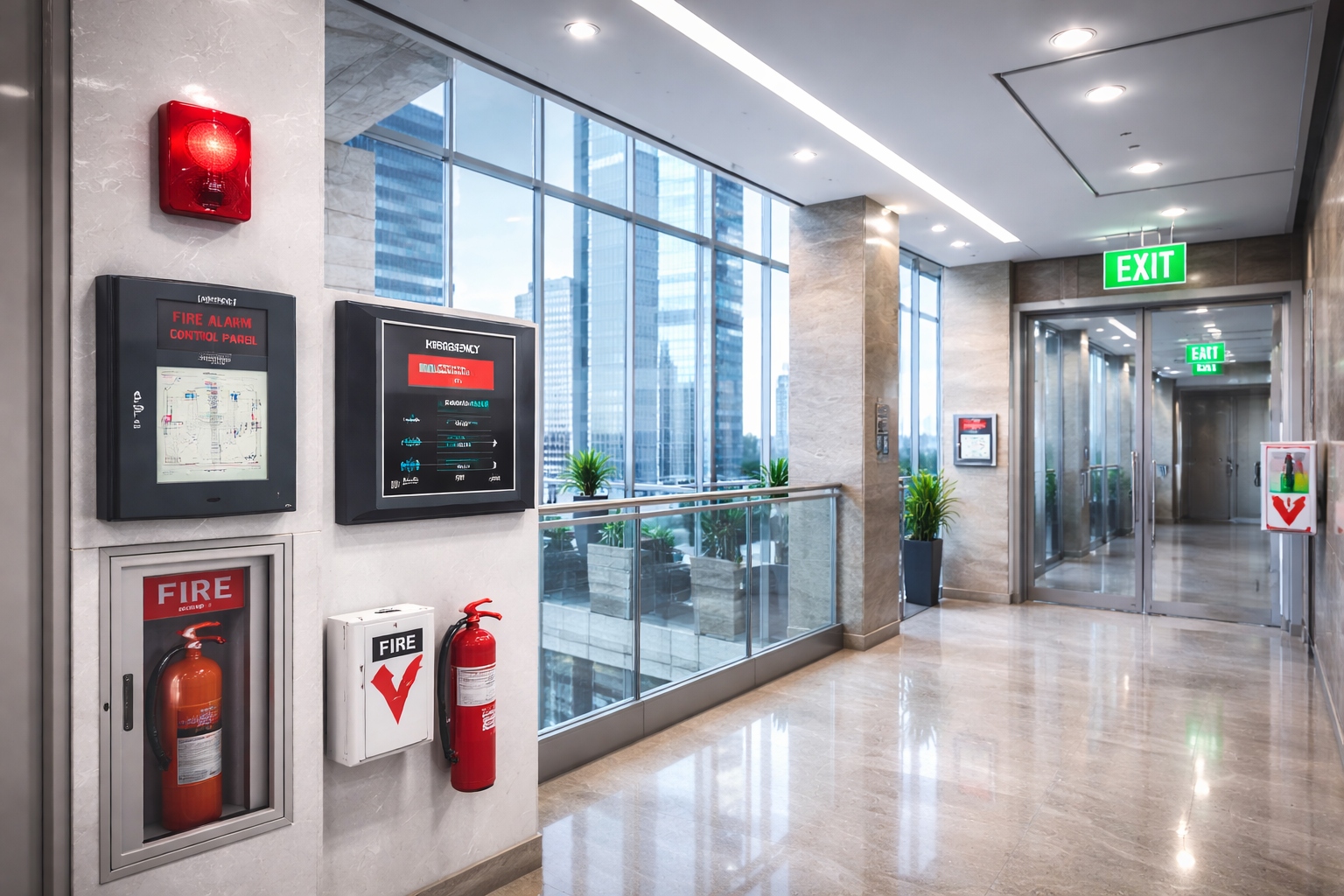
Walk into any commercial tower built after 2020 in Manhattan, and you’ll find something most tenants never think about: a life safety director stationed in the lobby, monitoring a panel of alarm systems, coordinating with building engineers, and running emergency protocols that cover everything from a grease fire on the fourteenth floor to a suspicious package at the loading dock. It’s a role that barely existed in its current form a decade ago, and it’s quickly becoming the benchmark that cities around the world are measuring themselves against.
For property developers in Salford, Manchester, and other fast-growing urban centres with increasingly ambitious skylines, the question is no longer whether to adopt a dedicated safety director model. The question is how fast they can get there.
Beyond the Fire Drill: What Modern Emergencies Actually Look Like
The traditional view of building safety revolved around smoke detectors and exit signs. That picture is hopelessly outdated. Today’s commercial high-rises function as vertical cities, housing thousands of occupants across mixed-use floors that might include data centres, medical clinics, childcare facilities, and restaurant kitchens—all under one roof. Each of those environments carries a distinct risk profile, and each demands a tailored emergency response.
Consider the non-fire scenarios that now fall squarely within a safety director’s remit. Active threat events require real-time lockdown coordination across dozens of floors. A medical emergency in a 40th-floor office suite means managing elevator recall protocols while paramedics are en route. A chemical spill in a basement mechanical room triggers ventilation shutdowns and targeted floor evacuations that have nothing to do with pulling a fire alarm. These are situations where a single misjudgement can cascade into a building-wide crisis, and they demand someone trained far beyond the old “fire warden with a clipboard” model.
The FLSD Standard: Technical Managers, Not Security Guards
New York City’s Fire Life Safety Director certification, governed by the FDNY under the Certificates of Fitness programme, has evolved into something far more rigorous than a basic safety credential. The F-89 designation—covering comprehensive fire and non-fire emergencies in commercial towers—requires candidates to demonstrate competency in alarm system diagnostics, building management system integration, multi-agency coordination, and the kind of situational decision-making that used to sit exclusively with emergency services personnel.
The bar is being raised even further for the 2026 exam cycle. The increasingly complex threat landscape that directors deal with on a daily basis—from cyberattacks on building automation systems to coordinated evacuation during extreme weather events—is reflected in the updated scenario-based questions. These aren’t abstract exam problems; they’re drawn from real incident after-action reports, and they test whether a candidate can think critically under pressure rather than simply recall memorised procedures.
From Local Regulation to Global Adoption
What makes the FLSD model particularly interesting to international developers is its comprehensiveness. The UK’s own regulatory landscape has been in flux since the Grenfell Tower tragedy, and the Building Safety Act 2022 introduced the concept of an “Accountable Person” for high-rise residential buildings. But the commercial sector still lacks a unified, technically demanding certification equivalent. Developers behind Manchester’s growing cluster of towers along the Irwell are reportedly studying the FLSD framework as a template for internal safety leadership standards, recognising that voluntary adoption of a rigorous standard is both a risk mitigation strategy and a competitive differentiator when courting institutional tenants.
Dubai, Singapore, and Sydney have each moved toward mandatory safety director roles in large-occupancy buildings in recent years, and all three have cited elements of the New York model during their respective legislative consultations.
The Preparation Gap That Nobody Talks About
Being a life safety director needs more than simply being physically there; it also requires a thorough technical understanding of intricate alarm systems and emergency procedures. Even seasoned safety officers are finding the written components difficult as the 2026 examinations shift toward extremely specific situational logic. To ensure a first-time pass and avoid costly retakes, many candidates are now using a comprehensive Fire Life Safety Director practice test to bridge the gap between their on-the-ground experience and the technical requirements of the official F-89 assessment.
That preparation gap matters more than most people realise. A failed exam doesn’t just mean rescheduling; it means a building operates without a fully certified director, which in New York carries legal liability for the property owner. As more cities move toward mandatory certification, the ripple effect will be felt by building owners, insurance underwriters, and safety professionals across the industry.
Looking Ahead
The trajectory is clear. High-rise safety is no longer a tick-box exercise managed by facilities teams as an afterthought. It’s a specialised discipline with its own career pathway, its own body of technical knowledge, and an increasingly global standard of professional competence. For cities building upward—whether on the banks of the Irwell or the shores of the Persian Gulf—the FLSD model offers a proven, battle-tested framework that treats building safety as what it truly is: a matter of life and death that deserves the highest calibre of professional leadership.